




Judiciary shows signs of independence
A landmark court decision to release a prominent critic, jailed without trial, is being hailed as a sign that Malaysia's battered judiciary is no longer willing to serve as a tool of the government.
The Nov 5 decision by a High Court has also dealt a blow to the Internal Security Act (ISA) under which journalists, opposition lawmakers and critics are regularly arrested and jailed for up to two years at a time.
The Home Minister can renew the two-year detention order for any number of years, a power that has had a chilling effect on political opponents who have seen victims emerge from such detention mentally and physically impaired.
A landmark court decision to release a prominent critic, jailed without trial, is being hailed as a sign that Malaysia's battered judiciary is no longer willing to serve as a tool of the government.
The Nov 5 decision by a High Court has also dealt a blow to the Internal Security Act (ISA) under which journalists, opposition lawmakers and critics are regularly arrested and jailed for up to two years at a time.
The Home Minister can renew the two-year detention order for any number of years, a power that has had a chilling effect on political opponents who have seen victims emerge from such detention mentally and physically impaired.
Previously, the judiciary has often found convoluted reasons to uphold detention without trial, stretching the meaning of legal terms to bizarre levels to justify arbitrary arrest and incarceration without trial.
Such decisions were fundamentally unacceptable by any civilised society and are completely contrary to constitutional guarantees of freedom of speech and inviolability of the person.
 But the Nov 5 decision by High Court Justice Syed Ahmad Helmy Syed Ahmad to
release
immediately prominent blogger and government critic Raja Petra Kamarudin was greeted as a landmark event and hailed by critics and constitutional lawyers.
But the Nov 5 decision by High Court Justice Syed Ahmad Helmy Syed Ahmad to
release
immediately prominent blogger and government critic Raja Petra Kamarudin was greeted as a landmark event and hailed by critics and constitutional lawyers.
"It is indeed a landmark decision and says that our is judiciary fighting and rising to the occasion," said constitutional expert, Malik Sarwar Imtiaz, who represented Raja Petra in court.
"Public demands for a brave and independent judiciary is very high," he told IPS .
Raja Petra, who has vowed to continue with his fiery exposes, is a staunch political ally of opposition leader Anwar Ibrahim and had employed his hugely popular Malaysia Today website to advance Anwar's political career and expose alleged wrong doings of Anwar's rival, Deputy Prime Minister Najib Abdul Razak.
Both Anwar and Najib are at war trying to outmanoeuvre each other and become prime minister, in the wake of a decision by incumbent Abdullah Ahmad Badawi to resign in March 2009.
He has promised to hand over to his deputy Najib who has already won unopposed as president of Umno.
Political warfare?
Barring unexpected twists, Najib is set to become prime minister next March and is widely expected to train his guns on Anwar.
But before that, Anwar hopes to engineer defections from government backbenchers to increase the number of lawmakers supporting him and topple the Barisan Nasional government and form a new government, with himself at its head as prime minister.
 He needs 31 lawmakers to switch to achieve that. But, since winning handsomely in the March 8 general election, Anwar has been unable to gather the "magic numbers" and remains the leader of the opposition in Parliament.
He also faces a possibly debilitating sodomy trial, charged as he is with having "unnatural sex" with a 23-year-old former aide.
The Sept 12 arrest of Raja Petra came at the height of the political war between Najib and Anwar. It was seen as a major setback for Anwar, but his subsequent release has boosted opposition ranks.
Raja Petra is also facing several sedition charges for linking Najib with the 2006 murder of a Mongolian interpreter who was shot dead and her body blown up with C4 explosives.
Najib has denied opposition allegations that he knew the victim, Altantuya Shaariibuu, and had an affair with her.
In a major blow to the government, the court ruled that Raja Petra does not pose any security threat to the nation as alleged by the authorities when arresting him.
"This is a brave decision," said Ragunath Kesavan, vice-president of the Malaysian Bar Council.
"It not only defends freedom of speech but also strikes a body blow at the ISA security law that allows for detention without trial," he told IPS .
"At a time when public confidence in the independence of the judiciary has taken a beating and at a time when promised judicial reforms have yet to take place, the decision gives hope that our judiciary has acted and will act with courage, integrity and independence when the liberty of an individual is threatened by the arbitrary use of power," said council president, Ambiga Sreenevasan.
No more hiding behind ‘absolute discretion'
Previously, the government had always used ‘national security' as reason to arrest political opponents and had always claimed to have ‘highly credible intelligence reports' to support the decisions.
 This was the case with the Hindraf 5, who are in jail without trial for alleged links with Tamil Tiger militants in Sri Lanka. The five have strenuously denied the charges and the government has not produced any evidence of such links, either in court or Parliament.
Raja Petra was charged with writing articles that angered Muslims and pitted one race against the other.
The government did not produce any evidence in the court, which also refused to buy the arguments that the exercise of the ‘discretion' by the minister was enough to keep Raja Petra in jail.
Raja Petra had filed for freedom under a habeas corpus application and the court agreed he should not be jailed a day longer.
"The landmark decision to free Raja Petra is a major victory for free speech, judicial independence and a blow to the ISA security law," said veteran opposition leader Lim Kit Siang.
"The time is right to repeal this draconian and barbaric law once and for all," he told IPS .
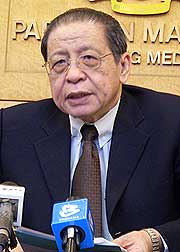 Lim himself has been a victim of detention without trial, along with his party colleagues on numerous occasions.
The judgment also sets precedents because the court appears to have agreed with the arguments of counsel Malik that the constitution empowers the judiciary to question any act of alleged abuse by the authorities.
"They can't anymore hide behind absolute discretion," said opposition member of parliament M Kulasegaran, who is also a lawyer.
"The judge did not buy it. He wanted proof of a threat to national security and the government could not show any."
However human rights activists warn it is not yet time to celebrate because the ISA law is still operative and a good part of the judiciary lies in a malaise and the promised reforms have not surfaced.
-IPS


Are you sure you want to delete this comment?
This action cannot be undone.