


Malacca polls: BN-PN banks on delivery, Bersama vows reform, Harapan talks aspirations
MALACCA POLLS | The Malacca state election has reached its halfway mark, with all three major political blocs having unveiled their manifestos.
Malaysiakini takes a closer look at what BN-Perikatan Nasional, Pakatan Harapan, and Bersama are offering voters ahead of polling day.
MALACCA POLLS | The Malacca state election has reached its halfway mark, with all three major political blocs having unveiled their manifestos.
Malaysiakini takes a closer look at what BN-Perikatan Nasional, Pakatan Harapan, and Bersama are offering voters ahead of polling day.
Confidence, recovery, regroup
Malacca has 28 state assembly constituencies and has historically been a BN stronghold. However, with the state election underway, the question is whether Harapan can defend its five seats or Bersama can pull off an upset.
BN-PN's manifesto adopts a "cradle-to-grave" welfare approach, with six main thrusts and 113 initiatives aimed at supporting Malaccans at different stages of their lives.
Titled "Membina Masa Depan Melaka, Memakmurkan Negara" (Building Malacca's Future, Bringing Prosperity to the Nation), the manifesto reflects the coalition's confidence heading into the polls, with BN-PN seeking to consolidate its position through an extensive list of pledges.

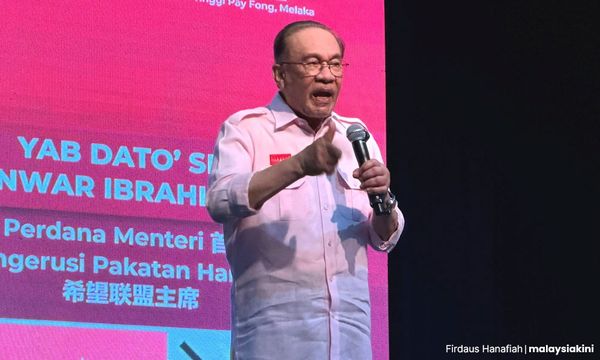
Harapan, meanwhile, is seeking to recover from its electoral setbacks in Sabah, Johor, and Negeri Sembilan. The coalition, led by Prime Minister Anwar Ibrahim, is battling to defend its five seats in Malacca, and its manifesto, themed "Melaka Rumah Kita" (Malacca Our Home), reflects the challenges of its defensive campaign.
Its manifesto outlines three main priorities and 12 core aspirations, although it offers relatively few details on how these pledges would be implemented.
Bersama's manifesto is considerably more detailed. Having lost all its deposits in its electoral debut in Johor, the "kancil party" appears to have regrouped, organising its proposals around two reform pillars: governance and socio-economics.
READ MORE: KINIGUIDE | Malacca polls hot seats and a rare opportunity for kancil party
Administrative pledges
Governance and administrative reforms take centre stage in Bersama's manifesto, which proposes major structural and democratic changes to the state administration.
Among its proposals is a proportional representation system that would see seven additional state assemblypersons appointed based on the distribution of votes across the state.
Additionally, the party wants to rationalise GLCs and state agencies, capping their combined number at 30 to curb potential leakages. It has further proposed independent professional boards to oversee state procurement contracts worth more than RM10 million.
Bersama also wants assemblypersons to hold open public complaint sessions at least once every fortnight, for a minimum of five hours, as a condition for receiving constituency allocations.

It has further pledged equal funding for opposition assemblypersons.
BN-PN, on the other hand, has focused on expanding existing channels for public engagement, including the "Wakil Rakyat Untuk Rakyat" programme, to all 28 state constituencies. It has also pledged to resolve public complaints within two weeks.
At the launch of its manifesto, BN-PN leaders touted the high completion rate of pledges made in its 2021 state election manifesto. Building on continuity, they have proposed establishing a manifesto implementation monitoring centre to track the fulfilment of its latest promises.
Other administrative pledges include upskilling civil servants in artificial intelligence and Big Data.
Meanwhile, Harapan has proposed a "smart city" transformation, promising to make state administrative procedures faster, more transparent, and user-friendly.
However, its manifesto provides little detail on what the transformation would involve or how it would be implemented.
Financial support
Cost-of-living relief and welfare assistance are among the strongest features of BN-PN's manifesto, which combines immediate financial support with targeted aid for different stages of life.
Newborns will be provided with a one-off RM100 SSPN top-up starting Jan 1 next year, while SPM and STPM students can expect to receive free tuition classes.
They have also pledged welfare support for bedridden patients and elderly citizens, alongside free ambulance and hearse services provided through local authorities.
READ MORE: Free water, tuition classes among BN-PN's 113 pledges for Malacca polls
Bersama proposed allocating at least 30 percent of state development expenditure directly to socio-economic programmes benefiting the public.
It has also pledged a state-wide healthcare protection programme under which households with a net disposable income of less than RM4,000 per month could receive RM500 annually.

The party estimates that the programme would benefit about 55,000 households, with a proposed allocation of RM28 million.
Addressing concerns about Malaysia's ageing population, Bersama has also proposed allocating RM5 million to train and certify homemakers as well as young women as professional childcare and elderly-care providers.
Harapan's approach centres on targeted welfare assistance, particularly for women.
Its proposals include special grants for female entrepreneurs and an expansion of state-funded daycare centres to support working mothers.
However, the manifesto does not specify the value of the proposed grants or the funding required to expand the daycare facilities.
Economic growth
On employment and economic growth, BN-PN has outlined an ambitious industrial expansion agenda, targeting RM30 billion in new investments and 25,000 job opportunities through the development of new industrial zones and high-tech sectors.
On the contrary, Harapan is banking on Malacca's established tourism industry to drive economic activity, setting a target of attracting 25 million tourist arrivals by 2032.

The coalition argued that strengthening the tourism sector would create more opportunities and activities, allowing service providers involved in the industry to benefit economically.
It further pledged to allocate 30 percent of local council contracts to youths and young entrepreneurs.
Bersama's proposal takes a different approach, focusing on ensuring that major developments generate employment and skills opportunities for local communities.
Under its proposed local opportunity policy, developers seeking planning approval for major projects would be required to submit plans for local hiring, paid apprenticeships, and skills development.
These social impact assessments would become legally binding conditions for obtaining planning permission, the party’s manifesto said.
It further emphasised fiscal sustainability, aiming to achieve a five percent revenue growth to three percent expenditure growth ratio by 2030 to ensure state-funded projects do not run into deficits or get abandoned.
Different approaches
Overall, the three manifestos reflect markedly different approaches to winning over Malacca voters.
BN-PN has put forward the most extensive list of pledges, with specific targets, allocations, and implementation timelines spanning the first 100 days, the first year, and the full five-year term.
Bersama, meanwhile, has positioned itself as the reform-oriented alternative as it continues to woo disillusioned Harapan supporters.
Harapan's manifesto stands in contrast to both, with broad aspirations but relatively few concrete details on implementation, funding, or measurable targets.
For instance, to address concerns over home ownership, BN-PN has committed to constructing 25,000 affordable homes over five years and housing loans up to RM80,000 for building on self-owned land.
In comparison, Harapan has merely vowed to “ensure that every citizen owns or rents a comfortable home through people-friendly housing schemes”.
The difference between the three manifestos is particularly apparent in the level of detail provided: BN-PN emphasises deliverables, Bersama proposes institutional reforms, while Harapan relies on wider policy commitments.
Who will pass the test?
As political analyst Bridget Welsh has noted, Malacca's distinctive historical and political position renders it as something of a microcosm of Peninsular Malaysia’s politics.
Coming on the heels of the Johor and Negeri Sembilan state elections, the Malacca polls have taken on significance beyond the state, with federal-level players closely observing the outcome.
The contest is unfolding amid growing speculation over the possibility of a snap general election, with BN and PN potentially seeking to capitalise on their electoral momentum.
A strong showing for the two coalitions could further fuel talk of a "blue wave" carrying them towards Putrajaya.
For Harapan, however, the stakes are equally significant. Losing ground in Malacca would add to a string of electoral losses and raise further questions about its ability to defend its position in the rapidly approaching general election.
Ultimately, the Malacca polls will test whether BN-PN's joint pitch of delivery, Bersama's reform agenda, or Harapan's sweeping aspirations can successfully court voters.



"Si Kancil. The underdog that conquered hounds. Small but formidable, Vote BERSAMA FOR CHANGE." Like every success story, it began with a small step.
Report this comment
Are you sure you want to delete this comment?
This action cannot be undone.