




Labu LCCT five times cheaper than KLIA Sepang
KLIA East at Labu will cost dramatically less to build than the KLIA at Sepang although both airports will have similar passenger capacities.
KLIA East at Labu will cost dramatically less to build than the KLIA at Sepang although both airports will have similar passenger capacities.
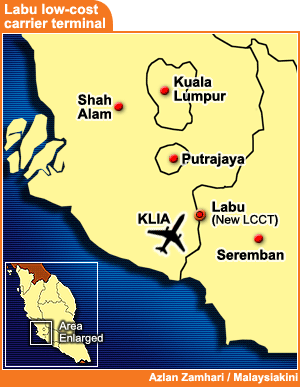 The privately funded
KLIA East
at Labu will cost RM1.6 billion and serve 30 million passengers per year. In contrast, the publicly funded KLIA at Sepang cost more than five times that amount to build, RM9 billion.
The privately funded
KLIA East
at Labu will cost RM1.6 billion and serve 30 million passengers per year. In contrast, the publicly funded KLIA at Sepang cost more than five times that amount to build, RM9 billion.
It was completed in 1998 to serve 25 million passengers. RM3.7 billion alone was spent on the airport terminal complex.
The reason for the large difference in cost is the size of the terminals.
The passenger terminal complex at Sepang has a floor area of approximately 400,000 m 2 . A source working on the Labu airport project told Malaysiakini that its terminal will be about a quarter of that size.
The Labu terminal will also be located closer to existing infrastructure. KLIA East will be about 2km from the Kuala Lumpur-Seremban highway and the KTM Komuter railway line.
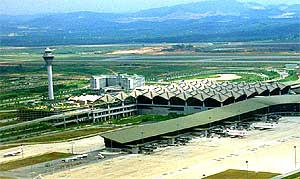 KLIA at Sepang is located 20km from the Kuala Lumpur-Seremban highway and it is served by a dedicated highway and the Express Rail Link (ERL).
Seventy-five percent of the airport terminal complex was financed by a ¥61.5 billion (RM2.4 billion) loan from the Japan International Co-operation Agency (JICA).
As a consequence, a large part of construction and design for KLIA was carried out by Japanese corporations Taisei, Kajima, Shimizu and Hazama.
As with the current Pahang-Selangor water transfer project which is also being financed by the Japanese government, it has been alleged that the Malaysian government is being forced to hire expensive Japanese contractors.
In addition to being very costly, poor planning decisions have been made since the construction of KLIA. This has further reduced the viability of the airport as Kuala Lumpur's only aviation hub.
KLIA was originally designed to serve 100 million passengers. Of this capacity, 25 million was achieved in 1998 with the construction of one satellite terminal. A second satellite terminal can be built adjacent to the existing one, bringing the airport's capacity to 50 million.
Infrastructure to support this increase was supposed to be built to the north, across the current main terminal. This will involve the construction of a new main terminal and two satellite terminals.
Poor planning
However, the site is currently obstructed by the ERL. The ERL track is too high, preventing airplanes from taxing to runway 1, rendering it useless. This was one of the objections raised by Air Asia in proposals to build a new low cost terminal there.
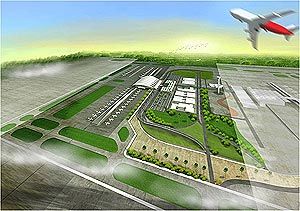 Air Asia has said that KLIA East at Labu will eventually be expanded to handle 50 million passengers per year.
The ERL started operations in 2002 and was constructed by YTL Corporation in co-operation with Siemens, a German electrical contractor. Costing RM2.2 billion, it was the cheapest high speed railway line in the world, costing just RM30 million per kilometre.
The project also received a RM700 million soft loan from the government.
The major shareholders of the ERL are YTL Corporation (50 percent), Tabung Haji Technologies (40 percent) and Nadicorp Holdings (10 percent).
In April last year, The Sun reported that the ERL receives a subsidy of RM80 million per year which is raised from KLIA airport taxes. The ERL concession lasts for 30 years and can be extended to 60 years by concession holders.
The obvious question that this raises is why the ERL was not built lower so that expansion in the north site could take place, especially after all the loans and subsidies the ERL has received.
Malaysia Airports Holdings Bhd, the manager of KLIA, could not be reached for comment yesterday.


Are you sure you want to delete this comment?
This action cannot be undone.