




Najib unveils RM60bil stimulus package
The government unveiled a RM60 billion stimulus package today as it attempts to arrest the export-driven economy's slide into recession.
The RM60 billion package will be implemented over two years up to 2010.
The government unveiled a RM60 billion stimulus package today as it attempts to arrest the export-driven economy's slide into recession.
The RM60 billion package will be implemented over two years up to 2010.
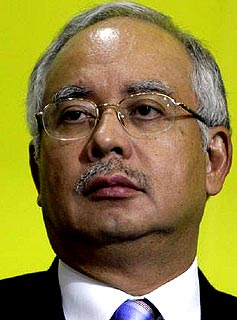 Deputy premier Najib Abdul Razak, who is due to take over as prime minister at the end of this month, announced the details of the spending plan when tabling the Supplementary Supply Bill 2009, or mini-budget, in Parliament.
The package, which is equivalent to 9 percent of last year’s GDP, is broken down as follows:
- RM15 billion in fiscal injection
- RM25 billion in guarantee funds
- RM10 billion in equity investment
- RM7 billion for private finance initiative and off-budget projects
- RM3 billion in tax initiatives
“The implementation of such a large stimulus package is unprecedented in the nation’s economic history,” said Najib.
With this package, the federal budget deficit will go up from 4.8 percent to 7.6 percent, but the government is confident the shortfall can be funded through domestic sources of funds.
 Last September, the government had announced a RM206 billion national budget for 2009, followed by a RM7 billion stimulus package two months later.
Despite the burgeoning deficit, Najib pointed toward precedent in the government's ability to manage the situation - it had reduced the deficit from a high of 16.6 percent in 1982 to 3.2 percent in 2007.
“The government is confident that the nation’s fiscal policy continues to have the flexibility and capacity to accommodate the higher deficit, as this increase is temporary,” he said.
Even with these measures in place, he painted a sombre picture of the economy by predicting GDP growth to be around -1 to 1 percent.
Najib, who is also finance minister, said the new stimulus measures would be focused on helping companies and workers affected by the global slowdown, to halt a steady stream of layoffs in recent months.
Major test for Najib
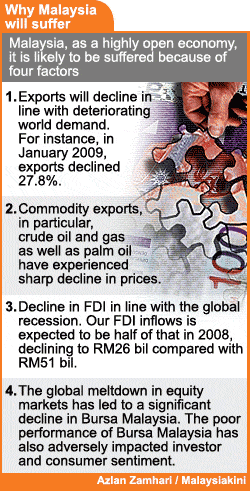
Malaysia's economic growth slowed to just 0.1 percent in the fourth quarter of 2008, hit by declining exports and manufacturing as demand from its trading partners in the United States and Europe evaporated.
January exports plunged 27.8 percent year-on-year, hitting their lowest level since 2001.
Prices of commodities such as crude oil, gas and palm oil, have also plunged.
The government has already acknowledged it may have to abandon its 3.5 percent growth forecast for 2009.
An influential think tank, the Malaysian Institute of Economic Research (MIER), said the economy is likely to sink into a technical recession in the first half of 2009 before making a recovery in the second half.
"The situation looks very grim and this package can probably help cushion the impact of the global downturn but cannot neutralise it," said MIER chief Mohamed Ariff Abdul Kareem.
The spending plan is a major test for Najib, who is taking on the top job one year after a general election that saw the ruling coalition battered by a resurgent opposition.
Within days of taking office he faces a series of by-elections which will be seen as a barometer of his popularity, and the coalition's ability to claw back support after the electoral drubbing.


Are you sure you want to delete this comment?
This action cannot be undone.