




Love Your Heart, Prevent Diabetes
The International Diabetes Federation (IDF) estimated that more than 371 million people worldwide had diabetes in 2012, and projected that this figure will escalate to a staggering 552 million people by 2030.
The National Health and Morbidity Survey showed that 15.1% of the adult population is diabetic equating to 2.6 million Malaysians.
Cardiovascular Disease (CVD) is a major complication of diabetes and the leading cause of early death among people with diabetes
- Adults with diabetes are 2 to 4 times more likely to have heart disease or suffer a stroke than people without diabetes.
- Two out of three people with diabetes die from either heart disease or stroke.
- People with diabetes tend to develop heart disease at a younger age than people without diabetes.
Diabetes is a major risk factor for heart disease but being diabetes-free does not make your heart 100% safe. Having higher than normal blood glucose, blood cholesterol or blood pressure levels – no matter how slight – puts you at risk of heart disease even if you do not have full-blown diabetes.
You are one step closer to the Terrible Trio if you are having any of the risk factors listed below:
- Blood glucose level: above 5.6 mmol/L before meals or above 7.8 mmol/L two hours after meals.
- Total cholesterol level: above 5.2 mmol/L or LDL (‘bad’)-cholesterol level: above 2.6 mmol/L.
- Blood pressure level: above 130/80 mmHg.
What can people with diabetes do to lower their CVD risk?
- Reach and stay at a healthy weight. Being overweight or obese is a risk factor for heart attack and stroke.
- Get at least 30 to 60 minutes of physical activity. Brisk walking or a similar activity most days of the week can help with weight loss and lower blood pressure.
- Eat foods that are low in saturated fats, trans fats, cholesterol, salt (sodium), and added sugars . Reduce red meat and choose fat-free or low-fat dairy products.
- Eat more dietary fiber – whole grains, fruits, vegetables, and dry peas and beans.
- Stop smoking
- Take medications as directed by doctor.
Oats, especially oat bran, consist of exceptional amounts of a unique soluble dietary fiber known as beta-glucan. The health benefits of beta glucans have been extensively studied, with the most well-known benefit of lowering blood cholesterol, thereby reducing the risk of cardiovascular diseases. But there is so much more to oat beta glucan, and now many health professionals promote its inclusion in diets for individuals suffering from or who are at-risk for type 2-diabetes.
The European Food Safety Authority (EFSA) has concluded that the consumption of oat beta-glucan contributes to the reduction of the glucose rise after a meal. The Malaysian Ministry of Health also approves the health claim: “ Oat soluble fiber (beta-glucan) helps to lower the rise of blood glucose, provided it is not consumed with other food.”
The mechanisms of which oat beta glucans are shown to aid in managing diabetes include:
- Oat beta-glucan slows down the increase in blood sugar level after a meal by delaying digestion in the gut. When oat beta-glucan within a meal is digested, it forms a gel which makes the contents of the stomach and the small intestine more viscous. Through this, the uptake of carbohydrates into the blood stream takes longer thus preventing sudden fluctuations in blood sugar levels.
- Positive glycemic response produced by ingesting oat beta-glucan has been shown to improve insulin sensitivity , which may prevent the incidence of Type 2 diabetes. A consistent decrease in insulin secretions was dose-dependently observed in overweight individuals in response to oat beta-glucan, with significant changes reported at a dose of 3.8 g of oat beta-glucans in a meal.
 Biogrow Oat BG22™
is made of oat bran powder imported from Sweden. Take 2 scoops (approx. 18 g) a day will provide
more than 3 g
of oat beta-glucan.
Biogrow Oat BG22™
is made of oat bran powder imported from Sweden. Take 2 scoops (approx. 18 g) a day will provide
more than 3 g
of oat beta-glucan.
Now, Biogrow Oat BG22™ is available in 30’s convenient travel pack - makes it much easier for people who are always on-the-go to achieve the 3 g recommended daily intake of oat beta-glucan! Taking 2 sachets (approx. 18 g) a day with cold or warm water will provide more than 3 g oat beta-glucan. Take 3g of oat beta-glucan daily can help reduce cholesterol naturally.
This article is contributed by Legosan (M) Sdn Bhd. For more product information, please contact:
Call Infoline: 03-7956 2220 (Monday-Friday, 9am-5pm)
Email: info@biogrow.com.my
Website: www.biogrow.com.my
Facebook: fb.biogrow.com.my
The International Diabetes Federation (IDF) estimated that more than 371 million people worldwide had diabetes in 2012, and projected that this figure will escalate to a staggering 552 million people by 2030.
The National Health and Morbidity Survey showed that 15.1% of the adult population is diabetic equating to 2.6 million Malaysians.
Cardiovascular Disease (CVD) is a major complication of diabetes and the leading cause of early death among people with diabetes
- Adults with diabetes are 2 to 4 times more likely to have heart disease or suffer a stroke than people without diabetes.
- Two out of three people with diabetes die from either heart disease or stroke.
- People with diabetes tend to develop heart disease at a younger age than people without diabetes.
Diabetes is a major risk factor for heart disease but being diabetes-free does not make your heart 100% safe. Having higher than normal blood glucose, blood cholesterol or blood pressure levels – no matter how slight – puts you at risk of heart disease even if you do not have full-blown diabetes.
You are one step closer to the Terrible Trio if you are having any of the risk factors listed below:
- Blood glucose level: above 5.6 mmol/L before meals or above 7.8 mmol/L two hours after meals.
- Total cholesterol level: above 5.2 mmol/L or LDL (‘bad’)-cholesterol level: above 2.6 mmol/L.
- Blood pressure level: above 130/80 mmHg.
What can people with diabetes do to lower their CVD risk?
- Reach and stay at a healthy weight. Being overweight or obese is a risk factor for heart attack and stroke.
- Get at least 30 to 60 minutes of physical activity. Brisk walking or a similar activity most days of the week can help with weight loss and lower blood pressure.
- Eat foods that are low in saturated fats, trans fats, cholesterol, salt (sodium), and added sugars . Reduce red meat and choose fat-free or low-fat dairy products.
- Eat more dietary fiber – whole grains, fruits, vegetables, and dry peas and beans.
- Stop smoking
- Take medications as directed by doctor.
Oats, especially oat bran, consist of exceptional amounts of a unique soluble dietary fiber known as beta-glucan. The health benefits of beta glucans have been extensively studied, with the most well-known benefit of lowering blood cholesterol, thereby reducing the risk of cardiovascular diseases. But there is so much more to oat beta glucan, and now many health professionals promote its inclusion in diets for individuals suffering from or who are at-risk for type 2-diabetes.
The European Food Safety Authority (EFSA) has concluded that the consumption of oat beta-glucan contributes to the reduction of the glucose rise after a meal. The Malaysian Ministry of Health also approves the health claim: “ Oat soluble fiber (beta-glucan) helps to lower the rise of blood glucose, provided it is not consumed with other food.”
The mechanisms of which oat beta glucans are shown to aid in managing diabetes include:
- Oat beta-glucan slows down the increase in blood sugar level after a meal by delaying digestion in the gut. When oat beta-glucan within a meal is digested, it forms a gel which makes the contents of the stomach and the small intestine more viscous. Through this, the uptake of carbohydrates into the blood stream takes longer thus preventing sudden fluctuations in blood sugar levels.
- Positive glycemic response produced by ingesting oat beta-glucan has been shown to improve insulin sensitivity , which may prevent the incidence of Type 2 diabetes. A consistent decrease in insulin secretions was dose-dependently observed in overweight individuals in response to oat beta-glucan, with significant changes reported at a dose of 3.8 g of oat beta-glucans in a meal.
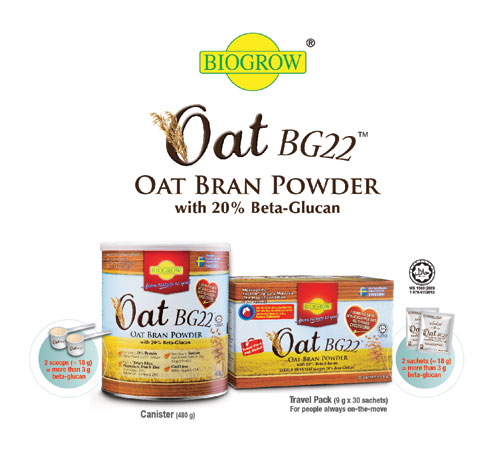 Biogrow Oat BG22™
is made of oat bran powder imported from Sweden. Take 2 scoops (approx. 18 g) a day will provide
more than 3 g
of oat beta-glucan.
Biogrow Oat BG22™
is made of oat bran powder imported from Sweden. Take 2 scoops (approx. 18 g) a day will provide
more than 3 g
of oat beta-glucan.
Now, Biogrow Oat BG22™ is available in 30’s convenient travel pack - makes it much easier for people who are always on-the-go to achieve the 3 g recommended daily intake of oat beta-glucan! Taking 2 sachets (approx. 18 g) a day with cold or warm water will provide more than 3 g oat beta-glucan. Take 3g of oat beta-glucan daily can help reduce cholesterol naturally.
This article is contributed by Legosan (M) Sdn Bhd. For more product information, please contact:
Call Infoline: 03-7956 2220 (Monday-Friday, 9am-5pm)
Email: info@biogrow.com.my
Website: www.biogrow.com.my
Facebook: fb.biogrow.com.my


Are you sure you want to delete this comment?
This action cannot be undone.