


/file/publisher-c1a3f893382d2b2f8a9aa22a654d9c97/2025/11/eae819a4e965f0abdb0fbf33eea53321.png)

True partnership means standing up for sustainable palm oil - MPOB chair
Datuk Mohamad Helmy Othman Basha, Group Managing Director of SD Guthrie and Chairman of the Malaysian Palm Oil Board (MPOB), has urged the palm oil industry to rebuild trust and consistency in its sustainability journey, warning that partnership without honesty and accountability would make progress impossible.
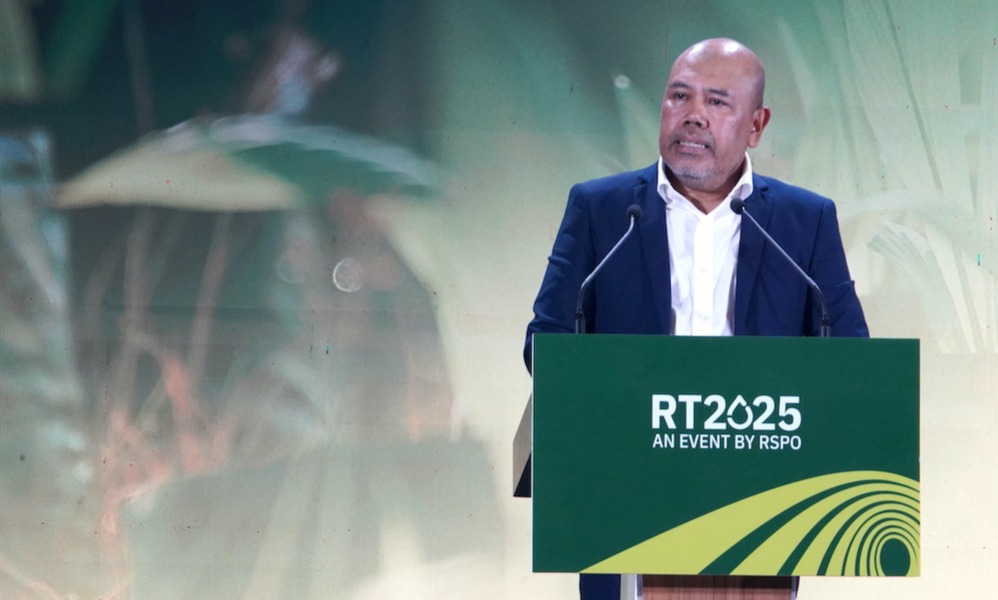
At the Roundtable on Sustainable Palm Oil (RSPO) Annual Roundtable Conference (RT) 2025 in Kuala Lumpur, Helmy (above), who has spent nearly three decades in the plantation industry across Malaysia, Indonesia, Papua New Guinea, the Solomon Islands and Liberia, said genuine partnership requires mutual trust and courage to speak the truth, even when inconvenient.
“For partnerships to work, we must be honest with each other. We must be accountable. I must be able to trust you, as you must be able to trust me,” he said.
Trust begins with traceability
In his speech, titled “Partners in Action”, Helmy reminded participants that transparency and traceability had come a long way since “sustainability” first entered the industry’s vocabulary.
“Twenty years ago, sustainability was a new language. Certification was experimental. Traceability wasn’t in the picture. Today, you can open an app and it’s all there at your fingertips,” he said, crediting collaboration among growers, brands and regulators for transforming palm oil into one of the world’s most transparent commodities.
He added, however, that traceability must be matched by genuine advocacy. Some RSPO member brands, he noted, still market products labelled “No Palm Oil” - a contradiction that undermines the very cause they claim to support.
“There are brands that claim to believe in sustainable palm oil, yet proudly sell products that say ‘no palm oil’. What message does that send to consumers? If we are truly partners, then our advocacy must match our membership,” he said.
Helmy urged RSPO members to defend Certified Sustainable Palm Oil (CSPO) “consistently, publicly, and without apology,” warning that silence or distance from the crop reinforced outdated misconceptions.
Calling out double standards
Helmy also took aim at what he described as hypocrisy and unequal treatment of palm oil-producing nations by developed economies.
Citing figures from the World Resources Institute and Global Forest Watch, he noted that both Malaysia and Indonesia have recorded steep declines in primary forest loss - with Malaysia’s rate down by more than 60 percent since its peak, and Indonesia seeing its lowest deforestation levels since records began.
“Both countries have over 50 percent forest cover - more than many rich countries in the world,” he said.
Yet, he added, Malaysia’s record of maintaining more than 50 percent forest cover still earned it only a “standard risk” rating under the European Union Deforestation Regulation (EUDR), while some nations with poorer track records were rated “low risk”.
“Applying a single standard for land use change is unfair. Applying a more stringent standard to a developing country is economic apartheid,” he said.
Helmy argued that deforestation must be considered alongside economic realities, saying poorer nations should be allowed to use natural resources responsibly to uplift their people.
“Every rich country that has less than 50 percent forest cover needs to start planting - or start paying underdeveloped nations to maintain their forests,” he said. “There is no other way.”
Shifting the narrative
Helmy criticised the long-standing vilification of palm oil while larger emitters, particularly fossil fuel producers, often escape moral scrutiny.
“When fossil fuel use is excused in the name of energy security, sustainable palm oil is banned in the name of deforestation. The hypocrisy needs to stop,” he said.
He warned that the relentless negativity toward palm oil had pushed major producers to turn inward. Indonesia is already running B40 biodiesel with B50 on the horizon, while Malaysia is advancing toward B30 - moves that will absorb more palm oil domestically and reduce global supply.
“While the global North debates whether to phase out palm oil, the two biggest producers are blending it for fuel,” he said. “The world is losing access to the most efficient, most productive, and most sustainably produced vegetable oil.”
Inclusion and smallholder justice
Helmy underscored that sustainability was not only about protecting forests, but also about protecting livelihoods. Smallholders, he said, are the backbone of the industry across producing countries.
In Papua New Guinea, for instance, smallholders account for nearly half of all palm oil output, yet many families still live below the poverty line despite the country having one of the world’s highest levels of forest cover.
“If we deny them that opportunity by saying ‘no expansion ever,’ we are effectively saying: stay poor, stay behind. That is not sustainability, that is hypocrisy,” he said.
He urged RSPO and its members to support smallholders in achieving “controlled, planned, and responsibly managed” growth that balances environmental integrity with social justice.
Defining true partnership
As the RSPO celebrates its 20th anniversary, Helmy said the organisation, now “old enough to vote and have a drink”, should take the opportunity to reflect on its founding purpose.
“True partnership means standing up, not standing by. It means telling our story - loudly, visually, emotionally. Facts are powerful, but faces persuade,” he said.
He warned that members who betray the shared purpose of sustainability do not deserve “a seat at the table”.
“Palm oil, done right, feeds billions, sustains millions of livelihoods, and protects more forest per tonne of oil than any other crop,” he said. “Let’s not allow others to define us. Let’s define ourselves - truthfully, transparently, and together.”


