


/file/publisher-c1a3f893382d2b2f8a9aa22a654d9c97/2026/01/8b11792c6019e874e45722b8777195d4.jpg)

DIPN enhances local industry capabilities in MRO, reduces dependence on OEMs
The National Defence Industry Policy (DIPN), which was launched yesterday, aims to empower local players to be included in the maintenance, repair and overhaul (MRO) contracts of the Ministry of Defence (MINDEF) assets.
Defence Minister Datuk Seri Mohamed Khaled Nordin said it benefits the national economy by reducing Malaysia's dependence on foreign equipment manufacturing companies (OEMs) unless repairs involving assets are still under warranty protection.
"There is no more OEM involvement in MRO activities. In fact, all MRO service activities must be carried out by local companies.
"It would be a great loss if the large allocation made to MINDEF each year is not utilized to develop a self-sufficient, sustainable and resilient national defence industry.
"Among them, in every procurement, the local content percentage requirement will be clearly set. Which is at least 30 percent," he said.
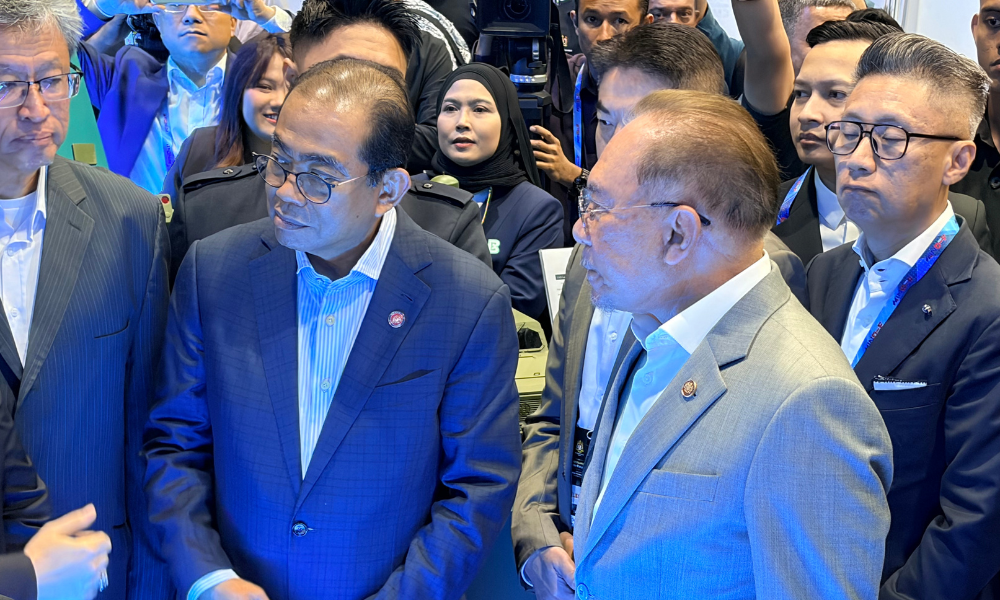
He said this when speaking at the DIPN Launching Ceremony held at the Malaysia International Trade and Exhibition Centre (MITEC), Kuala Lumpur yesterday.
The ceremony, which was officiated by Prime Minister Datuk Seri Anwar Ibrahim, was also attended by; Chief Secretary to the Government, Tan Sri Shamsul Azri Abu Bakar, Deputy Minister of Defence, Adly Zahari and Army Chief, General Datuk Azhan Md Othman.
According to Mohamed Khaled, each local company involved must demonstrate the ability to innovate and continuously improve in order to increase the percentage of local content and reduce costs.
According to him, any party that is selected but fails to carry out its responsibilities properly will face contract termination, including local companies.
“If they fail, we will terminate their MRO contracts, even if they are local companies.
“Because our goal is to prioritise the interests of the country. We will reopen the tender, to provide opportunities for local companies that are truly capable of innovation,” he said.
In addition, Mohamed Khaled said, the government will aggressively implement the Industrial Collaboration Program (ICP) through DIPN to facilitate effective technology transfer that aligns with the needs of MINDEF and Malaysian Armed Forces (MAF).
According to him, the programme is to ensure that technology transfer is made solely to local defence companies that are capable of using and producing results in exchange for the transfer.
“Imagine, for many years, around US$40 million from ICP, but we have not seen any company carry out or achieve the success of producing a product.
“Thus, we want to be stricter this time so that ICP can truly produce local manufacturers of national defence products.
“We cannot just transfer the technology to any company that is completely unable to utilise it,” he said.
He also stressed that research and development (R&D) plays an important role as a catalyst for the growth of the national defence industry, supported by government funding allocations and the implementation of ICP, including through the Defence Science and Technology Research Institute (STRIDE).
In parallel with the launch of DIPN, the Ministry of Defence also introduced the Defence Industry Portal which functions as a platform for ICP applications, R&D grants and technology offerings related to the defence sector.
In related developments, Mohamed Khaled announced several national defence projects, including the development of local defence satellites, defence laser systems, ground vehicle chassis manufacturing capabilities, weapons systems, passive radars, loitering munition systems (kamikaze drones) and defence simulators.
He explained that the initiative is not aimed at producing a comprehensive weapons system in a short period of time, but rather as an initial step to develop local components and services so that Malaysian companies can participate more significantly in the defence industry supply chain. “This is a strategic investment for the sake of the sovereignty, security and future of the country,” he said.


Are you sure you want to delete this comment?
This action cannot be undone.