


/file/publisher-c1a3f893382d2b2f8a9aa22a654d9c97/2026/01/def6e5e8fae1e518dbb5fab68c3a492e.png)

Gobind Singh Deo, a Digital Minister for all seasons
KUALA LUMPUR: Malaysia’s ambition to become an AI Nation by 2030 did not emerge overnight. It is the strategic outcome of deliberate choices about governance, trust and national readiness made by the Madani Government.
When the Ministry of Digital was established in late 2023, it marked a clear recognition that advanced technologies like artificial intelligence (AI), data and digital infrastructure would shape not only economic competitiveness but how Malaysia governs, serves the rakyat and positions itself in the region.
Two years after its establishment, that intent is beginning to take tangible shape. The work has been quiet, methodical and largely structural. It has focused less on spectacle and more on building the foundations required for AI Nation 2030 to be credible and achievable.
Much of that approach reflects the leadership style of Digital Minister Gobind Singh Deo: Steady, systems-driven and anchored in long-term national interest rather than short-term headlines.
The results of Gobind’s leadership are increasingly visible in the numbers. In 2025, Malaysia secured RM87.4 billion in approved digital investments, driven largely by growth in AI, big data, data centres and cloud services. These were a major contributor to the RM152.9 billion in approved investments recorded for the information and communication sub-sector, according to MIDA.
Backed by more than 600 Malaysia Digital status companies, the investments are expected to generate over 31,000 high-value jobs, further strengthening Malaysia’s position as a leading digital investment destination in ASEAN. The latest figures also reinforce the credibility of the nation’s digital blueprint in drawing higher-quality investments.
Domestic investors made up the largest share at RM36.66 billion, followed by Singapore at RM32.16 billion, the United States at RM11.43 billion and China at RM3.80 billion. In terms of talent impact, AI leads job creation with more than 12,600 roles, followed by Global Business Services at about 9,000, Data Centre and Cloud at about 2,600, Creative Media Technology at about 1,400 and Internet of Things at about 1,100.
On this achievement, Gobind said that realising AI Nation 2030 carries real responsibility, and that Malaysia cannot speak meaningfully about AI without first putting governance, trust and capability in place.
From the outset, Gobind has resisted framing digital transformation as a race. His emphasis has consistently been on order, clarity and coherence. The early months of the ministry were spent aligning agencies, strengthening governance and preparing institutional groundwork for higher-impact initiatives. It was not glamorous work, but it was essential.
“This ministry was created to bring structure and accountability into how Malaysia approaches digitalisation,” he said. “Without that, ambition remains fragmented and execution becomes uneven.”
“Our focus is to ensure that every ringgit of investment is matched with real capability building as reflected in the creation of more than 12,600 new AI-related roles this year,” he said. “Under the 13th Malaysia Plan (RMK-13), Malaysia is strengthening our nation’s focus on developing local talent capable of building, training and shaping AI technologies.”

That philosophy is rooted in a belief that technology must serve the rakyat from all walks of life. For all the focus on AI, cloud and emerging technologies, Gobind returns repeatedly to the same principle: Impact on the rakyat.
“Technology only matters if it improves lives,” he said. “If people cannot access it, cannot trust it, or do not benefit from it, then we have failed.”
That instinct has been evident well before the creation of the Ministry of Digital.
During his first tenure as a minister in 2018, Gobind pushed for lower broadband prices after recognising that connectivity was no longer a luxury but a prerequisite for participation in modern society. The resulting reduction in broadband prices in 2018 and 2019 widened access and laid foundations that continue to underpin Malaysia’s digital momentum today.
“At the time, broadband was still treated as a commercial issue,” he recalled. “But I saw it as a national one. If connectivity is expensive, you lock people out of opportunity. I am sorry that I had to ruffle a few feathers then, especially with the telcos, but I had to do what was best for the nation, our local businesses and the rakyat.”
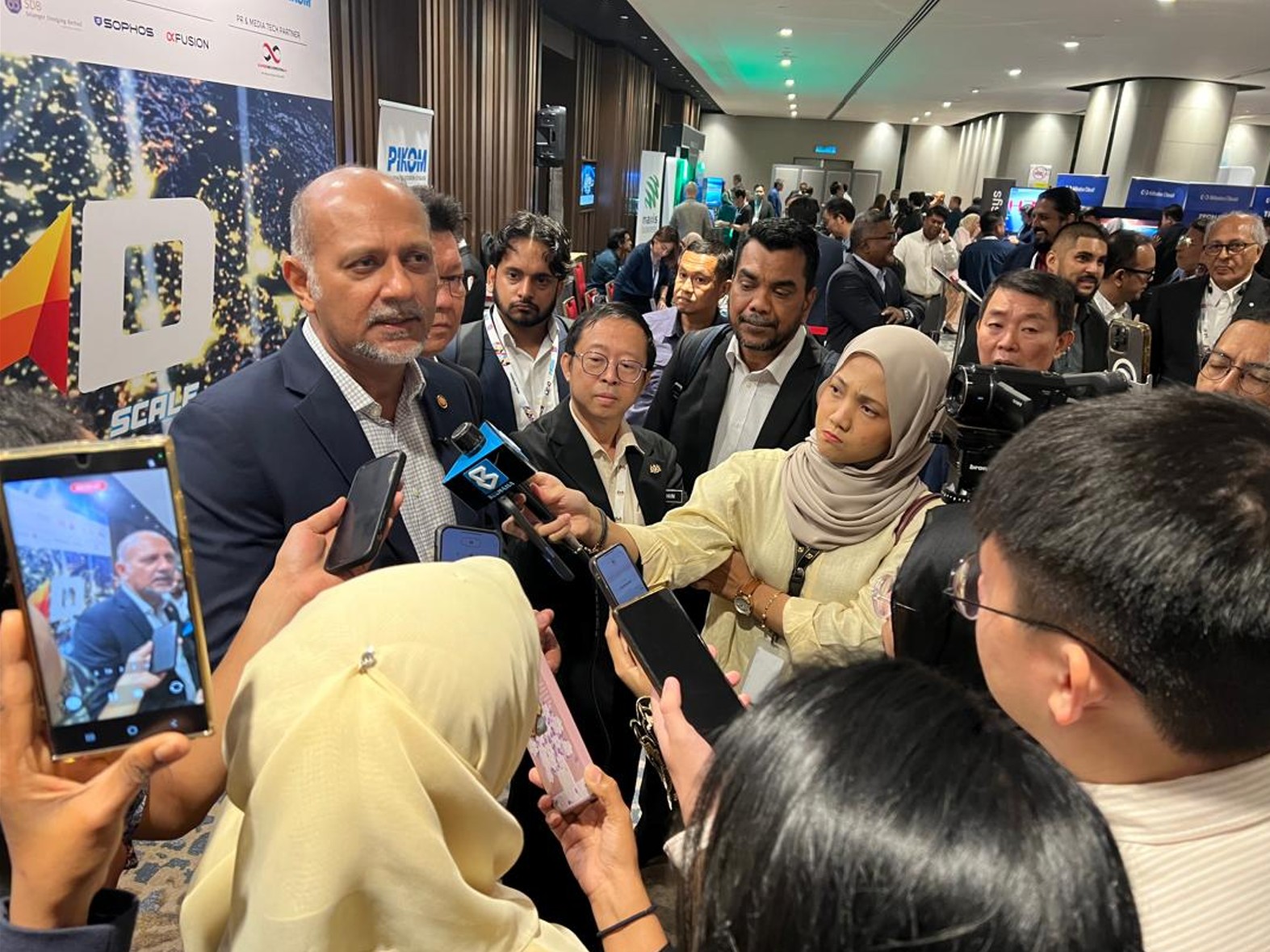
That episode captured a defining trait of Gobind’s leadership. He is instinctively attentive to how policy decisions land on the ground, especially for ordinary Malaysians.
Colleagues and industry players alike describe him as a hands-on minister who listens closely, asks practical questions and remains attuned to the lived realities of the rakyat. Whether engaging SMEs, community groups or technology leaders, his concern is consistent: That digital progress must be inclusive, accessible and fair, not abstract or elite-driven.
From foundations to execution
As Digital Minister, Gobind has carried that same mindset into policy. When the ministry was formed, its first year was defined by a shift from aspiration to architecture. Digital governance was streamlined. Strategic frameworks were prepared. Foundational reforms were put in place to support higher-impact initiatives.
“When the ministry was first formed, our priority was to bring order, clarity and coherence to the digital landscape,” he said. “Today, our responsibility is larger. We are shaping how Malaysia competes, governs and grows in an AI-driven world.”
Trust quickly emerged as a central pillar. Data protection, cybersecurity and governance were elevated from supporting considerations to core infrastructure. Amendments to the Personal Data Protection Act and support for the Cyber Security Act 2024 reinforced a clear message: Digital progress without trust is fragile.
That emphasis has extended beyond legislation into ecosystem development. Under Gobind’s watch, the ministry has prioritised strengthening local cybersecurity capabilities, encouraging home-grown solutions to protect businesses as digital adoption accelerates. This has helped create space for Made-by-Malaysia platforms such as LGMS Berhad’s StarSentry vulnerability management solution (pic), designed to help organisations, particularly SMEs, identify risks and strengthen their cyber defences amid rising threats.

“The more digital we become, the more important trust becomes,” Gobind said. “Cybersecurity is not optional. It is fundamental to confidence, adoption and long-term resilience.” “You cannot build an AI-driven economy on weak foundations. Trust is what allows adoption, investment and participation to scale.”
A Highly Successful ASEAN Chairmanship for Malaysia
The ministry’s second year coincided with a broader regional role. Malaysia’s ASEAN chairmanship in 2025 placed the Ministry of Digital at the centre of regional digital policymaking. Through platforms such as the ASEAN Digital Ministers’ Meeting, Malaysia moved from learning to contributing, shaping conversations on digital cooperation, emerging technologies and responsible innovation.
“We are no longer just observing what others are doing,” Gobind said. “Malaysia is now contributing ideas, standards and leadership to the regional digital agenda.”
Domestically, the ministry’s work coalesced around three pillars: Digital government, digital economy and digital society. Each pillar was designed to reinforce the others, creating conditions for AI Nation 2030 to move from concept to capability.
In digital government, the establishment of GovTech Malaysia signalled a shift towards innovation-led public service delivery. This was supported by the Data Sharing Act 2025 and the formation of a National Data Sharing Committee, enabling agencies to work across silos and deliver more integrated services. Enhancements to MyGOV Malaysia and the MyGovernment Portal reinforced a single-gateway approach for the rakyat and non-citizens alike.
“Government has to lead by example,” Gobind said. “If we expect the rakyat and businesses to embrace AI and digital tools, public services must be efficient, trusted and interoperable.”
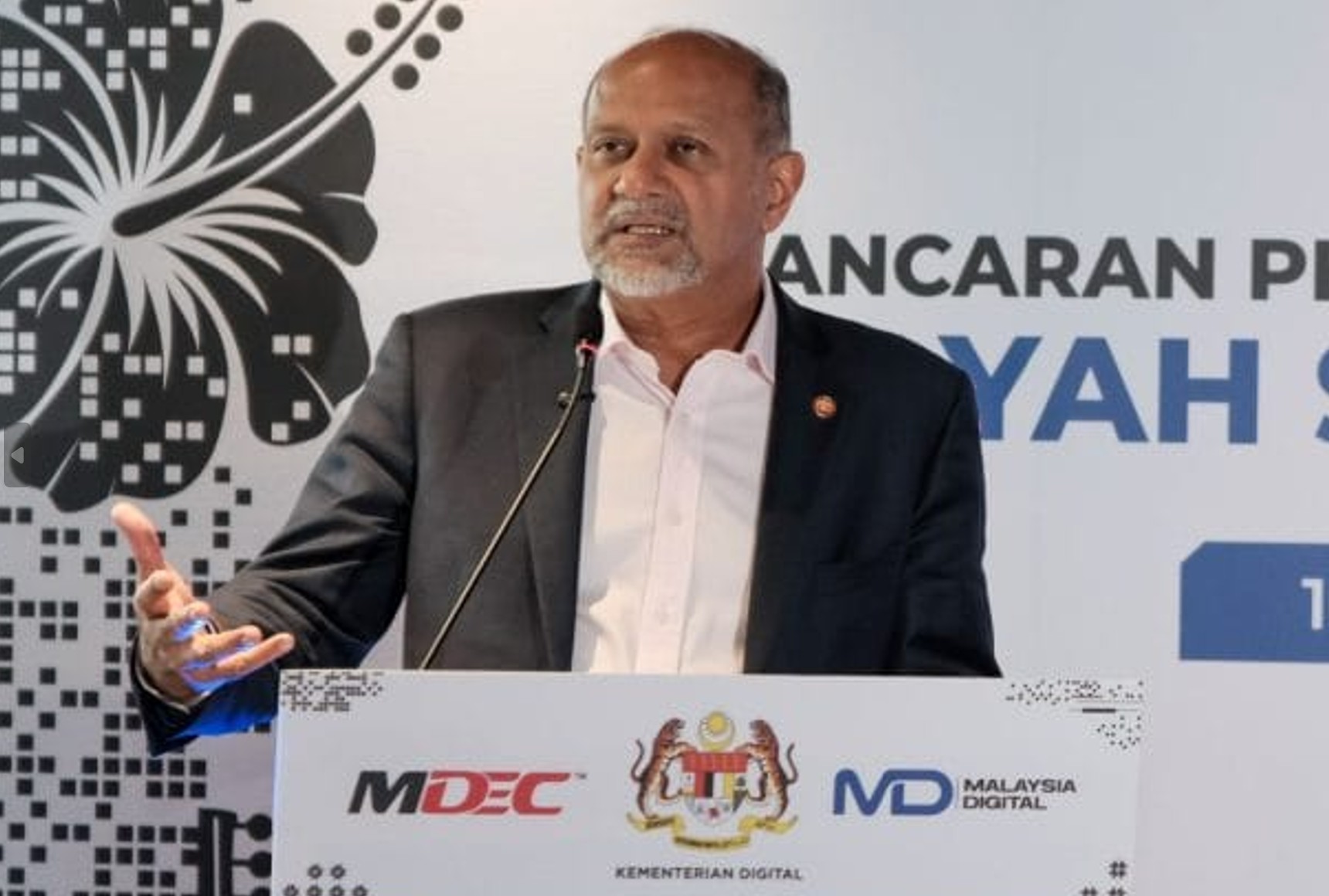
In the digital economy, attention turned to investment readiness and infrastructure. The National Cloud Computing Policy, grants under the 5G Adoption Programme and expanded international cooperation were aimed at accelerating enterprise adoption of advanced technologies, particularly among SMEs with the Business Development Initiative spearheaded by the Malaysia Digital Economy Corporation (MDEC).
“Our SMEs are critical to Malaysia’s economy,” Gobind said. “AI and digital tools give them the ability to do more with less, to improve productivity and to reach new markets.”
At the same time, the ministry introduced an AI Code of Ethics and an AI adoption regulatory framework, underscoring its belief that innovation must grow responsibly.
“We want to encourage innovation, but we must also give clarity,” he said. “Businesses and investors need to understand the rules, the risks and the expectations.”
Digital society formed the third pillar. Nationwide outreach through Jelajah Malaysia Digital 2025, leadership and talent initiatives such as the Executive Digital Leadership Programme and Rakyat Digital, and the launch of the National Cyber Ethics Module reflected a clear view that capability and citizenship must advance together.
“You cannot talk about an AI nation if large segments of society are left behind,” Gobind said. “Skills, ethics and inclusion are just as important as infrastructure.”
Running through all three pillars was a unifying idea: Artificial intelligence as a national capability.
The establishment of the National AI Office marked a decisive moment. AI was no longer treated as a niche technology or sectoral add-on. It serves as core infrastructure for productivity, governance and competitiveness.
“AI has to be embedded across government, industry and society,” Gobind said. “Not as an experiment, but as part of how we work to realise greater productivity and national competitiveness.”

Meanwhile, PIKOM advisor Ganesh Kumar Bangah (left in pic) said the ultimate measure of success lies in economic impact. By integrating digital transformation into Malaysia’s broader economic strategy, the Ministry of Digital has helped elevate the digital economy into a strategic growth engine. He noted that the digital economy contributed about 25.5% of GDP last year, up from 17.8% in 2015, underscoring its shift from a supporting sector to a core driver of national growth.
“AI Nation is steadily taking shape under the Minister Gobind,” said Ganesh. “The ministry’s focus on foreign investment and exports, business technology adoption and continuous upskilling and reskilling of the workforce is ensuring that the benefits of AI and digitalisation extend beyond large enterprises, reaching SMEs and the rakyat, and laying the foundations for a resilient and inclusive digital economy.”
From Vision to Resilience: Delivering RMK-13 and AI Nation 2030
The execution aspects now sit at the heart of Malaysia’s forward agenda. As the country embarks on the Thirteenth Malaysia Plan (RMK-13), digital and artificial intelligence policy is no longer treated as an adjunct to economic planning, but as a core national capability. Work is underway on a Policy Implementation Plan aligned with the Malaysia Digital Action Plan 2030 Towards an AI Nation, alongside the National AI Action Plan for 2026 to 2030. Together, these initiatives are designed to translate ambition into execution, and vision into durable national capacity.
Crucially, the emphasis is not on chasing technological breakthroughs for their own sake, but on embedding AI across the economy in a way that strengthens productivity, competitiveness and trust.
“Under RMK-13, AI is being positioned as an enabler across sectors, from public service delivery and manufacturing to healthcare, finance and education, supported by clearer governance structures, investment readiness and a pipeline of local talent,” said Gobind.
“The defining test of AI Nation 2030 is not how quickly technologies are deployed, but how well the ecosystem holds under pressure. Being an AI nation is not simply about infrastructure or talent,” he added. “It is about governance, ethics and the confidence to compete globally. Readiness must be comprehensive.”
That emphasis on resilience reflects lessons drawn from earlier phases of digitalisation. Rapid adoption without guardrails can expose vulnerabilities, widen inequalities and erode trust. By contrast, a resilient AI ecosystem is one where regulation keeps pace with innovation, data is protected, cybersecurity is strengthened and institutions are capable of adapting as technologies evolve.
This approach has shaped the ministry’s focus on institutional readiness, ensuring that laws, standards, agencies and skills frameworks evolve together. The establishment of the National AI Office, the introduction of an AI Code of Ethics and the strengthening of cybersecurity legislation form part of a broader effort to anchor innovation within a credible and trusted operating environment.
Industry response points to growing confidence in the ministry’s direction and execution. Local corporates cite clearer frameworks and more predictable engagement, while multinationals point to improving regulatory clarity, infrastructure planning and talent development. The common thread is consistency, not spectacle.
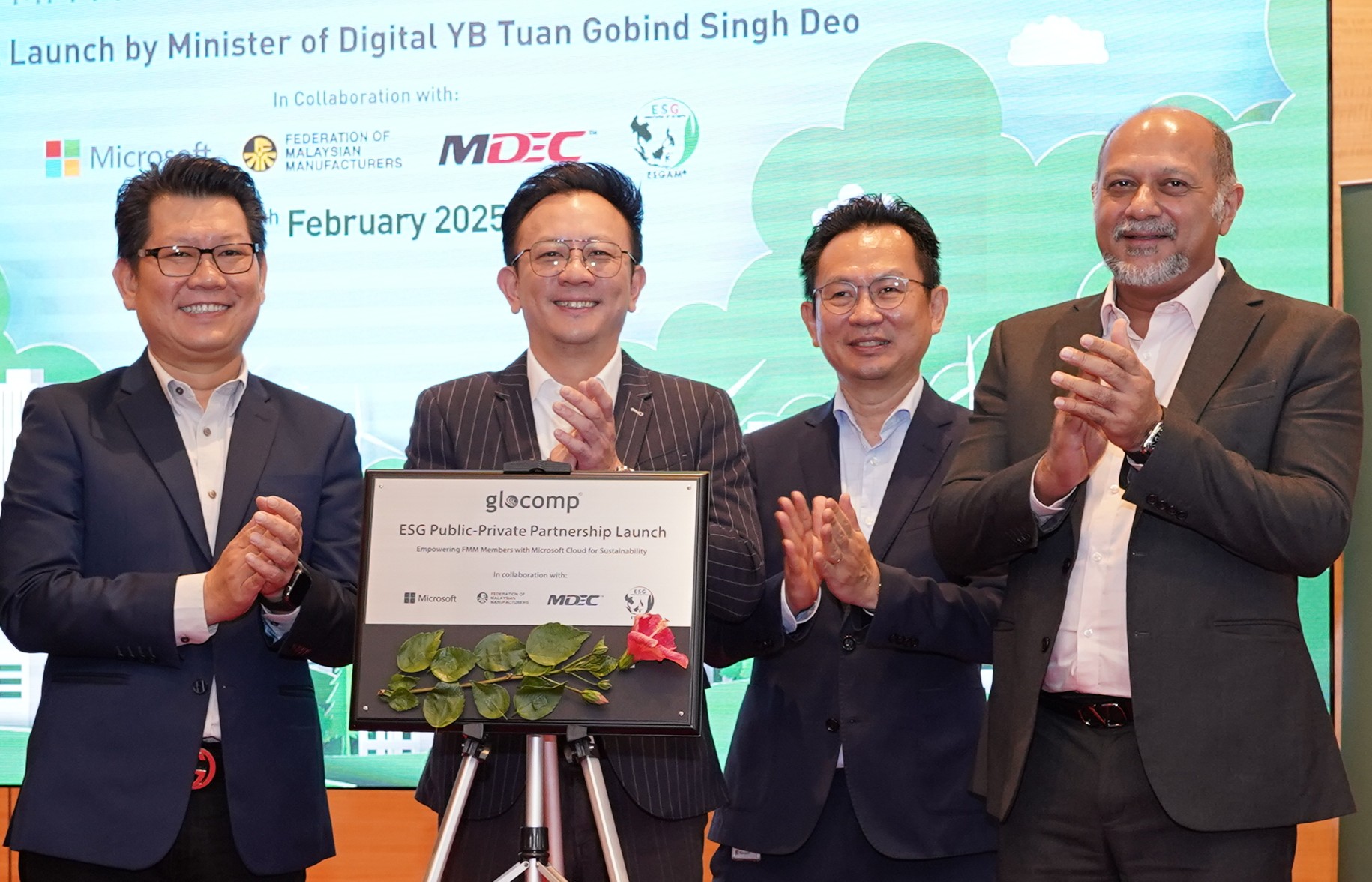
That confidence is reflected in industry endorsements. National Tech Association of Malaysia (PIKOM) Chairman Alex Liew (left in pic) has described Gobind as the tech industry’s “North Star”, citing his steady leadership and clarity of vision amid rapid technological change.
“Within the past two years under Gobind’s leadership, a clearer model has taken shape: Government sets the vision and guardrails, while industry translates ambition into real-world outcomes,” said Liew.
“This public–private collaboration has begun turning policy into impact, reflected in more connected services, stronger trust in digital systems and firmer foundations for AI adoption across the economy. Most importantly, the gains are designed to be inclusive, reaching not just policymakers or large enterprises, but the rakyat, government agencies and SMEs that form the backbone of Malaysia’s economy.”
International giants have further amplified similar sentiments. Microsoft Corporation has publicly commended Gobind for his “visionary and forward-thinking leadership” in shaping Malaysia’s digital future. Its ASEAN president Andrea Della Mattea said the minister and his team have continued to “chart a progressive course” for Malaysia by shaping policy and fostering partnerships that strengthen the nation’s innovation ecosystem.
“We thank Gobind Singh Deo and his ministry for their visionary and forward-thinking leadership,” she said at a Microsoft event in Kuala Lumpur. “This kind of leadership lays the foundation for a strong digital infrastructure that will support Malaysia’s economic ambitions and position the country as a leader in the era of artificial intelligence.”
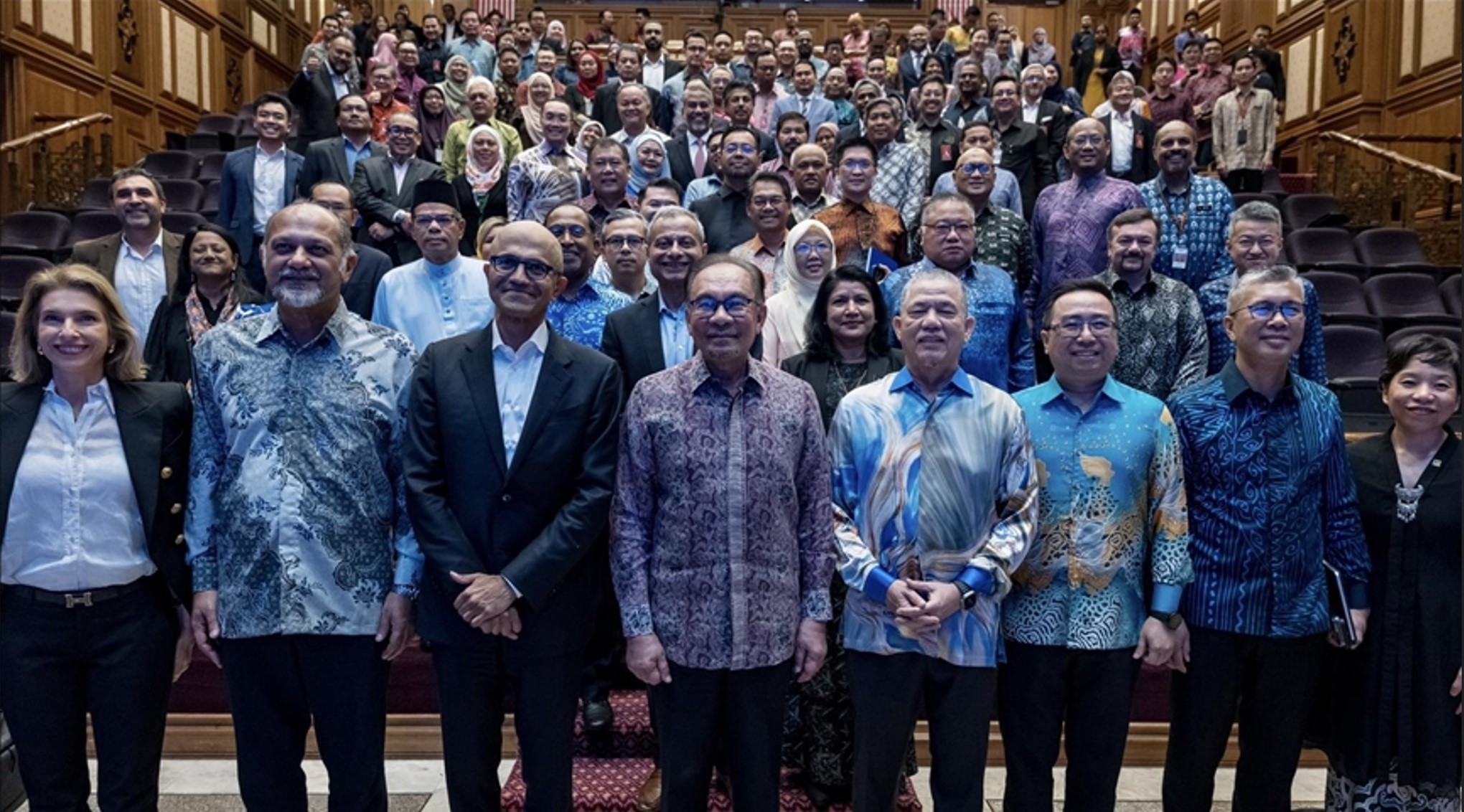
That confidence has been reinforced by Microsoft’s long-term commitment to Malaysia (pic – Prime Minister Dato’ Seri Anwar Ibrahim in centre, next to Microsoft CEO Satya Nadella with Gobind next to him together with other senior leaders and their teams).
The tech giant has pledged a multi-billion-dollar investment in cloud and AI infrastructure and skilling initiatives over several years, including programmes to train hundreds of thousands of Malaysians in AI, cybersecurity and digital skills. These investments are intended to support Malaysia’s ambition to become a regional AI hub and underscore industry confidence in the country’s digital and policy direction.
Indeed, two years after its establishment, the Ministry of Digital is positioning itself not as a symbolic institution, but as a long-term architect of Malaysia’s digital future. Under RMK-13, its task is to ensure that AI Nation 2030 is not merely an aspiration, but a sustained national capability.
In an era defined by relentless technological change, Gobind Singh Deo’s approach offers a quieter but more enduring measure of leadership. Not how loudly a vision is proclaimed, but how carefully it is built, and how well it stands as the pace of change accelerates, especially for future generations who will inherit the systems, safeguards and opportunities being put in place today.
Note: This article was contributed by Communications Practitioner Michael Ang and MDEC’s Director of Strategic Communications Frank Chan. A version of it was published in the latest issue of PIKOM’s MyIT magazine.
The views expressed here are those of the author/contributor and do not necessarily represent the views of Malaysiakini.
Interested in having your press releases, exclusive interviews, or branded content articles on Malaysiakini? For more information, contact advertise@malaysiakini.com or advertise@fgmedia.my


