


/file/publisher-c1a3f893382d2b2f8a9aa22a654d9c97/2026/04/85726c7aedef48390e59d20311781c95.jpg)

TVET skills now a ‘goldmine’ for youth future careers
INTERVIEW | The evolving employment landscape, with increasingly demanding technical skills and practical competencies, is prompting more parents to steer their children toward Technical and Vocational Education and Training (TVET) as a more relevant pathway to meet current industry needs.
This trend reflects a shift in public perception of TVET, which is no longer seen as a second-choice option but rather a mainstream technical education route for building competitive careers aligned with national economic demands.
Education Minister Fadhlina Sidek previously revealed that applications surged from 28,098 in 2022 to 58,263 last year, indicating that TVET is becoming highly sought after.
The evolving employment landscape, with its growing demand for technical skills and practical competencies is prompting more parents to steer their children toward TVET as a more relevant pathway aligned with current industry needs.
Future economic driver
Rahmatulfathiah Samsuri, Information Technology Officer at the Department of Syariah Judiciary Malaysia, believes the country’s education system is moving in the right direction. With her child currently pursuing Business Management at a TVET institution, she sees firsthand how the system is evolving.
She pointed to the growing integration of Science, Technology, Engineering, and Mathematics (STEM) alongside TVET as core pillars, introduced as early as secondary school.
According to her, this direction is evident through the implementation of the long-term education plan, the National Education Blueprint 2026-2035, as well as strong government funding to strengthen the sector.
“For me, the country’s direction is now clearly defined. STEM provides the theoretical foundation and logical thinking, while TVET serves as the platform to apply those skills.
“Exposure to these fields is now introduced much earlier, beginning in Year One under the 2027 school curriculum, to nurture technical skills from a young age and cultivate students’ interest in technology-related fields
“The government has also allocated RM7.9 billion for TVET in Budget 2026, in addition to supporting training and skills development in areas such as artificial intelligence (AI), semiconductors and electric vehicles (EV). This demonstrates Malaysia’s serious investment in STEM and TVET,” she said.
At the same time, Rahmatulfathiah noted that access to TVET education is becoming increasingly widespread, with approximately 1,398 institutions established nationwide.
Graduate employability assurance
Aligned with the shift toward a skills and services-driven economy under the Ministry of Investment, Trade and Industry (MITI), she sees TVET as a practical and forward-looking pathway for the future.
“The opportunity to enter this pathway is wide, especially for students who want to build practical and technical skills from an early stage,” she said.
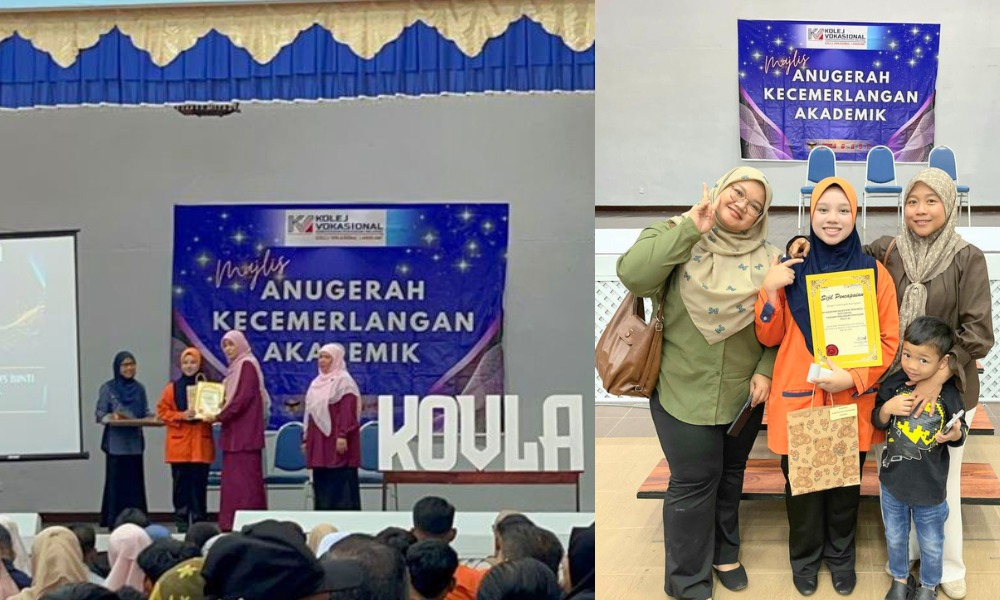
Reflecting on her decision to place her 18-year-old daughter, Wan Nurzafirah Balqis Wan Abdul Jalil, on the TVET pathway, Rahmatulfathiah said she is both satisfied and fully committed to supporting her education all the way to higher levels.
She is confident that the pathway can ensure long-term career stability, given the high graduate employability rate and the strong ties between institutions and industry.
“I am very satisfied and encourage my child to complete the Malaysian Vocational Certificate and subsequently the Malaysian Vocational Diploma.
“If the results are excellent, I’ll continue to support her up to the highest level in the TVET field,”
She added that the 99 per cent employability rate among TVET graduates is compelling evidence of the pathway’s relevance to today’s job market, further strengthened by its close ties with industry.
Rahmatulfathiah added that the TVET learning approach, which emphasises 70 per cent practical training and 30 per cent theory, provides students with an advantage in mastering real-world skills required in the workplace.
At the same time, she suggested several ways to further strengthen the TVET system, including expanding industry exposure, standardising quality across institutions, and improving public perception of the pathway.
“TVET needs to be more hands-on and closely aligned with industry, more consistent in quality, and more widely valued by society,” she said.
She also emphasised the need for clearer, more flexible education pathways to help students progress in their studies, alongside stronger training and support for educators.
Nurturing young entrepreneurs
According to homemaker, Raja Adella Raja Kamarulzaman, her child’s inclination toward skills-based learning was the main factor that encouraged her to enrol her teenager in a vocational college, majoring in cosmetology.
She emphasised that theoretical mastery alone no longer guarantees survival in today’s industry.
“Today’s world requires skills. Some students may perform well in exams, but when they enter the workforce, they lack practical experience.
“With the skills acquired, my child has already started generating her own income,” she said, highlighting the advantages of the TVET learning system.
According to her, early exposure to real working environments gives vocational students an edge over their peers in mainstream education streams.
Beyond traditional expectations
Raja Adella, 51, said that beyond salaried employment opportunities, skills-based fields such as cosmetology open up broad opportunities for youths to become entrepreneurs at an early age.
She noted that this is evident as her daughter, Puteri Harleyda Naylisya Norazlie, 24, has already begun applying her knowledge to generate her own income.

“With the skills she has acquired, my child has already begun generating her own income and has the potential to go even further, including starting her own business such as a spa or beauty salon in the future,” she said.
Raja Adella urged society, especially parents, to move beyond the negative stigma surrounding TVET and recognise it as a viable
“Do not limit success solely to academic achievement. TVET provides space for them to build skills and create their own career opportunities,” she said.
Meanwhile, Tabika Perpaduan Assistant Teacher, Raja Aida Raja Kamarulzaman, said that the decision to allow her son, Wan Arif Rusyaidi Shamsul Kamar, 19, to pursue a course in architecture and drafting (architectural design) under the TVET pathway aligns with current industry needs.
According to her, her child’s interest leans toward manufacturing sectors involving materials such as wood, paper, and furniture, areas that are also emphasised under the MITI through the New Industrial Master Plan 2030 (NIMP 2030).
Navigating the challenges of the technical industry
She acknowledged that the manufacturing and construction sectors now require the integration of modern technologies, which can only be mastered through intensive technical training.
Commenting on her child’s educational direction in facing future economic challenges, Raja Aida, 47, said that the changing employment landscape now demands practical competencies more than purely academic achievements.
As such, she expressed satisfaction with the decision and remains confident that her child’s chosen field has the potential to offer long-term career stability, depending on industry demand.

“Skills are more essential in today’s era. Many industrial sectors now utilise technologies that require a strong foundation in skills.
“Job demand is increasingly focused on practical skills and experience,” she said.
In line with the aspirations of the NIMP 2030, the TVET pathway is seen as a key catalyst in producing a skilled workforce capable of supporting high-value industrial sectors, including design, manufacturing, and construction.


Are you sure you want to delete this comment?
This action cannot be undone.