Legal and judicial experts from across Asia convened at the World Judicial Integrity Forum (WJIF) 2026 today to discuss major institutional challenges confronting modern court systems, ranging from judicial independence and digital transformation to insolvency reforms and cross-border legal cooperation.
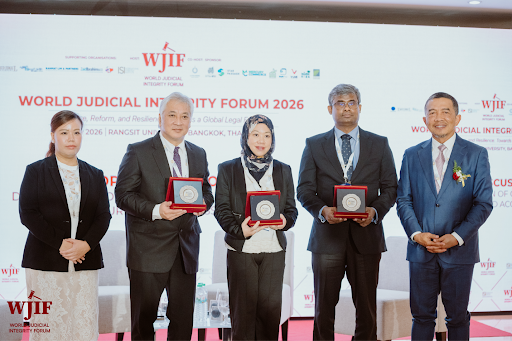
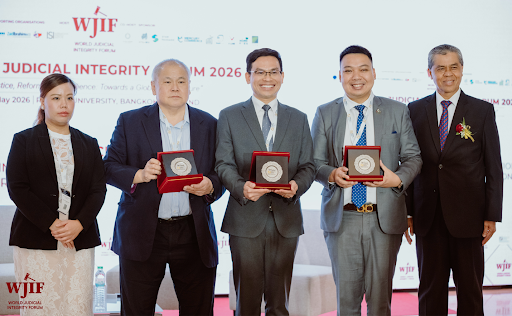
Image above: Guests of Honour and distinguished delegates posing for a commemorative photograph during WJIF 2026 at Rangsit University, Bangkok
Held at Rangsit University, Thailand, the forum brought together judges, lawyers, regulators, academics and policymakers from Malaysia, Thailand, Brunei Darussalam, Sri Lanka, the Philippines and China under the theme “Justice, Reform, and Resilience: Towards a Global Legal Future”.

One of the central discussions focused on judicial independence and public confidence in courts across Asia.
Thai legal academic and PDPC official Pol Col Dr Siriphon Kusonsinwut delivered one of the forum’s more candid presentations, raising concerns relating to transparency, political pressure, access to court information, delays in politically sensitive cases and public trust in judicial institutions.
He stressed that judicial independence must remain balanced with accountability, transparency and procedural fairness, warning that public obedience to court decisions ultimately depends on confidence in the integrity and impartiality of the legal system.
Building upon concerns surrounding public trust and institutional credibility, the forum also examined the accelerating digital transformation of courts and the growing role of technology in judicial systems.
Speakers discussed cybersecurity risks, digital evidence, AI-assisted systems, online dispute resolution and concerns surrounding unequal access to justice in increasingly digitised legal environments.
Panellists noted that while technological innovation may improve efficiency and accessibility, judicial systems must remain vigilant to ensure that technology does not compromise fairness, due process and human judgment.
The discussions then shifted towards the relationship between judicial efficiency, economic resilience and investor confidence across Asia.

Representatives from the Malaysian Department of Insolvency and Brunei Darussalam outlined how modern insolvency frameworks and specialised commercial courts are becoming increasingly important in attracting investment and supporting economic stability.
Malaysia’s presentation on the proposed Cross-Border Insolvency Act 2026 (CBIA 2026) drew significant attention for its alignment with the UNCITRAL Model Law framework and its emphasis on international judicial cooperation, recognition of foreign insolvency proceedings and regional restructuring coordination.
The reforms were presented as part of Malaysia’s broader effort to strengthen institutional credibility, modernise insolvency governance and position itself as a regional restructuring and commercial dispute resolution hub.
Brunei representatives similarly highlighted how the country’s Commercial Court and Insolvency Act reforms have improved efficiency, legal certainty and investor confidence while supporting Brunei Vision 2035.
Expanding from domestic reforms into regional collaboration, the final session focused on cross-border legal coordination and institutional cooperation in an increasingly interconnected legal environment.
Panellists explored the practical challenges arising from transnational disputes, digital regulation, immigration enforcement and cross-border investigations, while stressing the importance of stronger judicial and institutional cooperation across jurisdictions.
Malaysian international lawyer and arbitrator Philip Teoh discussed the establishment of Malaysia’s International Commercial and Admiralty Court (ICAD), describing it as part of broader judicial modernisation efforts aimed at strengthening Malaysia’s position as a regional hub for international dispute resolution, shipping and cross-border commercial litigation.
He highlighted the increasing importance of specialised commercial courts, international arbitration and judicial coordination in handling complex multinational disputes involving trade, maritime law and foreign investment.
The inaugural WJIF 2026 was jointly organised by the International Strategy Institute (ISI) and Rangsit University.
For more information, visit https://istrategyglobal.org
This content is provided by IAF Strategy Sdn Bhd.
The views expressed here are those of the author/contributor and do not necessarily represent the views of Malaysiakini.