


/file/publisher-c1a3f893382d2b2f8a9aa22a654d9c97/2022/11/d4dce90fb72385fa05fbedca86006adb.png)

Political stability helps strengthen flood management, both in the short and long term
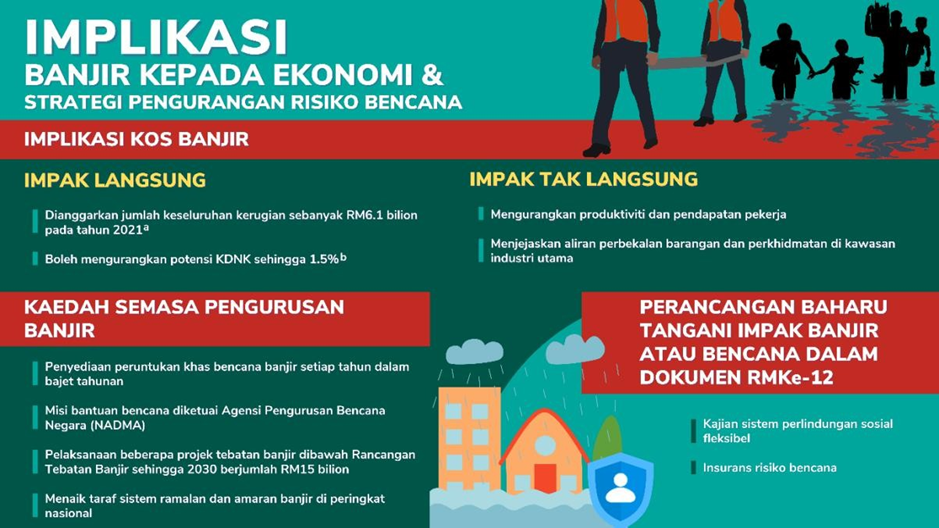
According to Dr. Muhammad Daaniyall Abd Rahman, Senior Economist at the Centre for Future Labour Market Studies (EU-ERA), losses due to flood disasters reach billions of ringgit every year. The Department of Statistics Malaysia estimates that in that in 2021, the country suffered a total loss of RM6.1 billion due to floods across the country; this covers damage to residences, vehicles, business premises and infrastructure.

In addition, Budget 2023 provided an allocation of over RM1 billion for the purpose of implementing flood mitigation projects as well as flood disaster relief operations and missions.
Quoting a study by researchers from the University of Malaya, Muhammad Daaniyall said the flood episode in Terengganu in 2014 was estimated to have reduced Malaysia’s potential gross domestic product (GDP) by up to 1.5%.
This means that the floods that occur every year have had a negative impact on the nation’s economy due to the damage to property, disruption to the smooth running of economic activities, and reduction in the rakyat’s income.
At the international level, the United Nations (UN) through the Sendai Framework for Disaster Risk Reduction 2015-2030 has outlined the need to strengthen disaster risk management to reduce the impact on life, health, the environment and the economy.
Muhammad Daaniyall noted that currently, the country focuses on short and long-term interventions to provide protection to people who are vulnerable to flooding risks. Cash aid for flood victims and flood management are among the initiatives carried out by the government.
In addition to that, in order to build up the country's resilience to adapt to climate change, a long-term strategy has been taken. This includes the implementation of a Flood Mitigation Plan until 2030 worth RM15 billion which covers the implementation of flood mitigation projects, construction of dual-function reservoirs, and upgrading of the weather forecasting system.
In addition, new innovations are also being intensified in the Twelfth Malaysia Plan (12MP). Cognisant of the fact that flood disasters not only result in damage to property and loss of life, but also people's income, the government is also turning its attention to protect the latter.
A flexible social protection system through a disaster risk transfer mechanism, including disaster risk insurance, will be studied for its implementation to reduce post-disaster liability, in addition to helping to ease the government's financial burden.
However, flood crisis management requires an integrated governance ecosystem formed through the involvement of political commitment, as well as the participation and coordination of a network of various government agencies, the private sector and local communities.
In order to realise these short- and long-term targets, the country needs a stable government to ensure that Malaysia’s flood management can be transformed into a holistic form of management and be implemented in a sustainable and inclusive manner so that the welfare and safety of its people continue to be preserved.


Are you sure you want to delete this comment?
This action cannot be undone.