




Islamic finance in a changing world
The Fifth World Islamic Economic Forum (WIEF) was held last week in Jakarta, Indonesia, (March 2-4). The global Islamic financing industry has over US$1 trillion in assets. But the member states of WIEF account for 19 percent of the world's population and only 6 percent of its income. ( Jakarta Post , March 3).
The Fifth World Islamic Economic Forum (WIEF) was held last week in Jakarta, Indonesia, (March 2-4). The global Islamic financing industry has over US$1 trillion in assets. But the member states of WIEF account for 19 percent of the world's population and only 6 percent of its income. ( Jakarta Post , March 3).
The Forum took place alongside a deepening Western banking crisis and recession.
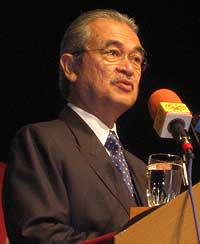 Prime Minister Abdullah Ahmad Badawi, speaking for a country where Islamic banking and finance manages 12 percent of banking assets, and aims for 30 percent by 2025, said that "Islamic finance is gaining credibility as an alternative."
The more globalised and Westernised your economy, the more likely you will be hit hard. Many countries in Africa, Latin America, and Central Asia do not have the underlying economic strength and financial reserves of the Middle East and Asia and will go down with the West, without support.
This is the crisis of capitalism many predicted, bigger than the Wall Street crash of 1929-1933. It will lead to a New International Economic Order and the restructuring of global economic institutions (UN, World Bank, International Monetary Fund, World Trade Organisation).
Which means there is global dependence on key Muslim-led economies to supply liquidity and demand. The G20 becomes more crucial than the G7 and three Muslim-led countries already reach the first rank: Turkey, Indonesia and Saudi Arabia.
Delegates to the WIEF in Jakarta saw this could be the opportunity Islamic banking and finance has been waiting for, but many doubted it was yet strong enough to meet the challenge.
It was claimed Islamic finance offered more reliable non-debt-based alternatives to the Western banking and financial system, which has been brought down by high leverage, greed and poor enforcement of inadequate regulatory systems.
HA Riawan Amin, president director of Bank Muamalat, fell back on the basic philosophy of Islamic finance, especially the principle not to buy and sell debt. He said Islamic banking and finance could be one of the ways to help the world out of the crisis, "but if we do it correctly."
Still a young industry
But participants and commentators at the Jakarta Forum warned that Islamic banking and finance was a young industry and had not yet been truly tried and tested.
Indonesian Finance Minister Sri Mulyani said: “Banking should be an instrument for development and not an instrument for speculation”.
She said shariah banking should not make the same mistakes and "end up like the conventional system." ( Jakarta Post , March 4).
President Susilo Bambang Yudhoyono has said he wants Indonesia, with its 235 million people, to become a global hub for Islamic banking but it accounts for less than 3 percent of Indonesian banking assets and lacks the know-how, staff and infrastructure it needs to expand.
The Indonesian case illustrates there is a global gap between aspirations for Islamic banking and finance, and realities.
First, Islamic finance is highly institutionalised and capitalised in a small number of rich countries with small populations, notably in Saudi Arabia, the Gulf states and Malaysia, whilst it is least institutionalised and capitalised in countries with large Muslim populations, confronting large-scale poverty, notably Bangladesh, Egypt, India, Indonesia, Nigeria and Pakistan.
Second, in large population poorer Muslim countries where it is least developed, Islamic banking and finance is over reliant on basic banking services based on fixed-rate systems, (more similar to conventional Western finance), often with greater emphasis on saving than lending. Too many clients do not access loans, especially the innovative and attractive variable rate profit and loss sharing loans.
Finally the WIEF needs to address more forcefully the weakness of South-South co-operation between Arab, Muslim and Southern economies. When the Organisation of Islamic Conference helped set up the WIEF in 2004, intra-trade between its members was only 4 percent. This has risen in four years to 7 or 8 percent but the target is 25 percent by 2011.
OIC and WIEF will need to push much harder to reach the target.
TERRY LACEY is a development economist who writes from Jakarta on modernisation in the Muslim world, investment and trade relations with the EU and Islamic banking.


Are you sure you want to delete this comment?
This action cannot be undone.