




Wen's swan song for China
If you go by the argument spun by Australia’s Labor government, its $A10.4 billion first stimulus package late last year was heralded to lift GDP by 0.5 percent and create 75,000 jobs.
Treasurer Wayne Swan was cocksure of his “economic security” plan. He was certain Australians would keep with tradition and spend the bounty channeled in their bank accounts. Retailers crowed over momentous sales. But somebody was fibbing. Because guess what? Eighty percent of the $10.4 billion was saved. That wasn’t part of the script.
If you go by the argument spun by Australia’s Labor government, its $A10.4 billion first stimulus package late last year was heralded to lift GDP by 0.5 percent and create 75,000 jobs.
Treasurer Wayne Swan was cocksure of his “economic security” plan. He was certain Australians would keep with tradition and spend the bounty channeled in their bank accounts. Retailers crowed over momentous sales. But somebody was fibbing. Because guess what? Eighty percent of the $10.4 billion was saved. That wasn’t part of the script.
So Swan swung into action. In late February he announced a second bailout package, this time of about $A40 billion. A good fraction of this is going into people’s pockets. The rest is targeted for crumbling infrastructure development. But with Australians starting to lose their jobs, it’s certain they’ll pocket whatever the government gives them to spend.
 And just to make the point about hastily hacked, politically motivated stimulus packages, the government statistician said in early March that GDP had slipped to a meager 0.5 percent for the last quarter of 2008. The first quarter of this year is expected to be 0 percent, or worse. That’s recession, by any language - except Swan’s and his boss, prime minister Kevin Rudd
(left)
.
And just to make the point about hastily hacked, politically motivated stimulus packages, the government statistician said in early March that GDP had slipped to a meager 0.5 percent for the last quarter of 2008. The first quarter of this year is expected to be 0 percent, or worse. That’s recession, by any language - except Swan’s and his boss, prime minister Kevin Rudd
(left)
.
Until the March number is known, Rudd and Swan will pussyfoot around, what is to them, a technicality but to most analysts a recession that probably started midway through the December quarter.
In fact Rudd lamented that there was now no way that Australia would avoid the “global cyclone”. No kidding, Einstein. But imagine if Rudd had used the well-worn cliché ‘financial tsunami’. He would have been hung from the tallest eucalyptus tree.
Rudd doesn’t seem to have the oeuvre, the long view, of what to do to halt the economy from sliding into recession. And he would be wise not to proffer projections of a quick upturn if he wants to survive the next federal election.
But he would be banking on China, as indeed have all those economies that, in their infinite wisdom, hitched their bandwagons to the Chinese economy. And they will be praying - desperately - that a series of fiscal stimulus measures crafted by Beijing would work wonders. Fast. Newly-minted US president Barrack Obama will be praying hard too.
 Premier Wen Jiabao hinted loudly in early March that Chinese GDP could lift to 8 percent on the back of a series of stimulus packages.
If Australia calculated that its $A10.4 billion would generate 0.5 percent GDP growth, imagine what China’s first round package, at US$586 billion, announced early last November, would do for the mammoth economy now suddenly facing doldrums. That figure, or 4 trillion yuan, represents 16 percent of China’s nominal output last year, and almost equal to total spending by local and central governments in 2006.
Whether China can achieve the 8 percent GDP is anyone’s guess. That is the minimum that Beijing requires for the economy to begin employing Chinese again. At least 20 million Chinese have lost their jobs as the first wave of the US sub-prime mortgage-led global downturn began to hit Chinese shores. With China’s key export markets also staggering into recession, the economic juggernaut has come adrift, and surprisingly quickly.
The economy expanded by 6.8 percent in the October-December 2008 quarter. But 8 percent GDP may not be enough to employ Chinese. The problem is being compounded as more and more factories throughout China close down.
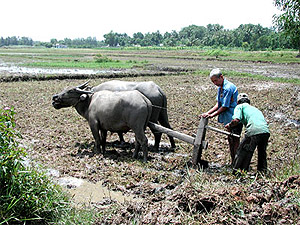 Moreover, as commodity and farm produce prices collapse, embattled farmers have been leaving their tiny plots for cities in search of work, only to be ushered back on buses and trains for the hinterland. This has cast a nightmarish pall on the centre’s ability to control the rest of the country.
There’s nothing on the horizon to suggest China’s stimulus packages will avert the worse in economic or political terms. In fact there’s little good cheer coming from the US and Europe. Even eastern European emerging economies are in strife, looking to their beleaguered western European counterparts to bail them out. That doesn’t look likely to happen. And Russia is in quagmire too.
More US banks to fold?
Many analysts are now predicting more bad news to come from the US financial markets, especially banking. Some banks are expected to fold, and that spells trouble for the real economy of the US and the rest of the world, particularly those economies, like China, that are overwhelmingly reliant on growth through exports.
 Problem is, nobody knows what exactly Obama
(left)
and his knights plan to do to save the US economy. He has been terribly short on detail, and that’s what the rest of the world is looking for.
Problem is, nobody knows what exactly Obama
(left)
and his knights plan to do to save the US economy. He has been terribly short on detail, and that’s what the rest of the world is looking for.
Still, from Wen’s language, Beijing appears to be hinting at fewer attempts at plodding along with short-term stopgap measures. It’s focused more on long-term structural problems.
Last year’s stimulus package, and another one expected to be announced this month of roughly the same amount as the first, will likely go towards improving China’s long-term productive capacity and innovation of existing industry, including agriculture.
There’s also the likelihood that the battered Chinese hinterland will receive critical funding for infrastructural development. Part of the plan is to assuage political angst against the centre for having ignored the plight of people in the countryside. The other is to open up the hinterland to the potential of production shifts from the increasingly costly coastal belt where the manufacturing industry has been concentrated since the early 1980s.
In all of this, the Chinese government’s budget will take a hammering. Until recently Beijing had boasted an almost balanced budget. The deficit in 2008 was a just 0.4 percent of GDP. This year’s budget deficit is expected to be around 950 billion yuan, or 3 percent of GDP. By most western standards, that’s manageable -for now.
Meanwhile, government debt was 20.9 percent of GDP in 2007, compared to the US government’s debt ratio of 61 percent of GDP. Well and good. Wen strode out to the National People’s Congress confidently, declaring that whilst the near-term looks tough, China will manage 8 percent GDP this year.
Time will tell. More telling will be what happens in the economies of the US and western Europe. The longer the crisis, the deeper the abyss, so the fewer China’s global exports - which leaves it only one option: to sink money into the Chinese domestic sector and crank up aggregate demand. That won’t be so easy. Chinese consumers are not like their western counterparts. Thrift is their first, middle and last names. Scrooges too, especially when the chips are down.
Wen must know this, but Wen also knows that he has to offer the Chinese people something that is politically palatable. If the 8 percent does not materialise, he’ll blame the problem on America’s cowboy capitalism. Or else it’ll be his head on a platter.
But there are anecdotal signs of the possible. China’s Purchasing Managers Index (PMI) for February, released in early March, was 43.4 from 33.7 in January, give or take a few distortions here and there. But there’s a silver lining, it seems: the PMI reading, whilst showing the Chinese economy has slowed (anything below 50 on the PMI reflects a downturn), the rate of the slowdown has moderated, albeit slightly.
Australia’s Swan no doubt will take heart from these sets of numbers and hope China will return to buying Australia’s minerals and other resources in quantities of yesteryear.
 In the wake of having nothing else credible to offer Australians for hope, he may even point to the fact that Beijing has approved salary increases for China’s two-million strong military through a 14.9 percent increase in the military’s budget to 480.6 billion yuan. And that must be a good sign, Swan will say.
China’s army does the one-party so-called communist state’s political dirty work, including political repression at home and abroad in Tibet. But Swan will turn a blind eye to this, under instructions from his boss, of course.
MANJIT BHATIA, an academician and writer, is also research director of AsiaRisk, a political, economic and risk analysis consultancy in Australia. He specialises in international economics and politics, with a focus on the Asia-Pacific.


Are you sure you want to delete this comment?
This action cannot be undone.