




Blight of Somali piracy
On the morning of April 8, a US-flagged cargo ship - the Maersk Alabama - carrying US government food aid destined for Africa was hijacked by Somali pirates.
Eventually, the crew and the ship escaped to safety, while Captain Richard Phillips was taken hostage by the pirates who fled in a smaller boat. After a significant US naval deployment, the pirates were killed and the captain was rescued.
Story over? Not really.
On the morning of April 8, a US-flagged cargo ship - the Maersk Alabama - carrying US government food aid destined for Africa was hijacked by Somali pirates.
Eventually, the crew and the ship escaped to safety, while Captain Richard Phillips was taken hostage by the pirates who fled in a smaller boat. After a significant US naval deployment, the pirates were killed and the captain was rescued.
Story over? Not really.
This wasn't the first piracy case off the coast of Somalia and it won't be the last. Last December, a Saudi super-tanker carrying US$100 million worth of oil was hijacked, with the pirates eventually getting paid $3 million in ransom.
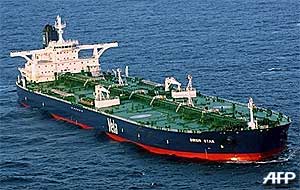 Piracy has risen dramatically in recent years, with over 100 incidents reported off the coast of Somalia last year.
This year is set to be even more dangerous with the International Maritime Bureau citing about 70 attacks in the first few months, and with Somali pirates currently holding about 200 international crew members hostage - Asians, Arabs and Eastern Europeans.
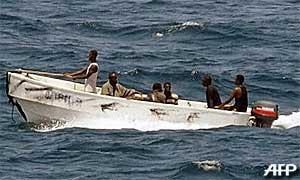
The pirates actually seek to ‘justify’ these attacks in their local society. They justify their attacks against international vessels on the ground that the latter represent foreign incursions into Somali waters to engage in unlicensed fishing and to dump toxic waste.
The costs to the global economy from Somali piracy, particularly the economies of the Gulf States, the US and Europe, are mounting.
Piracy off the coast of Somalia has amplified the price of vessel insurance and increased the price of goods transmitted through this prime trade route. Typically, at least 20,000 ships a year pass through these waters transporting goods, as well as 7 percent of the world's oil.
Furthermore, many ships have had to be rerouted, travelling all the way around Africa to avoid the pirates and the higher insurance rates. Egypt's economy, in particular, is suffering from route diversions.
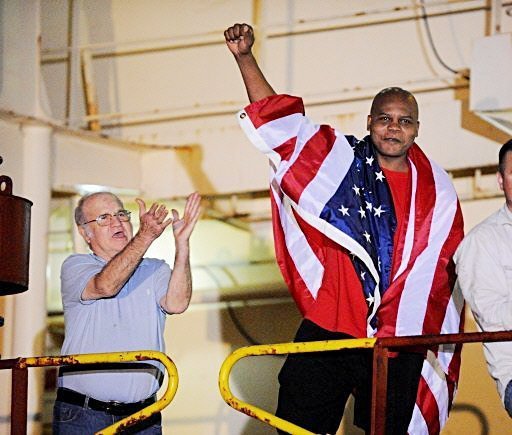 The UN Security Council responded forcefully by passing Resolution 1851 last December. This permits member-states to pursue and capture pirates with the permission of the transitional federal government of Somalia (as the US Navy did to rescue Phillips,
right
).
The UN Security Council responded forcefully by passing Resolution 1851 last December. This permits member-states to pursue and capture pirates with the permission of the transitional federal government of Somalia (as the US Navy did to rescue Phillips,
right
).
In addition, Nato and other counter-piracy forces have been dispatched to Somali waters, an area spanning 6.6 million square km - about 10 times the size of the state of Texas.
Also of major significance is that Al Qaeda leader Osama bin Laden issued an audiotape last month calling on fringe terror groups operating in the dark margins of Somali society to rise up against the new government.
Notably, no strong organic linkage has been established between Somali pirates and global terror groups like Al Qaeda; nevertheless, potential collusion between pirates and terrorist networks in that volatile region of East Africa constitutes a valid security concern.
Key ingredients
Piracy in the high seas is always a symptom of chronic issues on land.
Thus, in addition to bolstering maritime security, the international response to piracy off the coast of Somalia must focus on the core problems of the country, such as the lack of good governance and economic growth.
Even in the context of Africa, Somalia has been among the poorest and most unruly of countries over the past two decades, with a per capita GNP of a few hundred US dollars per year (so low, that it is hard to calculate) and a state of near-anarchy that has only just ended.
 Earlier this month we had the opportunity to privately meet with Foreign Minister Mohamed Abdullahi Omaar after the Arab League summit in Doha.
We learnt that the international community - particularly the US, the Arab world and Europe - now have an opportunity to remedy this plague of piracy by helping end the nearly two-decade-long state of conflict in Somalia.
The three key ingredients are:
- Political and financial support for the new government of Somalia and the inclusive peace process launched in Djibouti in January, including support for Somalia's security apparatus;
- Dramatically increased aid to help raise living standards in Somalia and give young people a pathway out of poverty and piracy to prosperity;
- The undercutting of any vestiges of pirate legitimacy in civil society, by ensuring an end to unlawful fishing and the dumping of toxic waste off Somalia's coastline.
These must be pursued alongside multinational naval deployments already underway.
Thus far, the military option has not borne tangible success. A more comprehensive strategic framework is needed.
The US, the Arab world and Europe have a unique opportunity to cooperate on these common objectives, and implement a far-reaching strategy that empowers Somalia's new government and effectively ends the blight of piracy - and in so doing, to create new models of international cooperation.
HADY AMR is the founding director of the Brookings Doha Centre and a fellow at the Saban Centre for Middle East Policy at the Brookings Institution.
AREEJ NOOR is a research assistant at the Brookings Doha Centre. This article is distributed by the Common Ground News Service with permission from Daily Star .


