




Using media to wage war in Eelam
On May 19, 2009 when the Sri Lankan government was pronouncing the annihilation of the Liberation Tigers of Tamil Eelam and their television channels were beaming the body of the slain leader V Prabhakaran, www.tamilnet.com carried as its lead story an assertion by the LTTE International Relations Head S Pathmanathan that all is well with Prabhakaran who will continue to lead the struggle for Eelam.
On May 19, 2009 when the Sri Lankan government was pronouncing the annihilation of the Liberation Tigers of Tamil Eelam and their television channels were beaming the body of the slain leader V Prabhakaran, www.tamilnet.com carried as its lead story an assertion by the LTTE International Relations Head S Pathmanathan that all is well with Prabhakaran who will continue to lead the struggle for Eelam.
This perhaps indicates best, the use of media by the Tamils, and in effect the LTTE, in the struggle against the Sri Lankan government for a separate Tamil homeland of Eelam.
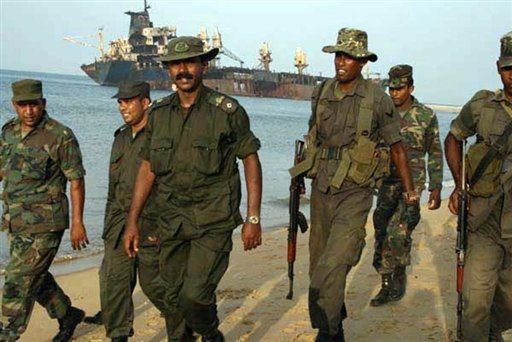 It is early days yet to predict the trajectory of the movement for Eelam or for that matter the future of the LTTE, but much as the LTTE would be known for its ability to sustain the struggle against a state for 25 years, it would also be known for the ingenious use of media to create a national identity and foment nationalism among people far removed from the physical boundaries of the nation.
There is perhaps no parallel in the world as to the way in which media technologies became an intrinsic part of an organisation's armoury in their fight against a sovereign state.
It is a little difficult to trace the point in time when the Tigers realised the potential of the media and decided to draft it in their struggle for a separate state.
But the mass migrations to the West of the Tamil population that could not be arrested and the realisation of the power of the diaspora that could be employed in lobbying with international players and persuaded to fund the war should have woken up the leadership to the need for a means to reach the Sri Lankan Tamils dispersed around the world.
And the border-transgressing Internet and new media technologies that were difficult to rein in provided the answer.
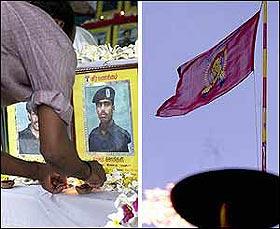 From blatant propaganda material that was put online that depended on volunteers to update and keep afloat, to comprehensive websites that made a sophisticated argument in support of the aims and means of the LTTE to win a separate Eelam, the Sri Lankan Tamil websites have come a long way.
In the absence of archival material, it is a little difficult to make an effective comparison between then and now, but anyone who has been following the war online can vouch for the fact that websites like www.tamilnet.com and www.tamilnation.org have long transcended being mere sources of information.
‘ Free media' is a misnomer
They are creators and nurtures of a distinct Tamil identity that has lent meaning to the struggle.
While researchers have documented the clever and ingenious use of Internet and other media technologies by the Sri Lankan Tamils, they have also pointed out that the Sri Lankan government weighed down by procedures and regulations typical of a government have lagged woefully behind in its use of media technologies in countering the LTTE propaganda.
Indeed it is only in the past decade that voices of different political hues are heard online.
For long, the LTTE and its supporters were the only voice online and as can be seen even now, the most vociferous of them all.
 Online critics of the LTTE were silenced with threats, humiliation and ostracism that so much so that ‘free media' became a misnomer and the Internet turned into a deep and dark alley that one must fear to tread.
The turning point in the emergence of the websites of one of the most powerful weapons in the struggle came about, ironically thanks to the Sri Lankan government, that has more often than not prohibited journalists from travelling to the north and east.
With the intensification of the war, the war zone remained completely out of bounds for the international and Sri Lankan journalists that by default websites such as Tamilnet, which engaged in reporting on the affairs of the north and east, became the only source of information.
It is not to decry Tamilnet's other strengths which are dealt with at length by anthropologist Mark Whitaker on his eulogistic book on Sivaram, ‘Learning politics from Sivaram'.
The late Sivaram better known as ‘Taraki', revamped Tamilnet to make it one of the most sought after sources for the Tamil-version of events.
Although he refuted the charge that the website was the mouthpiece of the LTTE, it is generally perceived as supportive of the LTTE. However, the perception does not hamper ‘objective' publications from quoting it.
The ‘success' of Tamilnet lies perhaps in the fact that while it began as an alternative media, it has managed to inveigle itself into the dominant media what with the BBC South Asia website and anti-LTTE daily The Hindu , published from Chennai, India, sourcing material from it albeit qualifying it as a pro-LTTE website.
The test of objectivity
With a near complete monopoly over information on events occurring in the north and east, Tamilnet redefined ‘objectivity'.
An objective publication became one that reported the Sri Lankan defence sources version emanating from Colombo and balanced it with the account published in Tamilnet.
For most readers, a complete account of the war emerged only by pitting the Sri Lankan government sources against that of the Tamilnet's version and making up their own version of reality.
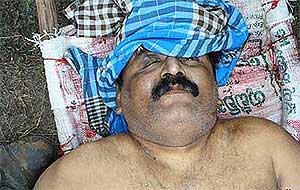 This however is no comment on Tamilnet's credibility. In times unfavourable to the LTTE, it has gone offline, remained silent, indulged in bravado and even illogically refuted charges just as it is now bravely asserting that the slain leader whose body is for all to see on television screens across the world is safe and alive and rearing to go.
Yet by filling in the void for an alternative voice, the website has risen to become the only source of information of the other side.
It makes to its reader's list of ‘objective' sources simply because it is able to get most of its readers most of whom have been harassed by the Sri Lankan government to relate to its accounts.
The first phase of the struggle for a separate Tamil state spearheaded by the LTTE for three decades has thrown up a few surprising lessons in media studies as well.
It has shown that media can be as deadly a weapon as a gun on the battlefield; that the battlefields extend beyond the physical to the virtual and that conventional journalistic wisdom ill equips one to handle the issues thrown up by new technologies.
MAYA RANGANATHAN is a post doctoral fellow in the National Centre for Australian Studies, Monash University, Victoria, Australia and a researcher on online Tamil nationalism.


