




Obama - no different from Bush
A leading global environmental group has accused the US of holding up the United Nations climate negotiations.
Friends of the Earth Malaysia's honorary secretary Meena Raman said that, throughout the second round of the United Nations climate talks in Bonn that ended June 12, the US administration had blocked progress to move negotiations forward.
A leading global environmental group has accused the US of holding up the United Nations climate negotiations.
Friends of the Earth Malaysia's honorary secretary Meena Raman said that, throughout the second round of the United Nations climate talks in Bonn that ended June 12, the US administration had blocked progress to move negotiations forward.
Delegates from 183 countries discussed key negotiating texts which will serve as the basis for an international climate change deal due to be reached at a meeting in Copenhagen on Dec 7-18. The Copenhagen meeting will seek to bring an international agreement to follow the Kyoto Protocol, which expires at the end of 2012.
The 4,600 participants included representatives of governments, business and industry, environmental organisations and research institutions.
 Rather than show global leadership, the Obama administration has failed to live up to its responsibility as the world's largest historical greenhouse gas (GHG) emitters, Meena told reporters.
"This strategy damages the prospects for a just, equitable, and effective outcome" at the Copenhagen meting, she said.
Echoing general disappointment with the current US administration, Karen Orenstein of Friends of the Earth US said: "The election of President (Barack) Obama created tremendous hope worldwide that the US would finally play a leadership role in solving the climate crisis that - more than any other nation on earth - it is responsible for causing.
"Unfortunately for the survival of people and the planet, the Obama administration's position at these UN negotiations sounds frighteningly similar to that of (predecessor) George Bush."
Disappointment with the US derives from the fact that industrialised countries need to cut GHG emissions by at least 40 percent by 2020 relative to 1990 levels for a reasonable chance of avoiding catastrophic climate change.
The US administration, however, is still talking about zero percent reduction by 2020 on 1990 levels. Japan tabled a dangerously low emissions reduction target during the talks of 8 percent below 1990 levels.
 The 27-nation European Union remained unimpressive with their 2020 target of 20 percent (30 percent if other industrialised countries commit to similar efforts). Considering that the EU is set to offset over half of its commitments, already weak EU targets will be further watered down.
"While the US is holding climate negotiations hostage, Japan and the EU appear to feel comfortable hanging on to Washington's apron-strings," a delegate said.
Delegations repeatedly warned industrialised countries that their refusal to set adequate targets is preventing any progress in other aspects of the negotiations under the United Nations Framework Convention on Climate Change (UNFCCC).
‘Assume responsibility’ call
Equally alarmingly, industrialised countries failed to agree to substantial transfer of money and technology needed to enable developing countries to tackle climate change.
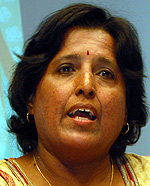 "Industrialised countries need to assume their historical responsibility and pay back their climate debt," Meena said, exhorting developing countries to "stay strong in calling for climate justice”.
"By ignoring calls to repay their climate debt, and hindering progress in these talks, rich countries are jeopardising the lives and livelihoods of millions of people," she said.
Industrialised nations owe developing countries a 'climate debt' for both excessive GHG pollution over the past 200 years and for the damage that pollution has caused and will cause, campaigners say.
Rich industrialised countries account for some 20 percent of the world's population but are responsible for around three-quarters of GHG emissions. But developed countries have so far refused to repay this debt.
The Third World Network's (TWN) briefing paper for the Bonn talks underlines that there will be no sustainable climate solution if developed countries seek to continue polluting at 70 percent or more of their 1990 levels all the way through until 2020 (consistent with 30 percent cuts).
"To avoid deepening their debt, developed countries must seek to become carbon neutral and more. Reflecting their historical responsibility, their assigned amounts of atmospheric space in any future year should be even lower.
“They must take a lead in cutting emissions through deep domestic reductions, and by accepting assigned amounts that reflect the full extent of their historical emissions debt."
TWN is a leading civil society organisation involved in research and publications in trade, environment and development issues.
 Its former director Martin Khor, now director of the South Centre, the inter-governmental policy think-tank of the developing countries, said historical responsibility should serve as a guide to climate change.
Addressing an event at the Bonn conference, Khor drew attention to a noting in the UNFCCC preamble that "the largest share of historical and current global emissions of GHG has originated in developed countries, that per capita emissions in developing countries are still relatively low and that the share of global emissions originating in developing countries will grow to meet their social and development needs." - IPS


