




Iran: Making sense of the elections
Iran’s presidential elections on June 12 has provided the west another opportunity to spout its venom.
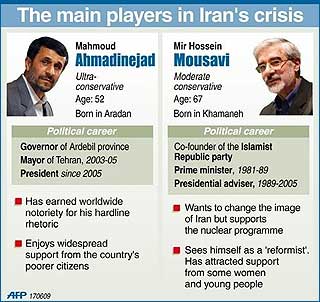
The incumbent, Mahmoud Ahmedinejad, retained his post with a wide margin over his nearest rival Mir Hussain Mousavi.
Through their corporate-controlled media mouthpieces, countries in the west had declared Mousavi the winner even before the people had an opportunity to cast their votes. When the result turned out to be contrary to their perceived wisdom, it was immediately denounced as “rigged”.
Iran’s presidential elections on June 12 has provided the west another opportunity to spout its venom.
The incumbent, Mahmoud Ahmedinejad, retained his post with a wide margin over his nearest rival Mir Hussain Mousavi.
Through their corporate-controlled media mouthpieces, countries in the west had declared Mousavi the winner even before the people had an opportunity to cast their votes. When the result turned out to be contrary to their perceived wisdom, it was immediately denounced as “rigged”.
It seems even Mousavi has fallen for this propaganda because, as soon as the polls closed, he told a press conference in Tehran that he had “won”. How he could make such a claim when no results had come in?
 When the first results started to trickle in late on June 12 and showed Ahmedinejad leading by a wide margin, the western media, led by the
BBC World Service
, started to question their authenticity. Others followed suit.
When the first results started to trickle in late on June 12 and showed Ahmedinejad leading by a wide margin, the western media, led by the
BBC World Service
, started to question their authenticity. Others followed suit.
Soon there was a flood of accusations that there must have been massive rigging - otherwise how could Ahmedinejad be ahead by such a wide margin? This was based on the western media’s wishful thinking.
Part of the reason for their failure to accurately read the mood in Iran is due to the fact that western journalists stay at five-star hotels in north Tehran.
A section of Iranian society only lives here physically; mentally they are in Europe or North America - destinations they frequently visit. Such people feed their prejudices to western reporters who need little prodding, based on their equally jaundiced view of the Islamic Republic, to reflect the most negative stereotyped images of Iran.
Some examples may help explain the point. In the weeks leading to the presidential elections, the overriding theme in the western media coverage was that most people would “boycott” the polls because they have “no faith” in the system.
As the election campaign generated excitement, especially with televised debates between candidates, the western media’s tune changed; their coverage started to focus on the “huge crowds” Mousavi was attracting and deliberately ignored the even larger crowds attending Ahmedinejad’s rallies.
Media outlets that bothered to report Ahmedinejad’s rallies dismissed them as “rented crowds”. The largely ignorant western public did not know the difference; besides, they had little interest in Iran’s elections. Their knowledge of Iran is based on the drivel fed to them by their own media: it is “building” a nuclear bomb and Ahmedinejad has threatened to “wipe out Israel”.
Such prejudices are reinforced by the Iranian expatriate community that is largely opposed to the Islamic revolution, hence their decision to live outside Iran. Supporters of the revolution went back to Iran to help the Islamic Republic.
Western media reports started to speculate that Mousavi would win. Besides, their hatred of Ahmedinejad, the plucky president who drew rings around them with his masterful interviews, did not allow them to see that he may have support among the Iranian masses.
False assumptions
Ahmedinejad has maintained a level of modesty and simplicity that has earned him respect not only among Iranians but also Muslims worldwide. The more the West ridiculed him, the more the ordinary people of Iran admired him.
But his popularity was not merely based on sentiment; he had promised during his first presidential campaign in 2005 that he would put Iran’s oil wealth on the tables of the poor. And this he did. He delivered this wealth to the Iranian masses in the rural areas where the majority reside. This majority had been ignored and dismissed by the liberals, reformists and other west-doting Iranians.
It appears that Mousavi’s campaign was infiltrated by such people despite the fact that during his tenure as prime minister (1981-1989), he was liked by the people because of his modest demeanour and able handling of the economy. It must also be pointed out that Mousavi was never elected to public office; he was appointed prime minister by Imam Khomeini.
(At that time, there were two offices: that of president and prime minister. Only the president was elected who then appointed the prime minister. In a constitutional amendment in 1989, the prime minister’s post was abolished and all executive powers were united in the office of the president.)
Mousavi’s supporters have questioned the wide margin of Ahmedinejad’s victory. They were expecting that there would be a run-off election because no single candidate would garner the 50 percent plus one vote as required by the constitution.
This was again based on wishful thinking and the fact that Mousavi drew huge crowds in Tehran. Two days before elections, Ahmedinejad cancelled an appearance at one of his campaign rallies in Tehran because the crowd was so massive that he feared people might get trampled in a stampede.
Few media outlets reported this. They also did not report the huge victory rally Ahmedinejad held on June 14 in Tehran. Instead, the media focused on Mousavi’s rally on June 15. This was preceded by rumours that he and his supporters had been arrested; when this turned out to be false, their tune changed: the authorities had refused to give permission for his rally, they alleged. When this, too, turned out to be untrue, then the media changed its tack again: they said Mousavi’s supporters had defied the ban and the authorities were forced to “retreat”.
There was no interference from the authorities to disrupt the rally. At the end of the rally, some people tried to storm the Basij offices in Tehran. It was at this stage that shooting occurred that resulted in seven deaths.
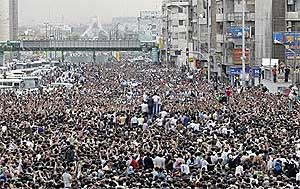 By nightfall, calm had returned. Both camps announced rallies for June 16 but only one - that of Ahmedinejad supporters - was held as they arrived at the rally site, Vali Asr square, ahead of the opposition group and seemed to take control.
Also, the Guardian Council announced on June 16 that it would hold a recount in those polling stations where the opposition said irregularities had occurred, this was rejected by Mousavi’s supporters who demanded that the June 12 election results be annulled and fresh ones held, a demand unlikely to be met.
Poll findings
Amid all the hype about rigging, some basic facts must be kept in mind. Ahmedinejad may be unpopular in the west because of his outspoken views but he enjoys widespread support in Iran. His support base includes the rural population, the urban poor as well as the religious groups. This constitutes the overwhelming majority of Iran’s population.
The urban educated middle class is a minority and is generally confined to the northern parts of Tehran. Their children go to university, drive expensive cars and frequent five-star hotels. It is this group that has largely coalesced around Mousavi. It would be unfair, however, to accuse Mousavi of egging on the rioters to indulge in violence.
Ahmedinejad’s supporters are largely poor; most do not speak English, hence their inability to convey their feelings to western reporters who in any case are not interested in their point of view, but they are solidly behind the revolution and know where their interests lie. It is this class of people that made the greatest sacrifices in defence of the Islamic Revolution during the Iraqi-imposed war in 1980-1988.
This is not mere conjecture. In an article published in the Washington Post on June 15, 2009, Ken Ballen and Patrick Doherty wrote that Ahmedinejad’s 2-to-1 margin was actually confirmed by their own survey of public opinion conducted in Iran three weeks earlier.
“While western news reports from Tehran in the days leading up to the voting portrayed an Iranian public enthusiastic about Ahmadinejad’s principal opponent, Mir Hossein Mousavi, our scientific sampling from across all 30 of Iran’s provinces showed Ahmadinejad well ahead.”
The poll from May 11-20, undertaken by two US non-profit organisations - Terror Free Tomorrow: The Centre for Public Opinion, and the American Strategy Programme at the New America Foundation - was the third in a series over the past two years.
It was conducted by telephone from a neighbouring country (probably Dubai); field work was carried out in Farsi by a polling company whose work in the region for ABC News and the BBC has received an Emmy award. The polling was funded by the Rockefeller Brothers Fund and thus had nothing to do with the government of Iran or with Ahmedinejad.
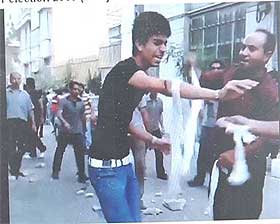 In recent media coverage, much has been said about Iranian youth with the automatic assumption that they all oppose the Islamic government. This is not true, as the survey found. The misconception has emerged because western reporters only talked to north Tehran-based, university educated youth. These youth do not represent the entire country.
Nor is the Internet the harbinger of change, as made out by media reports. The poll by Ballen and Doherty found “that only a third of Iranians even have access to the Internet, while 18-24-year-olds comprised the strongest voting bloc for Ahmadinejad of all age groups”.
There was an even more startling revelation. Some reports have questioned how Ahmedinejad could win in the home province of Mousavi. Here is what the Ballen and Doherty found: “The breadth of Ahmadinejad’s support was apparent in our pre-election survey. During the campaign, for instance, Mousavi emphasised his identity as an Azeri, the second-largest ethnic group in Iran after Persians, to woo Azeri voters. Our survey indicated, though, that Azeris favoured Ahmadinejad by 2 to 1 over Mousavi.”
It is not difficult to see why. Ahmedinejad had gone out of his way to help the poor and dispossessed in Iran. They in turn came out to vote with their feet. The survey also confirmed that Mousavi’s “support came primarily from university students and graduates, and the highest-income Iranians”. These are people who are well-connected and are able to convey their thoughts and ideas to western reporters, hence the kind of images of Iran created abroad.
Some people have argued that in Iran people make up their mind only in the last two weeks of elections. Again, this is true only for the urbanised elites; the rural population knows who their friend or supporter is. Besides, the vote can swing either way: both toward and against Ahmedinejad and it is inaccurate to assume that all the swing votes would have gone to Mousavi.
Ballen and Doherty reported that when their survey was conducted, “almost a third of Iranians were also still undecided. Yet the baseline distributions we found then mirror the results reported by the Iranian authorities, indicating the possibility that the vote is not the product of widespread fraud.”
Finally, one must make a quick comparison with what happened in the June 7 elections in Lebanon. Tens of thousands of people of Lebanese origin were flown from abroad, all expenses paid by the Saudis, to vote for the March 14 group led by Saad Hariri. The Saudis also paid each person US$500 for pocket money.
Despite this massive fraud, Hariri’s group got 68 seats in Parliament (two less than they had in the previous one) while the Hizbullah-backed alliance got 57 seats (one less than in the earlier one). There were three independents. The Hizbullah secretary-general did not complain that the election was rigged. He told his supporters to accept the result and move on.
There was little or no mention in the western media about Lebanese vote rigging; the only thing one heard was that Hizbullah had been ‘defeated’.
ZAFAR BANGASH is a journalist and commentator who specialises on Iranian and Muslim contemporary affairs. Based in Canada, he is director of the Institute of Contemporary Islamic Thought and president of the Islamic Society of York Region.


