




M'sian Indians: An incomplete history (Pt 2)
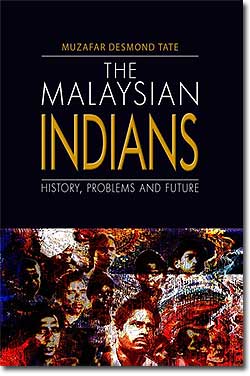
Book review: The Malaysian Indians: History, problems and future (Pt2) by Muzafar Desmond Tate
Tate's analysis of growing political awareness and industrial militancy among Indians in the period leading to World War II is equally thin. In general he overstates the influence of Tamil reform movements, and understates the impact of Gandhian ideals and principles.
Book review: The Malaysian Indians: History, problems and future (Pt2) by Muzafar Desmond Tate
 Tate's analysis of growing political awareness and industrial militancy among Indians in the period leading to World War II is equally thin. In general he overstates the influence of Tamil reform movements, and understates the impact of Gandhian ideals and principles.
There is little detail of the catalytic events of the Depression (for example the mass repatriations of Indian labour) upon the collective Indian consciousness.
Tate's analysis of what he terms "Dravidian nationalism" is undertaken without any reference to contemporaneous developments within the Madras Presidency, such as the Brahmin Mylapore movement, the reactive rise of the Justice Party and its use of anti-Brahmin rhetoric to mobilise popular support, and its subsequent eclipse by the more fervent chauvinism of the Dravida Munnera Kalagam (DMK).
Nor when Tate turns his attention to the rise of the Central Indian Association of Malaya (CIAM), does he grasp the significance of the association's strong links to the increasingly powerful Indian National Congress and the CIAM's consequent ability to use Congress as a conduit to ensure that specifically Malayan issues affecting overseas Indians were brought to the attention of the governing bodies of the British Raj.
Similarly Tate fails to discern the main ramifications of the Japanese occupation upon the Indian community. It can be argued that the experiences of the Pacific War were crucial in cohering the Indians of Malaya into an identifiable community, and that the wartime leadership of Subhas Chandra Bose opened this community, especially the labouring classes, to a range of political and social potentialities that had hitherto been wholly lacking.
 In particular the propulsion of Malayan Indians from the periphery of metropolitan Indian affairs to the very forefront of the struggle against the might of the British Empire for the liberation of India, and the inclusive nationalist narratives which emphasised that all Indians, whatever their religion, caste or status, were descended from and retained membership of one the world's great and enduring civilisations, captured the imagination of many Indians and were to animate Indian social, cultural and political renewal movements in the post-war years.
Tate provides no details of the factors which provoked much of the officer cadre of the British Indian Army to join the Japanese sponsored Indian National Army, nor does he refer to the series of crucial political developments upon the subcontinent - notably the Quit India campaign of 1942 or the Bengal Famine of 1943 - and how these resonated among the newly politicised diaspora Indians of Malaya and Singapore.
Post-war investigation superficial
In discussing the loss of morale within both the Indian National Army and the Indian Independence League after the ill-conceived Imphal campaign of 1944, Tate rightly emphasises the pernicious effects of Boses's punitive taxation regime, but completely overlooks the impact of Viceroy Wavell's offer of post-war Indian independence, an offer which secured the agreement of Congress giants Nehru and Gandhi, thus rendering Bose's campaign redundant.
Moreover Tate gives no real account of the appalling wartime rigours suffered by the Indian community, and seriously understates the extent of forced Indian recruitment to the infamous Burma Railway project and the death rate which was its concomitant.
His investigation of immediate post-war developments is equally superficial and jejune. He does not grasp the significance of the nationalist impulses which infused the founders of the Malayan Indian Congress, nor does he seem to comprehend the extent to which war time experiences had led the Tamil labouring classes to reject the smothering embrace of British paternalism and authoritarianism.
 For Tate, all manifestations of Indian radicalism, especially industrial activism, are conveniently subsumed under the rubric of Chinese Marxism and thus can be explained in terms of the subversive machinations of the Malayan Communist Party (MCP) and the Pan-Malayan Federation of Trade Unions (PMFTU).
Thus he seriously suggests that the radical estate based Thondar Padai movement, largely inspired by various strands of Indian reformism, and containing a wholly Indian membership, was little more than a creature of a Chinese dominated PMFTU.
Having thus dismissed virtually all Indian radicalism as instigated by, or least controlled by the MCP, Tate does not explore in any detail the June 1948 British declaration of the Emergency, and the subsequent opportunistic suppression of all sites - real or imagined - of left wing activism, including many moderate organisations, and the dire implications for the evolution of activist or non-communal social and political movements in Malaya.
So far, so bad. But at this point The Malaysian Indians unexpectedly undergoes something of a transformation, and the remaining chapters are presented with a workmanlike fluency and a general attention to detail that are notably lacking in the earlier and formative sections of the book.
Social injustice to Malaysian Indians
Unfortunately this comes too late to allow Tate to develop anything approaching a holistic narrative or a cogent analysis. This mutation is so marked as to once again give rise to the disconcerting suspicion that the author never really completed this study, and that The Malaysian Indians represents little more than what should be rightfully regarded as a work in progress.
Most of the later chapters recount the history of the Indian community in the immediate years prior to Merdeka, and the post-independence neglect - mostly benign, but not always so - experienced by Indian Malaysians under Alliance and later Barisan Nasional jurisdiction.
 In an administration dominated by the policies of communalism and moulded to the dictates of an exclusive foundational ideology structured on a permanent bifurcation between indigene and "immigrants", a small, divided and relatively impoverished community was always going to operate from a position of weakness.
As Tate shows, this pattern of dereliction, the failure to deliver anything approaching social justice to Indian Malaysians, commenced early in the years following independence, and has more or less continued unabated ever since.
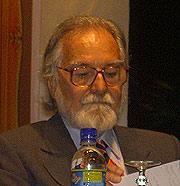
Thus the poorest sections of the Indian workforce have been subject to a series of injustices - the blinkered mentality which was prepared to tolerate the harsh iniquities of estate fragmentation (in the process ignoring the unequivocal findings of the government's own advisory committee headed by distinguished economist Professor Ungku Abdul Aziz, above ), the small minded and constrictive political opportunism which provoked the post May 13th citizenship crisis, the rigid and unimaginative implementation of the NEP which necessarily denied educational and employment opportunities to some of Malaysia's most impoverished citizens, and more recently the importation of a cheap foreign workforce which has kept the wages of estate workers below poverty levels.
 Nor as Tate demonstrates, has the continuing urbanisation of the Indian workforce lead to any major improvements in the situation of the working class Indians. Indeed, poverty among Indians may have actually worsened throughout the boom years of the Malaysian economic miracle.
It is frequently asserted that the Indian community has also been poorly served by its leadership, which is often accused of being weak, unimaginative, and more interested in self aggrandisement and the perquisites of high office than in devising political or economic strategies to improve Indian social mobility or at least mitigate Indian poverty.
However, Tate contends that while this argument might have some validity, and concedes that the MIC has indeed been seriously weakened by factionalism and the irruption of caste politics, the basic fact remains that the Indian community entered independence as a numerically insignificant minority and lacked either the political or economic resources available to the other communities, and thus, as a consequence, the reach and scope of Indian political parties has necessarily been circumscribed.
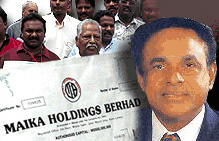
Similarly while much has been made of the failure of more recently established Indian cooperatives, and certainly mediocre management and poor investment strategies have weighed heavily upon the ill-fated Maika Holdings, it also needs to be noted that NEP and post-NEP imperatives prevented the cooperatives from pursuing potentially more profitable openings in the more promising and lucrative sectors of the economy.
Dismal history of Tamil medium schools
Many would echo Tate's conclusion that Indian expectations will never be met as long as the current communal based political structures endure.
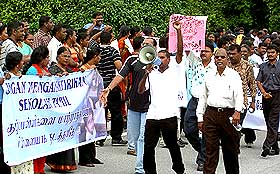 The final two chapters which trace the evolution of educational policies in Malaya/Malaysia, and their impact upon the Indian community, especially the Tamil educated, are the most closely researched of this book.
Tate traces the dismal history of Tamil medium schools in Malaya/Malaysia and recounts in depressing detail the lack of political will and the bureaucratic obfuscation and inertia which has militated against the creation of a vibrant Tamil medium school system.
He might have strengthened his argument by demonstrating how the supposed lack of parental interest in formal education for their children was often a product of the harsh reality of estate/workforce poverty. Under such circumstances the grim struggle for economic survival meant that children were required to contribute to the family income at the earliest opportunity.
This approach was tacitly encouraged by the colonial regime - as late at 1947, 7 year olds could be legally employed on estates, and an Ordinance passed that year merely raised the minimum age to 8 years with the accompanying decree that children under 12 years were restricted to light agricultural and horticultural work.
This stricture aside, Tate generally handles this subject well, highlighting the many handicaps faced by the Tamil medium sector, including internal weaknesses, lack of middle class Indian support, the absence of a secondary structure, and the seemingly intractable hurdles posed by an obstructive and unsympathetic bureaucracy.
The unexpectedly confident chapters which conclude this book do not mask its many and ultimately terminal deficiencies. In general The Malaysian Indians is a disappointing work, poorly organised, thinly researched and seemingly inchoate, which develops no generic narratives or sustained analysis.
Moreover its inaccuracies and omissions - especially the inexplicable neglect of religion - leave large areas of the Indian experience in Malaysia unexplored. While the latter chapters may provide scope for further research, overall the book represents the squandering of golden opportunity to produce a comprehensive and contemporary reference text which may have promoted debate and suggested policy initiatives.
But this authoritative work remains to be written.
DR CARL VADIVELLA BELLE lived in Malaysia for several years and has specialised in the study of Malaysian society and religion with special reference to Hinduism in Malaysia. He currently works as an independent scholar. The above book is published by Strategic Information Research Development Centre, Petaling Jaya, 2008.


