




Chinese schools produce calibre, not just copycats
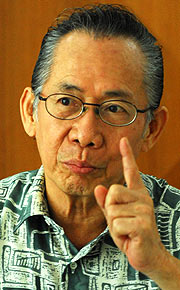
Professor Khoo Kay Kim's recent contention that the Chinese education system produces "copycats" through its rote-learning methods needs to be examined.
Professor Khoo Kay Kim's recent contention that the Chinese education system produces "copycats" through its rote-learning methods needs to be examined.
He challenges his detractors to refute his claim by asking how many scholars of world calibre the Chinese schools have produced and how many students from Chinese schools have obtained scholarships from the government.
His underlying motive is not clear - is he calling for Chinese schools to be closed down or to be improved?
Chinese schools in general or Malaysian Chinese schools?
In the first place, is Khoo saying that Malaysian Chinese schools produce copycats or that education in the Chinese language produces copycats? As an educationist, I am sure he knows the difference.
If he is saying that education in the Chinese-language produces copycats then he implies that the education systems in China, Taiwan and Hong Kong also produce copycats.
Do I then have to produce examples of Nobel Prize laureates from these Chinese-language countries to rebut his argument?
- Lee Tsung Dao (Physics, 1957)
- Yang Chen Ning (Physics 1957)
- C. C. Ting (Physics 1976)
- Lee Y. T. (Chemistry 1986)
- Edmond Fischer (Medicine 1992)
- Daniel Tsui (Physics 1998)
- Gao Xingjian (Literature 2000)
- Charles K. Kao (Physics 2009)
Perhaps Khoo (
left
) w
 ill protest and say he was only referring to Malaysian Chinese schools. But what's the difference? Is he saying that Chinese schools in China and Taiwan are not copycats? Surely the key issue revolves around the quality of education, not the medium of instruction.
The early curriculum of the Chinese schools in Malaysia, like their counterparts in China was based on rote-learning. But after the "Thought Revolution" of the May 4th movement in 1919, this was replaced by a modern curriculum in China as well as in the Chinese schools in Malaya. This situation was by no means perfect. How could it be?
As a historian, Khoo will no doubt be aware that while the English schools in Malaya were nurtured by the British colonial power, the Chinese schools were totally neglected. The Chinese schools in this country had to rely on self-help to survive in sharp contrast to the British-supported English schools.
Up to the present day, they still have to survive through the sacrifice of the community to support the 1280 Chinese primary schools and 60 independent Chinese secondary schools.
The earliest record of Chinese schools dates back to 1815 in Malacca (See Kua Kia Soong, "The Chinese Schools of Malaysia: A Protean Saga", New Era College 2008). The colonial government rationalised their lack of financial support for educating the Chinese masses in this way:
"British colonial administrators were so impressed by the high level of community organisation among the Malayan Chinese that they left them virtually alone to manage their own affairs." (Enloe, C.H. "Multi-ethnic politics: The case of Malaysia" quoted in Kua 2008: 16)
If Khoo cares to research the anti-colonial movement in Malaya, he will be aware that large sections of the anti-colonial movement were products of Chinese schools. Let us ask for the statistics on all the political detainees of the British colonial power from colonial times right up to independence and note the proportion of Chinese-educated anti-colonial fighters.
Khoo might say that wasn't what he was talking about. But as a nationalist, is not anti-colonialism, equality, justice, freedom and democracy as important as "creativity" and international scholarship?
English Schools or BM Schools?
The scholars of international renown cited by Khoo are almost all products of the colonial era, products of the elite schools in which the medium of instruction was English. Is that surprising?
We do not doubt that the students who have been educated in elite schools in Malaya and gone on to the Ivy League institutions have turned out to be luminaries in their fields. This is the case in every society where privilege prevails, whether in China, Russia, Saudi Arabia, Britain, US or wherever. It does not matter whether the medium of instruction is in English or Chinese or Malay.
 But what about the post-1971 generation when the medium of instruction was exclusively Malay?
Have we produced any scholars of international distinction, despite the existence of these traditional elite institutions?
If we haven't, then why are the national schools teaching in Malay also producing copycats? If not, why not? Why is Khoo only casting aspersions on the Chinese schools?
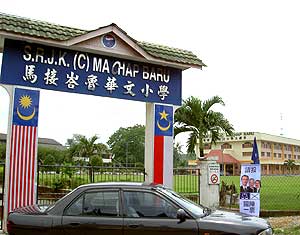
Khoo may not be aware that the Chinese schools in Malaysia (including the independent Chinese secondary schools) have been following the national curriculum ever since the 1961 Education Act. If the Chinese schools are producing copycats, then so are the national schools!
Chinese school kids getting national scholarships?
Prof Khoo shows his unfamiliarity with the national education policy and the Chinese school system when he challenges his detractors to show him how many Chinese school students have won national scholarships.
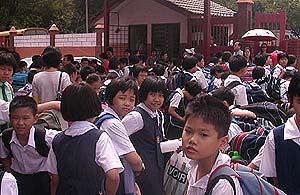
First, he must know that at least 90 percent of Chinese children go to (partially-assisted) Chinese primary schools but only 10 percent of these go on to independent Chinese secondary schools.
 Thus any Chinese student who wins a national scholarship is quite likely to be from a Chinese primary school background.
If too few Chinese students are getting national scholarships that is surely an issue for a Suhakam commissioner to answer!
On the other hand, if you ask why no student from the independent Chinese secondary schools has won a national scholarship, it is because of the simple reason the Malaysian government does not recognise their unified examination certificate!
The National University of Singapore has been poaching our students for years - at one time they wanted 1000 of our students a year. I suggest Khoo uses his influence to get the statistics from NUS to find out how many Malaysian Chinese school students have won NUS scholarships through the years.
Don't we recall the case of the prodigy from an independent Chinese secondary school in Seremban who was admitted to MIT with a scholarship in the 80s? There have been many other cases highlighted in the Chinese-language press.
We have a recent case of Pan Jian Cheng, the inventor of the thumbdrive, who is a product of an independent Chinese school in Klang and is now a very rich young entrepreneur in Taiwan.
There are numerous Nanyang University graduates who are luminaries in their academic fields in universities in Malaysia, Singapore and abroad. They are all products of our Chinese schools. My good friend and colleague, Tang Hai Chang, a product of Nanyang University was a research fellow in nuclear physics at the Rutherford Laboratories of Manchester University, UK in the 70s.
Our own son and daughter are graduates of the Chinese schools. Our daughter did not gain a national scholarship but she was awarded a UK National Health Service Bursary to study medicine. Like other Chinese school students, they are both fluent in Mandarin, English and BM. Our son is also conversant in French and Spanish and can banter in Tamil. Copycats they are not.
Excellence and mediocrity in Chinese schools
My rebuttal to Khoo by no means argues that the Chinese schools of Malaysia are all excellent. There is a vast diversity throughout West and East Malaysia - large and small Chinese schools, rich and poor, mediocre and excellent, depending on the locality, school committee, and awareness of the community. The problems they face stem from lack of state support for teacher training and insufficient schools resulting in gross overcrowding.
Their existence stems from the historical fact that the early Chinese Malayans - like their Malay and Indian counterparts - wanted education in their mother tongue. They have sustained the schools for nearly two hundred years, surely a feat all Malaysians can be proud of.
And when the government works out how much the Chinese community has subsidised the education budget since independence, they will realise that the bill runs into the billions of ringgit.
Then think of the contribution of our Chinese school graduates to the national human resources all these years. Foreign universities, including those in the West often acknowledge the positive values, such as discipline, eagerness to learn, selflessness that our Chinese school graduates impart into their campuses - how do we measure such qualities?
There have been efforts at education reform in the Chinese schools but this has surged and waned with the calibre in leadership of the Chinese education movement and limited resources. The present leadership of Dong Jiao Zong leaves much to be desired.
The point I want to stress is that despite the odds and gross discrimination in financial allocation and teacher training, the Chinese schools of Malaysia have survived a veritable "protean saga". Calling them copycats is an old 19th century story.
Let me end here with a snippet from old correspondence I received from the world-renowned writer, Han Suyin, dated 12 March 1983:
"...the English-educated (in Malaysia) were also the worst enemies of Nanyang University. They knew only English and fought to retain their supremacy through English, knowing well that the Chinese education in the Chinese medium was totally adequate and in some ways a better type of education than that dispensed by the English schools."
Well, that's her opinion.
KUA KIA SOONG , a former MP, was principal of the New Era College, Kajang. He is also a director of human rights group Suaram.


