




On a wing and a prayer
The trauma and grief of individuals and families after a fatal bus crash are long-lasting, but the public-outrage and official interest remain only for as long as the spotlight is on.
Anyone boarding an express bus does so with a feeling of trepidation. In the run-up to Chinese New Year, our roads will be at over-capacity, tempers will run high and boy-racers will make up for lost time.
Road users must wonder if they will reach their destination safely, if at all.
If the authorities are serious about restoring public confidence in road travel, they must change their work culture and focus on processes, relationship, management and leadership.
It is the statements of the various heads of transport departments that suggest our transport system exists on a wing and a prayer.
Why are we subjected to the ‘drip-drip' release of new regulations after a serious accident, when we also discover that previous recommendations were never fully implemented?
Why the frenzy of activity in the aftermath of a serious crash, with opportunistic photo calls of politicians visiting the injured in hospitals? All are unacceptable.
Where is the forward thinking, the initiation of safety programmes and the provision for open dialogue between employer, employee and transport agencies?
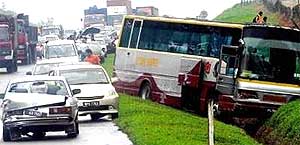 The roll-call, for bus tragedies, last decade is frightening: Kuala Lipis (December 2003 with 14 deaths), Nibong Tebal (July 2006, 12), Bukit Gantang (August 2007, 22), Jelapang toll (December 2007, 7), Slim River (January 2008, 3), Rawang (April 2009, 6), Ipoh (December 2009, 10)
Didn't we hope for each accident to be the last?
The director-general of the Malaysian Institute of Road Safety Research (Miros), Ahmad Farhan Sadullah said after the Ipoh crash: "Double-decker buses have different requirements. Only professional drivers should be allowed to handle it."
Compulsory centralised training, first proposed in 2005, was postponed indefinitely because our decision-makers pandered to the wishes of companies.
The Commercial Vehicle Licensing Board (CVLB) chairman Halimah Sadique wanted companies "to enhance its driver management system and adhere to the Code of Practice for Safety, Health and Environment".
Were companies knowingly practising dangerous work practices without being cautioned?
She added that "CLVB conducts random checks on companies to review working procedures and safety elements."
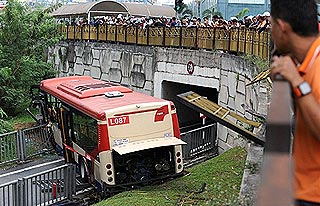 But they overlooked one important consideration - driver-related safety and health matters, such as aspects of his working environment which could contribute to crashes.
She is correct to say that it is not the CVLB's responsibility to act against errant drivers. Thus, the dereliction of duty by the Road Transport Department (RTD) and police is unacceptable.
Poor communication and interaction between the various transport agencies, which didn't perform or were unsure of their roles/responsibilities, must be addressed.
When the National Institute of Occupational Safety Health chairman, Lee Lam Thye said it was "high time drastic action was taken to curb the instances of fatal bus crashes and make safety training and defensive driving courses compulsory for bus operators", we wondered about the timing of his statements.
Shouldn't his agency, responsible for advising and supporting industries in safety and health campaigns, have demanded these recommendations years ago?
Bus-drivers underpaid and overworked
Meanwhile, Road Safety Department director-general Suret Singh said that he "hoped the incident should be a lesson to all express bus drivers".
His statement is highly irresponsible and reprehensible. The driver who fell asleep at the wheel was not the first, nor last, to do so. This serious matter didn't require an "I told you so" response.
The DG need only ask the simple question why? Why do our drivers suffer intense fatigue - to realise the magnitude of the problem.
Some bus drivers receive a basic monthly wage of RM500. The majority of transport employees are part-timers. Our bus-drivers are underpaid, overworked and lack training. Some are so stressed, they consume drugs.
This bus driver was probably trying to make ends meet, doing several trips or overtime shifts and foregoing sleep.
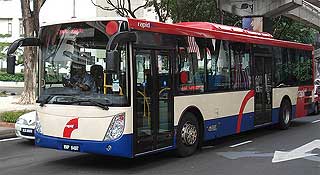 The debate about minimum pay and working conditions for bus-drivers should be resurrected. (Note: It has since been announced that the minimum pay for bus-drivers will be addressed in eight months time).
He might have noted that passengers in this, and previous, bus crashes were ejected from the vehicle. He could make seat-belt use in buses compulsory.
The crash barriers sliced through the bus like a hot knife through butter. He could re-examine the use of alternative materials for barrier construction.
Wire-rope barrier technology, used in Europe and Australia, which successfully cushions a vehicle's impact, and then safely redirects the vehicle, could replace traditional barriers.
We have all witnessed speeding buses, buses overtaking dangerously, driving erratically in bad weather, not indicating or bus-drivers who take risks using mobile phones while driving.
We have expressed fury at the highway authorities for inadequate signs, bad road conditions, terrible facilities, poor lighting or unsafe road work practices.
We bemoan the ineffective 'complaints system' for the public to report transport problems and abuses. Overall, the best response should incorporate two levels - personal and institutional.
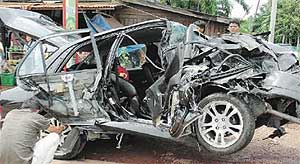 We need a zero tolerance to bad driving habits and inculcate good driving practices.
The deterrent should be a severe punishment comprising individual fines, penalty points, revoking of licenses (personal and company) or incarceration.
Company directors could be fined and jailed for the failure of their employees/company to comply with the law. Companies could be made to cease operations. Agency heads and politicians need to seriously reconsider their positions at their failure to implement rules.
Time, money and good management are necessary before any improvements can take effect. There will never be a 100% safe transport system but much can be done to minimise the dangers, through a comprehensive and tough education, training and development regime.
Should we compel our politicians to travel in long distance buses for their out-of-town work, instead of their luxurious chauffeur driven cars, to focus on a solution? Possibly.
We don't want a quick fix. We want recommendations to be strictly implemented and enforced. We want each transport agency to do its duty. Only strong political will and leadership can improve our transportation problems.
That is the least we owe the crash victims.


Are you sure you want to delete this comment?
This action cannot be undone.