




Mission: Film literacy
When I first saw ‘The Wizard of Oz’, it made a writer out of me. Salman Rushdie
Malaysians consume a varied diet of films, from thrillers, comedies, classics, history and science fiction to romance. Such is the stuff of popular culture.
When I first saw ‘The Wizard of Oz’, it made a writer out of me. Salman Rushdie
Malaysians consume a varied diet of films, from thrillers, comedies, classics, history and science fiction to romance. Such is the stuff of popular culture.
Years ago I attended a course in Bangkok on use of audio-visuals for education and advocacy. I was inspired by the idea of using films as a tool for consumer and environmental education. However, my proposal did not get many supporters as making such films would be costly and would require government permission to be aired over national TV or distributed to schools.
Last September I met Nick Deocampo whose works have rekindled my interest in films as tools for knowledge and social transformation. Decampo, a Filipino, is a filmmaker, writer, film teacher and historian.
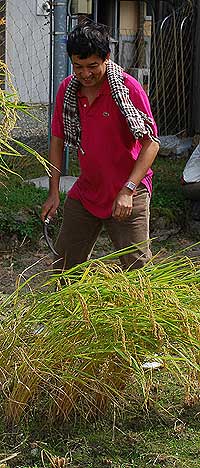 I was able to capture glimpses of Deocampo’s passion for making films during the two weeks we were in the mountainous areas of Biwako in Japan, as part of a team in a regional project on human-eclogical balance. He is making a film on the five-country project of Nippon Foundation.
At the end of each day, Nick would edit his shots on his laptop in a corner of the sitting area, demonstrating the immense possibilities of technology.
This multi-talented Deocampo, who is passionate about making and watching films, has made ‘film literacy’ his mission. A pioneer in organising independent film festivals in the Philippines, he has seen the potential for education through cinema, particularly Filipino films.
‘Film literacy’ is the act of acquiring knowledge and values through the use of movies. Short films, documentaries, feature films, animation , digital video, television programmes and interactive media promote literacy .
For 20 years, Deocampo has travelled across the Philippine archipelago to bring films to students in the remotest areas. The experience, he said, has made him think about how motion pictures can serve as a tool for learning.
‘SineGabay, A Film Study Guide’ by Deocampo, is a teaching manual on film literacy. It focuses on the subjects of independent cinema, Filipino film history and early cinema in Asia. Each module gives a synoposis of a specific film, and raises questions on universal themes and issues like freedom, oppression, horrors of war, sexuality, religion and gender. Films are classified for audience suitability.
“To be film literate is to be able to use media for personal or social development rather than to be merely used or manipulated by media,” Deocampo said in ‘SineGabay’.
About film literacy
We can all acquire film literacy which will enable us to critically evaluate media content, forms and functions. When we learn to read a book, we decipher letters. When ‘reading’ a film, we decipher moving pictures and sounds and we look for meanings in the images and sounds.
 The study of film literacy “begins with an understanding that film consists of moving pictures. Film combines sight and sound to produce an experience that brings close to a lived reality. This verisimilitude ought not to preclude our notion that persons and events we see on film start and end through our imagination; while things do really happen in the actual world,” says the introduction in ‘SineGabay’.
We take films or the moving picture medium for granted as technology enables us to view films from around the globe in our living rooms. Being film literate helps us to become aware of the symbolic images, sounds and manipulation produced and delivered through technology.
The function of films like most audio visual materials is to communicate. When we watch a film we look for meanings in the images and sounds we see and hear. So films can be understood by many including those without formal schooling.
Such is the power of films that they can be manipulated by those who have control over what you watch and hear.
Cinematic authorship enables the film director to accomplish more than the literary script. How often we have heard comments like, ‘The film is better than the book’ (if the story is based on a book). The director uses cinematic elements like sound, music, lighting, costumes, design of sets and make up to produce meanings in films.
Film literacy enables us to understand how even the use of language and movement in space is significant and has contextual relevance. Placement of actions matter in films. When in a movie, colonisers push natives to the background or an occupying country places its flag in the centre on the screen, the message is clear. The flag is endowed with authority and superiority.
Film literacy can help us analyse issues like discrimination, marginalisation, hegemony, poverty and corruption. One of my favourite films is ‘The Constant Gardener’ which shows the devastating effects of corruption on a country’s healthcare system.
P Ramlee movies
A film literacy programme for Malaysia should start with a manual about the films of iconic performer P Ramlee. He was an actor, director, composer and singer par excellence. Five of his 66 films won Asian awards in an era when Malaysia was not on the global map, as the Twin Towers had yet to be built and there were no political dramas being fought out in court.
The P Ramlee films are still watched by young Malaysians. Astro, Malaysia’s pay-TV station, bought the rights to 43 of his films from Shaw Brothers. Astro took them out of the dusty warehouses and digitalised the films to enable generations of Malaysians to enjoy evergreen movies.
 Many of Ramlee's
(left)
films have social messages and are relevant to nation building and the 1Malaysia concept. The films capture issues related to politics, liberalism, diversity and culture, among others, in the context of Malaysia.
Many of Ramlee's
(left)
films have social messages and are relevant to nation building and the 1Malaysia concept. The films capture issues related to politics, liberalism, diversity and culture, among others, in the context of Malaysia.
For example, ‘Penarek Becha’ (The Trishaw Rider) and ‘Antara Dua Darjat’ (Between Two Classes) are political movies. ‘Madu Tiga’ (Three Wives) captures the challenges of polygamy.
Malaysia’s independent film movement can play an important role in developing film literacy programmes, just as Deocampo has done in the Philippines. The annual Freedom Film Fest is an important contributor to film literacy in this country.
In the digital age we are not mere film consumers. We learn skills to operate electronic gadgets like the DVD player, projector or a camera to produce films. Everyone can fly, says a budget airline operator. Film teachers like Deocampo can teach everyone to become film producers.
“Film should no longer be in the hands of artists. As (it is) a medium for communication and education, scientists, economists, writers, sociologists, parents, farmers, elderly, the poor and marginalised must have access to the motion picture medium in order to derive, produce and spread knowledge,” said Deocampo.
With knowledge and information, we can counter media manipulation.
JOSIE M FERNANDEZ is currently an Asian Public Intellectual Fellow, director of Philanthropy Asia, researcher and engages with Transparency International Malaysia in anti-corruption measures. An educationist, Josie moved on to citizen's advocacy as founder president of ERA Consumers and regional director (Asia Pacific) for Consumers International.
She holds a masters degree in development management from the Asian Institute of Management, Philippines. Working on sustainability, philanthropy and anti-corruption actions are some of her current passions besides writing.


Are you sure you want to delete this comment?
This action cannot be undone.