




Experts who control thought, speech
On March 30, Dr Wan Azhar Wan Ahmad, a senior fellow/director of Insitute for Islamic Understanding, Malaysia, wrote a column in Star, headlined ‘Let religion be the business of the experts’.
In it, he vented his anger and stated that only experts such as himself are qualified to engage in any religious discussion.
My colleagues who are true Islamic scholars, scoff at him and his pronouncements.
On March 30, Dr Wan Azhar Wan Ahmad, a senior fellow/director of Insitute for Islamic Understanding, Malaysia, wrote a column in Star, headlined ‘Let religion be the business of the experts’.
In it, he vented his anger and stated that only experts such as himself are qualified to engage in any religious discussion.
My colleagues who are true Islamic scholars, scoff at him and his pronouncements.
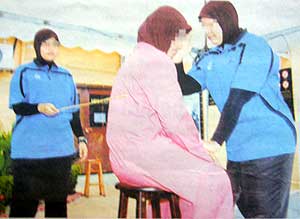 Malaysians had rightly condemned the recent whipping of three women for alleged illicit sex. However, Wan Azhar termed these concerned people as prejudiced, in denial and obstinate.
He was incensed that Muslims had dared to challenge the punishment because (a) these three women themselves ‘had no qualms’ about being whipped, and (b) the Muslims who protested had an “inadequate Islamic upbringing, resulting in confusion and ignorance”.
For a self-professed expert, he seems very small-minded when it comes to intellectual discourse. Why doesn’t he just say that anyone who disagrees with him is wrong, is a kaffir and is doomed to spend eternity in hell-fire? When he can’t convince, he makes personal attacks by calling into question people’s upbringing.
Is this the official line of retort to dissenting voices? He does not hesitate when attacking Muslim parents’ failure to raise their offspring as true, unquestioning, Muslims. When SIS protested, its director was publicly named and shamed in the Friday sermons throughout Selangor.
Wan Azhar conveniently forgets that Malaysians were only informed of the whipping of the three women weeks after the punishment - which amounts to deceitful behaviour.
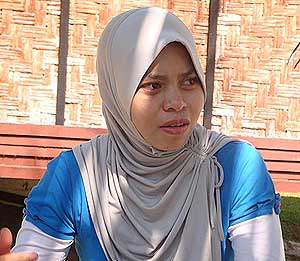 Did the government imagine this was no big deal? Did it delay the release of information because it feared a backlash more forceful than in the case of Kartika Sari Dewi Shukarno
(left)
.
Did the government imagine this was no big deal? Did it delay the release of information because it feared a backlash more forceful than in the case of Kartika Sari Dewi Shukarno
(left)
.
The girls, we are told, accepted their punishment. There is no independent verification of this. Who were their lawyers? Were they coerced? When the news broke, the adulterous men were not even mentioned.
In fact, we were not told of the involvement or whipping of four men until much later. Three women and four men? Was this a ménage-a-trois or an orgy?
Wan Azhar seems oblivious to the fact that we were protesting because the punishment goes against Malaysian civil law which clearly prohibits the whipping of women. Why the secrecy? Why were they whipped especially when Kartika’s whipping was being debated?
If Wan Azhar had reread our protests, he would have seen that no one was going against Quranic teachings. They merely disagreed with the interpretations of some of the self-proclaimed Syariah law experts. In some Islamic countries, adulterers are stoned, and thieves have their hands amputated. But thankfully, not in Malaysia. So which interpretation is correct?
Consequence of blind faith
What is an expert? Who qualifies as an expert? Is he skilled as judged by his peers or the public? Has he extensive knowledge based on research or a particular area of study? Even experts can disagree on their respective subjects.
Someone can become expert after prolonged experience through practice in specific fields, and therefore it is unnecessary for an individual to have professional or academic qualifications to be accepted as an expert by consensus. I know a brilliant horse-whisperer who has no academic or professional qualifications but whose skills are valued worldwide.
 Wan Azhar said people will not dare challenge any registered lawyer, accountant, engineer or architect. He is wrong. People do. The medical profession welcomes informed patients who demand a second opinion.
People frequently lodge complaints with the Bar Council if they are dissatisfied with the services of their solicitor. There are registered bodies for all accredited professions, so the public can lodge protests or register grievances.
Wan Azhar said our nation is blessed with many educated people who lack wisdom and do not know their limit. Conversely, Malaysia has ‘experts’ who bristle at the thought of being questioned or challenged; they demand absolute control.
A true expert has an open mind, asks questions and is not averse to suggestions and possibilities. People will recall the fool who once said that ‘computers are always right’. Don’t humans input the data into computers and aren't humans prone to error?
Contrary to Wan Azhar’s belief, concerned Malaysians do not wish to intrude upon or belittle any religion. But as concerned humans, they will speak out against any injustice. Should we keep silent when two 10-year-old girls are married off to men in their forties? A 10-year-old is a child and not some man’s plaything or child-bearing machine.
Recently, a 15-year-old from Langkawi Island eloped. Why should the Syariah Court give permission for this girl to marry when her mother is against it? Do we condone the Syariah Court for taking over the role of parent? And who will protect the girl if her husband leaves her to remarry? Haven’t we enough families without a solid family or financial structure?
A girl of 10 or 15 coaxed into marriage is denied an education and opens herself to abuse, a life of drudgery and low health expectations. If women cannot be empowered, how are they going to make a useful contribution to their families and their community? They are condemned to a life of wasted opportunities and abject poverty.
In his concluding paragraph, Wan Azhar contends that religion is open to human interpretation, but not by anybody. He claims that only learned people like him can engage in religious discussion.
 We know that Islam invites its followers to exercise their intellect and utilise their knowledge (
'ilm
), whilst embracing socio-political and moral aspects, to attain the ultimate truth (
haqq
). Muslim thinkers adopted different paths to attain this goal. Knowledge is not mere information.
We know that Islam invites its followers to exercise their intellect and utilise their knowledge (
'ilm
), whilst embracing socio-political and moral aspects, to attain the ultimate truth (
haqq
). Muslim thinkers adopted different paths to attain this goal. Knowledge is not mere information.
Thus, Wan Azhar forgets that Islam never maintained that only theology is useful and the empirical sciences useless or harmful. His concept is similar to the ones commonly adopted by semi-literate clerics or by the time servers among them who want to keep common Muslims in the darkness of ignorance and blind faith so that they are not be able to oppose unjust rule and resist the clerics.
It is this blind faith that resulted in the decline of Muslims in politics and the economy. Today, in large segments of Muslim society, both the common man and many clerics suffer from this malady.
This unhealthy attitude, which is opposed to the acquisition of knowledge, has resulted in some movements, which considered elementary books of theology as sufficient for a Muslim, and discouraged the assimilation or dissemination of empirical knowledge as leading to the weakening of faith.
It is significant that Wan Azhar wrote that ‘Islamic law does not differentiate between male and female offenders’. So why can he not apply this equality of the sexes to responsibly promote fair Syariah laws by the inclusion of women in policy decision making?
Women make the greatest advocates for progressive, anti-extremist agendas. Ignoring their solutions would be an unfortunate mistake. If policy makers address the barriers to women’s participation in matters of public discourse, they would soon open a new space for moderate voices. Alas, some experts are silent on this.
MARIAM MOKHTAR is a non-conformist traditionalist from Perak, a bucket chemist and an armchair eco-warrior. In ‘real-speak’, it means she is from Ipoh, values change but respects culture, is a petroleum chemist and also an environmental pollution-control scientist.


