




Israel and M'sia: Ethnocracies par excellence
Israel-bashing is fashionable across the Muslim world. Here in Malaysia, Umno politicians relish in projecting themselves as champions of the Palestinian cause.
Mahathir Mohamad, for one, still goes around the world preaching against the oppression of the Palestinians, while turning a blind eye to the years of gross negligence committed against the Indian and the Orang Asli communities in Malaysia under his watch.
Israel-bashing is fashionable across the Muslim world. Here in Malaysia, Umno politicians relish in projecting themselves as champions of the Palestinian cause.
Dr Mahathir Mohamad, for one, still goes around the world preaching against the oppression of the Palestinians, while turning a blind eye to the years of gross negligence committed against the Indian and the Orang Asli communities in Malaysia under his watch.
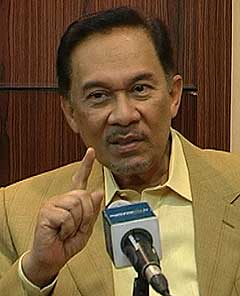
Lately, Pakatan Rakyat has been turning up the heat on Umno, seeking earnestly to cast aspersion on the Malay party with alleged Israeli links: ‘1Malaysia' having its origins in ‘One Israel', Apco Worldwide, an international consultancy firm, working for Tel Aviv, and the bombshell by Anwar Ibrahim (left) that Bukit Aman was infiltrated by Israeli intelligence.
I leave it to the parties involved to substantiate or refute all these claims. But there is one very important similarity between Israel and Malaysia that many on both sides of the political divide are not quite aware of, and it is that Umno, like the Jewish state, represents an ethnocratic regime through and through.
 Oren Yiftachel, a Jewish scholar at the Ben-Gurion University of the Negev, contends that "ethnicity is often constructed as a tool of oppression by ethno-national majorities", which appropriate "the state apparatus to advance its control over a contested territory and power apparatus". In the case of Israel, the successive ruling elites since 1948 have been at pains to create an ethnocratic regime at the expense of the Palestinians.
Hence, the immediate task of an ethnocracy is to design a concerted and collective project of exerting ethnonational control over a territory that is perceived to be the nation's homeland. Meanwhile, a corresponding discourse is put in place to justify the ethnicization of the territory and political space.
With this in mind, Israel declares that the new state is "open for Jewish immigration and for the ingathering of the exiles".
In an ethnocracy, distribution of power and resources is based on ethnic affiliation, rather than citizenship. Moreover, privileges in the areas of the economy, education and culture are granted to the major ethnic group with a view to securing an absolute control of the state and territory.
As an ethnocracy, Malaysia bears strong resemblance to Israel. A piece by Geoff Wade of the Australian National University, entitled The Origins and Evolution of Ethnocracy in Malaysia, provides a rather comprehensive picture on the root causes of Malaysia's contemporary conundrum.
Attempts by Umno
Over the years, various attempts have been made by Umno to destroy the independence of the judiciary, expand executive powers, and suppress the legislature through gerrymandering and weakening the role of Parliament/state assemblies, all for the purpose of ethnic dominance.
This aside, the ideas of Ketuanan Melayu and Tanah Melayu are there to provide the process with a "theoretical" basis, the fact that they do not appeal to Sabah and Sarawak is irrelevant.
Ethnocracy is neither democratic nor authoritarian, but often swings between the two. Malaysia is blessed with regular elections and boasts one of the most vibrant political competitions in the region, but all this did not stop the state from enacting draconian laws as deterrence so that any open challenge to the "historical consensus" is kept to a minimum, if not nipped in the bud.
Umno leaders of the early years well understood that an ethnocratic regime could be risky and fragile, so they opted for coalition in the form of the Alliance and latterly Barisan Nasional, thereby justifying the ethnonational agenda.
Still, the Malay party was least willing to see its arrangements disrupted by these non-Malay parties, hence the absence of public debate among them. But the so-called power-sharing formula is nothing more than a convenient fig leaf to cover up the home truth that the coalition partners are in government but not in power.
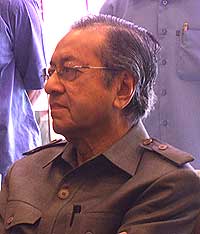 And it was Mahathir
(right)
who turned Umno into an extreme ethno-centric party by mobilising ethno-centric discourse in full force, repeatedly arguing that the future existence of the Malay race was threatened. Later, he upped the ante and resorted to religion - yet another major feature of an ethnocracy - when faced with the intense competition from Pas.
And it was Mahathir
(right)
who turned Umno into an extreme ethno-centric party by mobilising ethno-centric discourse in full force, repeatedly arguing that the future existence of the Malay race was threatened. Later, he upped the ante and resorted to religion - yet another major feature of an ethnocracy - when faced with the intense competition from Pas.
Mahathir's iron rule led to pervasive fear and ‘White Terror' ensued. Thanks to the decade of economic prosperity, the public was numb to all the injustices and the latent ethno-religious conflict. Abdullah Ahmad Badawi's inability to harness the powerful state apparatus and rein in the bloated bureaucracy, coupled with his failure to produce another "economic miracle" eventually gave rise to a relatively liberal environment in which various groups were competing to vent their anger and frustrations, paving the way for the political tsunami of March 2008.
But Umno is bent on blaming it on others, so it continues to heighten the sense of crisis among the Malays. A grand national debate is either missing or descends into a farce, while politicians race to prioritize their identity, as both Muhyddin Yassin and Lim Kit Siang have hilariously demonstrated.
The ethnocratic regime in Malaysia seriously distorts our value system in that the public are unable to tell right from wrong. So long as power is concentrated in the hands of the dominant community, it no longer matters if the country's political system is based on a set of objective, equitable and transparent rules. Under the Umno-led ethnocracy, one's "ultimate values" lie in his/her ethnic affiliation, rather than the pursuit of democracy, justice and a highly professional and disciplined police force.
Defenders of ethnocracy?
Therefore, a Malay voting for the opposition is branded a traitor to the Malay race, while the non-Malay rooting for Pakatan is portrayed as a threat to Malay dominance. Once the regime starts to disintegrate, clowns like Ibrahim Ali and Ahmad Ismail jump on the stage to declare themselves as defenders of ethnocracy.
Of greater danger is the strengthening of racial prejudice under an ethnocracy. Teo Beng Hock was a victim of institutional torture, but many Chinese Malaysians tend to see the tragedy as reflective of their own position in the country. One does not see much empathy or sympathy on the part of Chinese for Malays or Muslims who have similarly been wronged by the state. In the same vein, a non-Malay criticizes the police over corruption and violence at the risk of being accused of smearing the Malay-dominant public service.
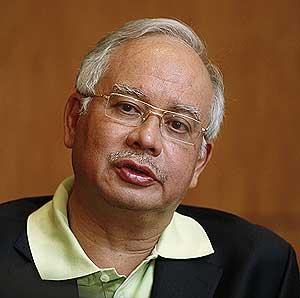 Last week, Najib Abdul Razak
(left)
marked his first anniversary as prime minister with series of TV interviews, but I know a couple of journalists who were scheduled to interview him were told to give way to their Malay colleagues. So much for ‘1Malaysia'!
Last week, Najib Abdul Razak
(left)
marked his first anniversary as prime minister with series of TV interviews, but I know a couple of journalists who were scheduled to interview him were told to give way to their Malay colleagues. So much for ‘1Malaysia'!
It also shows that all that Najib is interested in is apple-polishing and spin-doctoring. Despite his relatively stronger command of public issues compared to his immediate predecessor, Najib has no desire to alter the ethnocratic nature of Malaysia. After all, he was the one behind the coup in Perak so that Umno could continue to monopolize all the resources in the state!
Najib clearly hopes his Government Transformation Plan will upgrade Malaysia to become a high-income economy by 2020. His cabinet has also agreed to a special inter-faith committee to promote religious understanding and harmony.
Be warned: so long as the state remains ethnocratic and ethno-centric, there will never be real understanding and genuine cordiality among races. Until and unless Najib unveils concrete plans to reform Malaysia's political system root and branch, we may still end up where we have been the last 52 years: enjoying the feast next to a volcano.
JOSH HONG studied politics at London Metropolitan University and the School of Oriental and African Studies, University of London. A keen watcher of domestic and international politics, he longs for a day when Malaysians will learn and master the art of self-mockery, and enjoy life to the full in spite of politicians.


