




Wrong time, wrong place, right connections
Some entertainment outlets in Kuala Lumpur are raided frequently, yet others escape attention. Many of us believe that raids on well-known clubs and bars, frequented by artistes or the sons and daughters of politicians or the rich and famous, are avoided.
Some entertainment outlets in Kuala Lumpur are raided frequently, yet others escape attention. Many of us believe that raids on well-known clubs and bars, frequented by artistes or the sons and daughters of politicians or the rich and famous, are avoided.
The police and religious authorities are accused of double standards because the less well-off and ‘nobodies’ are caught whilst the big fish escape censure. The reasons for a raid are not necessarily clear. A lot is apparently at stake and sometimes one department is pitting its wits and authority against another.
Last July, Kartika Dewi, a model and minor celebrity, was caught drinking beer in public. It is alleged that someone, possibly a worker or a patron of the place, saw her drinking and lodged a complaint. A raid was organised. When caught, she challenged the ruling. Her contention was that if the law applied to her, the well-known drinking antics of a minister’s son, should not be allowed to go unpunished.
 She stuck rigidly to her principles and was punished. The religious authorities’ poor handling of the case descended into a publicity nightmare. Kartika was in the wrong place at the wrong time. Had she been well-connected, none of this would have happened.
Despite the claim that the more famous clubs in KL are never raided, this is incorrect. They are! Random checks are done, and sometimes, raids happen twice in a weekend; recently, it was once on a Friday night and again the following Sunday night.
Just like in Kartika’s case, raids are conducted because to be seen doing nothing, is unacceptable. When a complaint is lodged, a raid transpires. The difference is what ‘operating procedures’ are involved - meaning finding out whose son or daughter is at the club - during a raid.
The higher up the parent falls in the political or social hierarchy, then the less likely the raid will produce results. Sadly, our law-enforcers are beholden to our law-makers, the upper-crust of society and royalty. A police flunkey may want to flex his law-enforcing muscles but will be demoted or transferred to a distant posting were he to apprehend the offspring of a ‘titled’ person. Publicity must be avoided at all costs.
Dancing goes hand-in-hand
The night life of KL is dominated by clubbing, lounge-drinking and shisha-bars. The majority who go clubbing are Malay, with Heritage Row in the heart of Kuala Lumpur being the obvious choice. Some clubs have a predominantly Malay clientele, like Zouk or Space, whilst Indians frequent Mist in Bangsar. All have a minimum age requirement and are open till 3 am. The dress code is smart casual.
Shisha-bars like Rasta in Taman Tun Dr Ismail can remain open till 4 am and cater to the Muslim crowd. In these, sweet fragrant smoke fills the air, music plays in the background and Middle Eastern food is served. The attraction of shisha is the communal activity of smoking through a pipe. A few typical bars which serve alcohol have now started having shisha.
The Chinese usually like to sit and listen to music at the lounges. A favourite haunt is the Sultan Lounge at the Mandarin Oriental. One normally has to be smartly dressed, ie, no Polo T-shirts or trainers. It is twice as expensive to drink in a lounge.
 When clubbing, dancing goes hand-in-hand with drinking. Although drinking is prohibited in Islam, this personal choice is a very public crime and punishable by law in Malaysia.
But Malays who are regular clubbers are not afraid of being caught. They are aware that being the children of ‘somebody’, or being artistes themselves, is protection enough.
These children simply present themselves at the entrance to the club, are recognised by the bouncers and allowed in without paying the cover-charge (RM40). Although only those above 18 years are allowed, any under-aged girl need only dress sexily - mini-skirt, hot-pants, or something revealing, to be admitted.
The under-aged daughter of one politician, who is accompanied by her two body-guards, is usually waved in by the bouncers. Some under-aged patrons without body-guards sometimes resort to showing fake identity cards. It is also alleged that some parents believe their children to be at a friend's house for a sleep-over for group study.
Entering without paying the cover-charge is easy when you know how. One club allows people in when patrons say they are friends of a famous sportsman, a Datuk.
In most cases, paying for a bottle of spirits means the cover-charge is waived for the buyer’s friends. Four or five people are admitted for a bottle of Jack Daniel’s costing about RM300, or a bottle of Johnnie Walker Black Label or Chivas Regal. The teenage son of one restaurant chain owner frequently buys six of these one litre bottles for his party of around 20 people.
Fame has its downside
Raids do happen, but they are ‘controlled’. There are informers and also look-outs who operate outside the clubs. Just as in racing and gambling, informers within the police, will telephone and notify of an impending raid.
Otherwise, when the police turn up at the entrance, they will be engaged in conversation with the bouncers. These establishments are legitimate businesses, abhor interference, and usually the events manager or club owner will prepare a sweetener of around RM5,000 to ‘settle’ things.
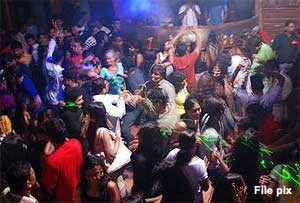 During the duration of this conversation, for 10 to 15 minutes, the lights in the club are switched on and off, in quick succession, as a warning and are then left on permanently so that the path to the back doors are well lit for the Malay patrons to filter out quickly. When the authorities finally enter, the remaining clubbers are non-Malays or foreigners. The usual checks proceed and those under-aged ones, foolish enough to remain, are caught.
In one rare case, an unannounced raid was conducted, with insufficient time for the escape of the children of high-profile Malays, who were then herded into waiting trucks. Their parents intervened and gave the police hell. The others who were also caught were relieved to be released without any charges.
The money and attention that comes with fame are all very well. But fame, has its downside. In Malaysia, fame is a weapon that divides the country. The well-connected and powerful people are protected.
Those who abuse the system indignantly claim they provide jobs with businesses and services to our entertainment industry. That may be so, but it is the hypocrisy and double-standards with which law-enforcement and justice are meted out that is outrageous. It is this iniquity which rankles the man-in-the-street.
We are disgusted by the same people who claim the moral high ground and chastise us but who condone the same sins in their family.
MARIAM MOKHTAR is a non-conformist traditionalist from Perak, a bucket chemist and an armchair eco-warrior. In ‘real–speak’, this translates into that she comes from Ipoh, values change but respects culture, is a petroleum chemist and also an environmental pollution-control scientist.


