




Religion and politics in Malaysia
A new book by the London-based political scientist Eric P Kaufmann, entitled ‘Shall the Religious Inherit the Earth? ' , barely three months ago stirred up some very interesting debate in the UK. It became a subject of instant media attention and shouts of alarm by many who had read it.
A new book by the London-based political scientist Eric P Kaufmann, entitled ‘Shall the Religious Inherit the Earth? ' , barely three months ago stirred up some very interesting debates in the UK. It became a subject of instant media attention and shouts of alarm by many who had read it.
Kaufmann begins the book by alerting that secularism - both public and private - is in crisis, attested to by the growing influence of the most fundamental adherents to Abrahamic faiths in the West's political realm.
Yes, the paramount concern of the author is not the Muslim world, but Europe and North America, alongside the ultra-Orthodox Jews that threaten the future of Israel. (The Jewish state now spends more public monies on safeguarding the Jewish faith than ever before.)
 In the US, the Christian Right movement has come to dominate public issues, forcing both the Republicans and the Democrats to take their strong religious views into consideration. Kaufmann notes that George W Bush (
right
) was re-elected in 2004 because the majority of Christians - Protestant and Catholic alike - were aghast at John Kerry's support for abortion plus other seemingly secular agenda of his, despite that the Democratic candidate is himself a Catholic.
In the US, the Christian Right movement has come to dominate public issues, forcing both the Republicans and the Democrats to take their strong religious views into consideration. Kaufmann notes that George W Bush (
right
) was re-elected in 2004 because the majority of Christians - Protestant and Catholic alike - were aghast at John Kerry's support for abortion plus other seemingly secular agenda of his, despite that the Democratic candidate is himself a Catholic.
As far as Europe is concerned, Kaufmann sees no immediate threat of the continent sleepwalking into Eurabia . In a worst-case scenario, he foresees Muslims to make up no more than 8 per cent of Europe's population.
So, what Kaufmann really argues is that the ultra-orthodox groups within the Abrahamic faiths, ie. Christianity, Islam and Judaism, have been responding to the waves of secularism over the last few decades by giving birth to more children, and by raising them in accordance with their respective religious teachings. He suggests new political alliances will emerge in Europe at some point that will "set the stage for a new era of religious politics , an unprecedented European desecularisation".
The book has since come under much criticism for its generalisations and reductionistic approach, but the scholar of 'ultra-secularist' background defends his theory by saying it is time for some real debate on the future of secular politics.
Apolitical religions
Religion and politics are touchy issues. In Malaysia, they are so closely linked that most government policies are tinged with religious fervour. Strange, that other than Islam, nearly all other religions in this country are apolitical still.
I mean, they are not de-politicised, for politicians of various persuasions, the ruling coalition especially, court them enthusiastically. But the followers of these faiths - Buddhism, Hinduism, Christianity, Sikhism etc., are generally conspicuously silent before injustice, corruption and abuse of power.
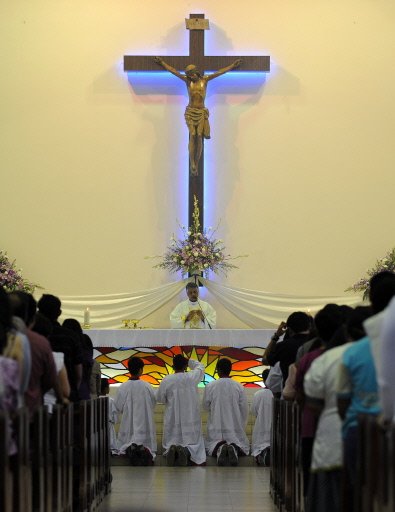 As far as Malaysian churches are concerned, they are largely evangelistic, the myriad denominations notwithstanding. Their work is predominantly geared towards doctrinal teaching and preaching the gospel. While social concern has become a core part of the mission, Christian communities continue to be perceived as an "inward-looking churches".
In fact, churches in Malaya, Singapore, Sarawak and North Borneo have historically been apolitical in nature. At the height of imperialism, various churches in Europe and North America sent missionaries to all corners of the world for the proselytising purposes. Some indeed saw this as mission civilisatrice, more seized the opportunity to build hospitals and vernacular schools so that the gospel would be widely accepted.
The British colonial authorities discouraged political activism on the part of religious bodies for the sake of stability, while churches - then mostly headed by westerners - living in a foreign land and among the "pagans" too chose to shun politics in order to develop and consolidate religious, medical and educational work.
The colonial administration acted in some way as the guardian for churches in pre-independence Malaysia. Post-1957/1963, the then Alliance government (and the MCA in particular) turned out to be the "natural" partner for Christian communities now that the country was confronted with communist insurgency, the widening influence of the Islamic party PAS east and north of the Peninsula and, more importantly, the departure of the erstwhile suzerain.
Draconian laws
In the aftermath of the bloody May 13 incident in 1963, the Alliance/BN government introduced a series of draconian laws to pre-empt questioning on Umno's ultra-Malay agenda. With racial and religious issues banned from public discussion, Christian communities as a minority group in a Muslim-dominant nation were made to exercise greater caution, resulting in political apathy and even ignorance.
Most of all, an alternative political group that could counter-balance the Alliance and the latterly BN was missing, making it possible for the government to become a dominant force in the distribution of national resources and policymaking. A cordial relationship with the BN is therefore vitally important in ensuring the "survival" of Christian communities. Resistance was never in the church's dictionary even during the colonial era.
To be fair, this phenomenon is not confined to Christianity only. Apart from Islam (and Christian bumiputeras in Sabah to some extent), whose believers are split between Umno and PAS, all other major religions in Malaysia are "beholden" to the ruling coalition.
 For instance, successive MCA leaders - such as Ong Ka Ting (
left
), Ong Ka Chuan, Tan Chai Ho and Ong Tee Kiat - in recent years consciously highlighted their Buddhist background so as to strengthen their "credentials" to represent the Chinese community, as if this act could resolve the constitutional crisis triggered by Mahathir's arbitrary declaration of Malaysia as an Islamic state!
For instance, successive MCA leaders - such as Ong Ka Ting (
left
), Ong Ka Chuan, Tan Chai Ho and Ong Tee Kiat - in recent years consciously highlighted their Buddhist background so as to strengthen their "credentials" to represent the Chinese community, as if this act could resolve the constitutional crisis triggered by Mahathir's arbitrary declaration of Malaysia as an Islamic state!
"Minority mentality"
It is this "minority mentality" that compels Christians - and adherents of other religions too - to become muted. As demography moves more in favour of the Muslim community, and the country becomes outwardly Islamic, misgivings of the non-Muslims are often felt but not publicly expressed for fear that it too could incur serious political implications.
Such acquiescence also blinds the Christians to fundamental truths. When people speak out against the acceptance of government allocations by church leaders during electoral campaign, others call on the critics not to "cast the first stone".
Yet since the timing and the manner in which this was done were clearly illegal and politically-motivated, would the church not be perceived as condoning bribery?
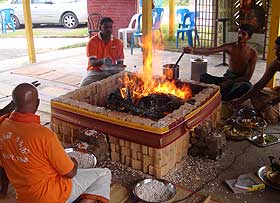 Being a minority does not mean Christians (and other weak communities including downtrodden Muslims) have to live a submissive and passive life among the majority. One only safeguards one's own dignity and honour by being brave to resist temptation when necessary.
Kaufmann's employment of demography to portray a future populated by the religious is no doubt provocative, but our concerns are poles apart. He is wary of greater role assumed by religious orthodoxies, I am despondent at the political inertia of the religious communities in Malaysia.
To me, the time has come for us to ponder hard on how non-Muslims should conduct themselves politically in an increasingly Islamised country.
If we dare not stand the ground from the relative strength of today, I cannot imagine a future in which the Christian church - in a much weaker position - will be bold enough to act justly.
I simply do not believe stronger religiousness begets greater judiciousness. Period.
JOSH HONG studied politics at London Metropolitan University and the School of Oriental and African Studies, University of London. A keen watcher of domestic and international politics, he longs for a day when Malaysians will learn and master the art of self-mockery, and enjoy life to the full in spite of politicians.


