




Out with the old, in with the new
At some point in the future, Malaysia will be led by people who are now in the junior ranks. A glimpse into their personalities, makes interesting observation.
At some point in the future, Malaysia will be led by people who are now in the junior ranks. A glimpse into their personalities, makes interesting observation.
When the Umno information chief Ahmad Maslan said "The mentality and attitude of the Malays have to change so that they will be more open minded and competitive", I was reminded of the saying, ‘People who live in glass houses, shouldn’t throw stones’.
It might be more judicious, if he first tried convincing his own party members and tell them to come out of their ivory towers.
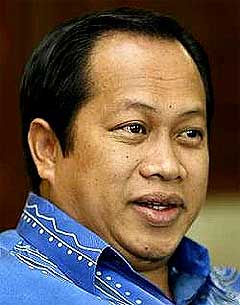 At the Wangsa Maju Umno divisional meeting, Ahmad
(left)
who is also Deputy Minister in the Prime Minister’s Department, reminded the Malays of the objective of Vision 2020. He said Malays had to seize opportunities and he emphasised the importance of education in progress: "Without knowledge, we cannot change society". He also encouraged them to venture into the business sector for better income.
At the Wangsa Maju Umno divisional meeting, Ahmad
(left)
who is also Deputy Minister in the Prime Minister’s Department, reminded the Malays of the objective of Vision 2020. He said Malays had to seize opportunities and he emphasised the importance of education in progress: "Without knowledge, we cannot change society". He also encouraged them to venture into the business sector for better income.
Has he wondered why the rest of the country is angry about Umno members having the inside track? The special position they hold, that is denied most ordinary Malaysians, including the not-so-well-connected Malays, means that there is an unequal distribution of the country’s wealth, power, resources and economic aid.
It worries me that someone who is so shortsighted can occupy an important post, such as information chief. He said that there was no need for the government to entertain Kelantan Menteri Besar Nik Abdul Aziz Nik Mat's request for government to give ample warning before holding a general election, to enable the other political parties to prepare themselves.
Think about the people
Nik Aziz has a point. Ahmad and his BN colleagues should put aside political posturing and think about the good of Malaysians for once.
I would rather politicians discussed their plans to manage the country. They could talk about issues like education, the economy, the health system, immigration and infrastructure, rather than bore us with half-baked, outdated policies.
Instead, they rely on inducements such as presents of saris, sacks of rice, tins of Milo, outboard motors, shopping trips to Haadyai or Medan, even money, to influence our voting.
Maybe I shouldn’t be surprised. When interviewed in 2008, Ahmad was asked if he played a musical instrument, danced or sang. He replied that he only sang Umno songs and the ‘Negaraku’. It sounds like he was brought up in the Hitler Youth movement, with their Nazi songs. Possibly, it is he who should show more open-mindedness. Allegiance to party and country are commendable, but there is a whole world out there to be discovered.
Ahmad is not the only person urging us to change our mindset. Recently, there has been an increase in government rhetoric for a change in our attitudes.
Consider the RM810 million for a new palace or RM800 million for the new Parliament. Often, these projects are only made known once the construction is already underway.
First, we were tricked into believing that it was necessary to spend such vast amounts of money. Once, we had swallowed this lie, we were told that it was the absolute minimum cost. Next, the cabinet’s excuses for the lack of transparency, were ‘security concerns’ or ‘to enable ministers and civil servants easier access’. Had these projects been offered for open tender, the costs would have been substantially reduced.
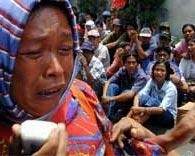 How do they justify these exorbitant costs when people in the estates or
kampungs
do not have one decent meal a day? Or that some children do not even go to school? Or that mothers do not take contraception because pills cost money, or transport to the family planning clinic is expensive? Or, that a
kampung
in Perak had no electricity one Raya because the inhabitants could not afford the rates?
How do they justify these exorbitant costs when people in the estates or
kampungs
do not have one decent meal a day? Or that some children do not even go to school? Or that mothers do not take contraception because pills cost money, or transport to the family planning clinic is expensive? Or, that a
kampung
in Perak had no electricity one Raya because the inhabitants could not afford the rates?
Why is this government anxious to obliterate structures that remind us of our past? Anything that was built around Merdeka is earmarked for demolition or obscurity. Is someone trying to rewrite history and present a cherry-picked, sterilised Umno/BN version?
It is not just structures that are at risk, but also ceremonies.
The Tugu Negara, Tunku’s brainchild in 1963 and designed by Austrian sculptor Felix de Weldon, who also built the Iwo Jima Memorial in Virginia, might as well be confined to the scrapheap.
Defence Minister Ahmad Zahid has relocated the Hari Pahlawan (Warriors Day) ceremony to Putrajaya and Prime Minister Najib Abdul Razak has designated three acres for the new site.
Everything migrating
Is the forced migration of everything and everyone to Putrajaya to justify the presence of this artificial town, with its artificial lake, and grand buildings that look like they came straight out of the Tales of the Arabian Nights?
The city is populated by civil servants who live, think and breathe officialdom. They are detached from the real world – ‘our’ Malaysia.
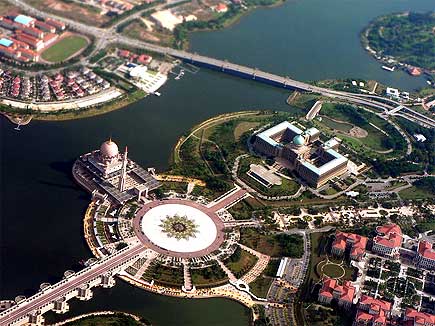 Putrajaya
(right)
is synonymous with Naypyidaw, the new capital of Burma which was carved out of the Burmese jungle.
Putrajaya
(right)
is synonymous with Naypyidaw, the new capital of Burma which was carved out of the Burmese jungle.
I can’t believe that this government wants us to embrace change when they refuse to be open to scrutiny. Ahmad said that knowledge is the ‘basis for progress’.
Knowledge is definitely power. Governments have the technology and capability to make information accessible. But, in this government’s case, it has become more creative in inventing excuses to keep their excesses hidden. What they want is for the population to remain gullible and compliant.
The old ways of deceit, delusion and dishonest economic figures must stop. The new method of transparency, obsession with detail and consultation should be the norm. The new ways will include our demand that politicians be held to the same moral standards and face the same punishment that is meted out to the common man.
It is time that Ahmad, his Umno/BN colleagues, and also opposition parliamentarians, worked with the local community and respected their concerns.
If politicians can change their own mindset and be open-minded, then others might follow their lead.
MARIAM MOKHTAR is a non-conformist traditionalist from Perak, a bucket chemist and an armchair eco-warrior. In ‘real–speak’, this translates into that she comes from Ipoh, values change but respects culture, is a petroleum chemist and also an environmental pollution-control scientist.


