




Religion, politics and the media
Politics is news and news is politics, for most people. But when there is an unusual and prominent coverage of news linked to religion and politics, the general election is not far away, said a veteran journalist to me recently. So we may not find the whole news, the truth, in our media. So we turn to God to help us find the truth. But politicians seem to be doing the same, according to news reports.
Politics is news and news is politics, for most people. But when there is an unusual and prominent coverage of news linked to religion and politics, the general election is not far away, said a veteran journalist to me recently. So we may not find the whole news, the truth, in our media. So we turn to God to help us find the truth. But politicians seem to be doing the same, according to news reports.
In various surveys, newspaper readers rated religion as an important topic for papers to cover - besides sports and education. But when religion and politics are mixed, the news coverage becomes unbalanced, biased and distorted. We have seen this in the coverage of the Israeli-Palestinian conflict, the war on terrorism, etc.
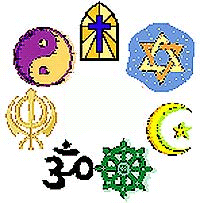 Various studies also show that “religion is covered almost exclusively as an argument for conservative political policies.” Just scan through, particularly the mainstream or old media, and you will not fail to notice that politicians’ views on minorities, migrants, women or homosexuality are politicised to promote the more conservative positions often taken by religious authorities.
Politicians never fail to take the opportunity to use the position of religion on various issues like the abandoning of babies by unwed mothers. That such mothers should be given the death sentence received wide media coverage and the support of many readers. The socio-economic conditions of and the religious positions on unwed mothers received scant attention.
Criminalising abandonment, on the basis of morality and religion, were used to call for the death penalty for mothers who abandon their babies. Issues of protection, care and sex education were not the priority on saving babies and mothers.
Using religious conservatism for politics
Some potential candidates hope religion, or issues of morality, are factors to be considered in the selection of a candidate. But politicians, with their eyes and ears on any opportunity to obtain voter support, have always used religious conservatism for political purposes, with the support of the media. Such positions are not peculiar to Malaysia only.
In the United States for example, the media’s definition of “religious issues” seems to centre on gay rights, abortion and school prayers - the issues focused on by the Christian right. Even when religious leaders talk about issues like economic justice or anti-militarism, they are not reported in a religious context.
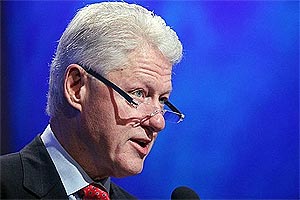 For example when former US president Bill Clinton (
left
) expressed support for homosexual and abortion rights, the media gave prominence to the views of evangelicals who were alarmed by Clinton’s position. However, Clinton still won the elections.
For example when former US president Bill Clinton (
left
) expressed support for homosexual and abortion rights, the media gave prominence to the views of evangelicals who were alarmed by Clinton’s position. However, Clinton still won the elections.
Often the mainstream media ignores the progressive perspectives that are found in all religious teachings - Islam, Christianity, Hinduism, etc.
All religions call for non-violence, equality among people, justice, protection of nature and the environment. These teachings are not revolutionary,
But the media tends to distort. As one study on religion and politics highlights that “Christians are often pigeonholed on abortion, Jews get the same treatment with Israel. Despite a long tradition of Jewish activism on civil rights and other progressive causes, reporters use the term “Jewish lobby” when they seem to mean “pro-Israeli lobby”.
Meanwhile, Islam, with its emphasis on social justice and racial equality, has been caricatured as “violent, irrational and bigoted”.
God portrayed along party lines
When the media mixes politics and religion, God is portrayed along political party lines and of course on the religion of who owns the particular media. And of course, the close relationships of media barons with politicians determine the daily news on print and electronic media and perhaps in the new media too, the Internet news portals.
In the US, for example, since the religious right bought up the airwaves, “they have convinced the mainstream that there’s a Republican God,” said Tom Roberts of the progressive National Catholic Reporter . Henry Luce, the founder of Time magazine once said, “I’m a Protestant, a Republican and a free-enterpriser, which means I’m biased in favour of God, Eisenhower and the stockholders of Time, Inc (Eisenhower was US president then).
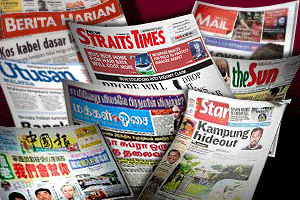 In today’s market-driven economy, the words of Luce ring with greater truth. In Malaysia, of course, where political parties own most of the mainstream media, the news is unbalanced and distorted to reflect political party positions .
Ethics and objectivity, the principles which should guide the reporting of news, are conspicuous by their absence in Malaysian media, particularly in political reporting. However as Luce pointed out, “Objectivity is myth.”
Is there a place for conscience in a market-politics driven media?
Two interesting quotes I hope gives you food for thought on religion, politics and the media. Two hundred years ago, Thomas Jefferson, the third American president, proclaimed, “Where it left me to decide whether we should have a government without newspapers, or newspapers without a government, I should not hesitate a moment to prefer the latter.”
And the philosopher Henry David Thoreau said, “Blessed are they who never read a newspaper, for they shall see Nature, and through her, God”.
JOSIE M FERNANDEZ is currently an Asian Public Intellectual Fellow, director of Philanthropy Asia, researcher and engages with Transparency International Malaysia in anti-corruption measures. She holds a master’s degree in development management from the Asian Institute of Management, Philippines. Working on sustainability, philanthropy and anti-corruption actions are some of her current passions besides writing.


Are you sure you want to delete this comment?
This action cannot be undone.