




Keep charitable bodies and politics apart
Mixing charity and politics can lead to abuse of power. The integrity and accountability of charities and foundations linked to politicians have raised legitimate and fundamental concerns everywhere.
Mixing charity and politics can lead to abuse of power. The integrity and accountability of charities and foundations linked to politicians have raised legitimate and fundamental concerns everywhere.
Soon after the tsunami-like general election of 2008, the Malaysian media began to highlight various abuses of power in state governments.
Among the exposes were the quick transfer of funds from charitable organisations as well as the overnight closing down of these entities. One headline in a print media screamed, "RM10 million gone in three days."
The news underscored a key concern of the nexus between politically linked charities and government decisions i.e. abuse of power. Transparency International defines corruption as abuse of power.
On March 11 2008, three days after the 12th General Election, the Association of Wives of State Assemblymen and Members of Parliament in Selangor (Balkis) held an EGM and dissolved the association.
The next day, it closed its accounts and transferred RM9.9 million to an account under the Association of Wives of Federal Ministers (Bakti). The reports claimed these actions were taken with the advice of a sitting judge.
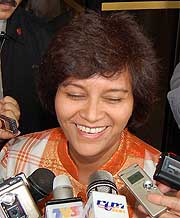 Another foundation linked to a politician was in the news too soon after GE 12, raising questions in relation to its accounts. The Women's Sports and Fitness Foundation Malaysia had spent RM2.1 million for meals, RM242 million for volunteers' allowances and RM858 million for travel and transportation according to its annual report.
Its patron was Azalina Othman Said ( right ), former minister of sports. She was cleared of any wrongdoing.
Photo opportunities
Politicians and their wives in many countries have been known to establish charitable foundations not only to get photo opportunities when they give out charity but to channel funds for political financing.
Politicians have been suspected of receiving funds for favours they may have given to businessmen and cronies. Sometimes foundation funds have been used to make illegal payments to parliamentarians.
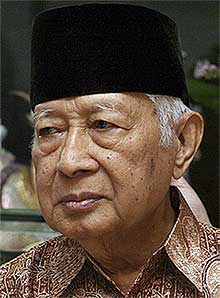 For example, The Supersemar Foundation, set up by Suharto (
right
), the late former president of Indonesia, was on March 28, 2008 found guilty of misusing funds meant for scholarships and for orphans all over Indonesia. Supersemar had given the funds from the foundation to companies managed by Soeharto and his cronies.
For example, The Supersemar Foundation, set up by Suharto (
right
), the late former president of Indonesia, was on March 28, 2008 found guilty of misusing funds meant for scholarships and for orphans all over Indonesia. Supersemar had given the funds from the foundation to companies managed by Soeharto and his cronies.
Sometimes regulations to encourage charitable contributions and corporate social responsibility activities are abused for political purposes.
A 1976 Indonesian government regulation stipulated state owned banks had to contribute five percent of their profits to foundations and charities. Corruption watchers in Indonesia have highlighted these regulations sometimes provided opportunities for corruption.
The late Anita Roddick, founder of Body Shop and a pioneer in corporate social responsibility (CSR) , lamented it was not working and that it has been taken over by marketing houses.
Some company insiders have commented that CSR contributions have been channeled to political parties, too.
Development funds in the Philippines, according to corruption watch groups, have often been diverted for corrupt purposes. Many foundations were established by wives of politicians in the Philippines for political purposes, particularly after the fall of Marcos when donor money poured into the country.
Network of thieves
An Indonesian journalist has coined the term ‘kleptocracy' to describe this form of abuse of power. Kleptocracy refers to a power network of "thieves" that are protective and supportive of each other.
Corruption watchdogs in Australia point out that often civil servants suppress, cover up and lie about misuse of public funds to protect their political masters.
Whenever a tragedy occurs or a case of abject poverty is highlighted, the first people to arrive at the scene are politicians and their entourage, including wives. Of course, the cameras are there at the right moment to capture the charity given out by politicians or their spouses. But where do the funds come from?
Should politicians see themselves as some sort of Robin Hood dipping into the public till for the welfare of children and their constituents?
With the establishment of numerous foundations by politicians and their wives, we have in Malaysia a form of state based philanthropy. Who monitors the financial transparency and accountability of state based charities?
Organisations involved in charities too are responsible to taxpayers, donors, the public and recipients of philanthropic aid. There are various critical elements of accountability which must be highlighted in annual reports such as identifying the donors including state agencies, quantum and purpose of the donation and how the money has been spent.
The challenge has been to obtain these annual reports.
The situation is very similar to political parties whose annual accounts are difficult to obtain. One reason being, political parties are reluctant to disclose sources of funds for fear of action against their donors.
State funds diverted
Compliance with the rules of accountability are a matter of public concern particularly when state funds have been diverted to organisations managed by wives of politicians or where politicians are patrons and advisers.
Charitable institutions linked to politicians can lift a politician's image and help win votes. Such institutions create opportunities for abuse of power.
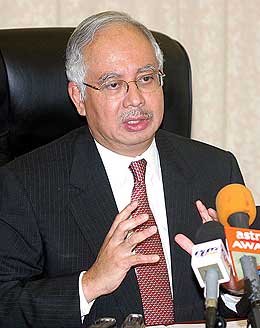 The Malaysian Prime Minister Najib Abdul Razak (
left
) has embarked on several significant reforms to combat corruption in Malaysia since taking over the political leadership of the country. One initiative is to review legislation related to political funding.
The Malaysian Prime Minister Najib Abdul Razak (
left
) has embarked on several significant reforms to combat corruption in Malaysia since taking over the political leadership of the country. One initiative is to review legislation related to political funding.
In this context, reforms related to charities headed by politicians and their wives must come on the radar of anti-corruption reforms. The management of politically-linked organisations involved in charitable giving need greater transparency.
Reforms are urgently needed to demand greater accountability and transparency from entities that have been established by politicians, their wives and cronies for whatever purposes.
Legislation may be required for example, to prohibit the channeling of development funds to charities and foundations linked to politicians and their families, including political party owned media foundations.
JOSIE M FERNANDEZ is currently an Asian Public Intellectual Fellow, director of Philanthropy Asia, researcher and engages with Transparency International Malaysia in anti-corruption measures. She holds a master's degree in development management from the Asian Institute of Management, Philippines. Working on sustainability, philanthropy and anti-corruption actions are some of her current passions besides writing.


Are you sure you want to delete this comment?
This action cannot be undone.