




Politicians put party above folk
Politicians are sailing against public opinion and openly defending policies that their party and supporters desire and will benefit from.
Politicians are sailing against public opinion and openly defending policies that their party and supporters desire and will benefit from.
Recent announcements of one mega project after another without public consultation should be of serious concern to us, the public.
Politicians do not seem to worry about the threat of electoral retribution if these projects fail and Malaysians are burdened with debt for generations.
For too long politicians have avoided electoral accountability and this has led to the situation that public opinion is not a part of the process of policy making.
The public should be raising questions on the mega projects the government has announced recently such as the development of land banks in Kuala Lumpur and Selangor.
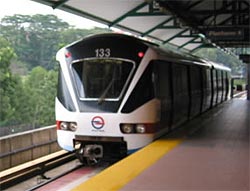 Three thousand acres of land in Sungai Buloh is to be developed into a new Klang Valley hub. The Sungei Besi army airport will be turned into a financial hub. Were there open tenders for the award of these projects?
One of the largest MRT systems is to built for Kuala Lumpur. Many concerned groups are raising questions on the scale and cost of this project without examining more sustainable forms of transport system, the proposed mega MRT system will result in every average Malaysian household having to bear the debt for generations.
Did public opinion matter in the design and award of these projects? These projects are often submitted by companies who have an interest in them.
They are developed on the concept of public-private partnerships (PPPs) without public opinion inputs. Without open tenders and transparency, the PPPs are the icing on the cake of development.
Widening gulf
Increasingly, there is a widening gulf between the policy decisions of politicians and the needs and interests of Malaysians. Clearly, there is a trend of declining responsiveness from politicians to the policies the public would want and prefer.
In Malaysia, politicians do not seem to respond to public opinion. Politicians gather information from a range of sources, e.g. public opinion research entities, academic institutions, public relations firms and consultants to design policies and projects that that will keep politicians in power and bring financials gains to supporters and cronies. This modus operandi has worked for more than 50 years.
Increasingly, popular consent and influence over government policies is not the preferred option of the government in decisions on policies and implementation of projects.
There are no signs the government is going to listen to public opinion, although they may claim they are consulting us, the public. If you have been following the announcements of politicians, it is clear they are only talking to each other.
The policy goals of enacting legislation without public consultation and approving projects without open tenders are to please the party, supporters and the ruling elite.
Politicians track public opinion not to make policy but to determine how to craft their public presentationst to win support for the policies and their party and cronies favour.
Politicians want the best of both worlds; to enact their preferred policies and to be re-elected. Politicians use even taxpayers resources to shape public opinion by ‘priming' public opinion.
They do not really give enough information to evaluate policy proposals.
 Messages like Kuala Lumpur is to be a global city, a financial hub that will outdo Hong Kong, Tokyo or Singapore sounds like music to most urban Malaysians. But rural Malaysians are not forgotten.
A few days ago the Prime Minister announced a master plan for rural development. The messages are well crafted and timed to sway public opinion for specific policy proposals.
Support without debate
Parliament is now in session and government announcements on new policies and projects will provoke reactions from the opposition. These reactions will often be new or competing policy views.
The opposition views will make it more difficult for a united public opinion as the media uses the strategy of highlighting conflicts between government and the opposition.
All these announcements and their timing are attempts by politicians in power to obtain public support for their policies without public debate.
Confuse the public, change public perceptions of party and politicians by crafting policy settlements and announcements is the strategy.
Politicians use public opinion research to manipulate public opinion. They craft messages that will create impressions they are responsive to public concerns.
The 1Malaysia experiment makes a good example. It may well be a public relations exercise gone wrong.
 Former prime minister, Dr Mahathir Mohamad (
left
) is claiming that 1Malaysia is causing "irreconcilable conflicts".
Former prime minister, Dr Mahathir Mohamad (
left
) is claiming that 1Malaysia is causing "irreconcilable conflicts".
Public opinion polls are used not to change programmes but to use the information to reshape arguments in favour of programmes not necessarily in the public interest.
The media is the vehicle that ‘creates' the language and arguments to support politicians to remain in power. What drives press coverage of national policies?
Just one factor - who owns the media? If the media is owned by the political party in power, public must not expect any open and unbiased debate on policies.
In a media environment where political parties or ruling politicians own the media, the public's recourse to unbiased debates on policies are the independent media (if there is one).
The social media used by politicians , according to a young graduate in public policy studies is "a fan club, yes it provides information but not a medium for policy debates".
Public opinion polls are cleverly used to justify intentions to remain in power. A recent poll that the "BN is regaining support" is being utilised to announce new projects without any public debate.
 When politicians continue to disregard public opinion, representative democracy and good governance are threatened. Opposition members of Parliament are not provided with adequate information on Bills to be passed in Parliament.
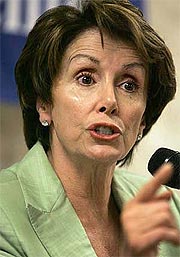
As Nancy Pelosi ( right ), the Speaker of the US House of Representatives said before the vote on healthcare reforms, "Pass the bill so you can see what is in it"!
Our opposition MPs perhaps see the bill after it is passed?
A quote from Winston Churchill - "the best argument against democracy is a five-minute conversation with the average voter," leaves much food for thought on why we the public must speak up.
JOSIE M FERNANDEZ is currently an Asian Public Intellectual Fellow, director of Philanthropy Asia, a researcher and consultant. Working on sustainability, philanthropy and anti-corruption actions are some of her current passions, besides writing.


Are you sure you want to delete this comment?
This action cannot be undone.