




Ikut Suka Aku
Politics is the driving force behind the Polis Di Raja Malaysia, and also its weakness. The police appear to uphold the law, but only when it is advantageous to their political masters. It prevents crime, but not when one of its own is involved. It reassures people, but only BN supporters.
Politics is the driving force behind the Polis Di Raja Malaysia, and also its weakness. The police appear to uphold the law, but only when it is advantageous to their political masters.
It prevents crime, but not when one of its own is involved. It reassures people, but only BN supporters.
 Within the past week, several people were arrested: K. Selvachandran, four university students and Teoh Lee Lan's (
right
) group of four.
Within the past week, several people were arrested: K. Selvachandran, four university students and Teoh Lee Lan's (
right
) group of four.
Ten innocuous individuals, each doing what they believed was right. It could just as easily happen to any of us.
The Malay translation of Ikut Suka Aku is, "do as I please". Ikut Suka Aku has the same acronym as the Internal Security Act (ISA). The ISA was enacted by the government in 1960, under Article 149 of the Constitution.
Ikut Suka Aku or the ISA is an arbitrary rule that is convenient for the political ruling elite. Despite the call by civil society for its abolition, it appears that the BN government is in no hurry to do so.
And why should it? The ISA is handy, when the prospect of losing control of the Federal government is on the horizon.
Malaysians are familiar with the ISA but few are aware that the ISA is part of a trio of preventive detention laws, including the Dangerous Drugs (Special Preventive Measures) Act 1985 and the Emergency (Public Order and Crime Prevention) Ordinance (EO) 1969.
ISA and the EO
In the Human Rights Watch publication, ‘Convicted Before Trial', one non-governmental activist made the following subtle difference between the ISA and the EO: ‘The ISA is top down - a government minister orders detention of someone seen as a threat to the government - whereas the EO is bottom up. The police, having failed to collect evidence to prosecute a criminal suspect, request an EO detention order from the minister'.
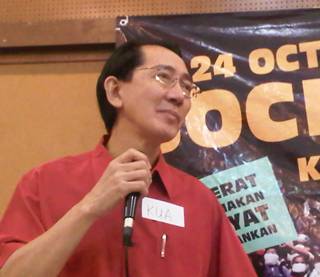 In the ‘foreword' of Kua Kia Soong's (
left
) book "445 days under the ISA", K Das, once the bureau chief of the
Far Eastern Economic Review
, related how a guard in Kamunting told the detainees that "there were hundreds of ISA rules in the book, but who cares about them?"
In the ‘foreword' of Kua Kia Soong's (
left
) book "445 days under the ISA", K Das, once the bureau chief of the
Far Eastern Economic Review
, related how a guard in Kamunting told the detainees that "there were hundreds of ISA rules in the book, but who cares about them?"
In short, ikut suka aku.
The ISA, a temporary measure to fight the communist insurgency, has remained even though the communist threat no longer exists.
Last Sunday, Teoh's group claimed that the police told them they would be arrested under the Criminal Procedure Code. They were initially denied legal representation and later, were arrested under Section 4(A)1 of the Election Offences Act.
The group believed their presence, would have been perceived to have taken attention from the ‘1Malaysia' walk planned later that day.
Teoh's co-ordinator, Chong Kok Siong said, "The plainclothes police stopped us: they said the (death in) custody issue will affect security (and that we) can't speak openly."
It is debatable how seeking justice for her brother's (Teoh Beng Hock) suspicious death is likely to threaten public order and the country's security.
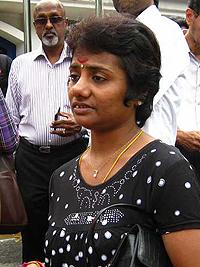 A few days earlier, K. Selvachandran who claimed he witnessed the police beating up R. Gunasegaran who subsequently died, while in police custody in 2008, was himself assaulted and arrested by several men, alleged to be policemen.
After beating Selvachandran in front of his wife ( right ) and children, the police tried to force her to kiss him, before bundling him away. The family was later informed that Selvachandran would be detained for 60 days at the Kuala Lumpur police headquarters for drug-related offences.
Arbitary detention
Malaysia's public confidence in its enforcement agencies is ebbing away fast but the police continue to detain people arbitrarily.
The day before Teoh's arrest, four students who had gone to Galas, from university campuses across Malaysia, to "participate in the democratic process as a check and balance to the government" and to observe the by-election, were arrested.
October 27 is the 23rd anniversary of Operasi Lalang , when over 100 civil society activists, opposition leaders, academics, religious converts and ordinary civilians were arrested and detained under the ISA.
 It is alleged that over 10,000 people have been detained under the ISA, (one for over two decades), in the past 50 years. It is also alleged that three people go missing everyday in Malaysia.
In London, Malaysians marked this inauspicious day with an ISA Protest Walk and a Wayang Kulit, which started at the Malaysian High Commission in Belgrave Square and continued through Green Park (which borders Buckingham Palace), past Constitution Hill, Admiralty Arch and terminated at the Malaysia Tourism Office in Trafalgar Square.
The group chanted to call for the abolition of the ISA and distributed leaflets to the thousands of people who thronged Trafalgar Square for Saturday night's Halloween celebrations. The aim was to highlight and draw attention to the injustices and detention without trial, meted out to normal Malaysians.
Unlike Malaysia where a police permit is mandatory for gatherings of five or more people and where peaceful society protests have received a violent reaction from the police, with chemically treated water from water-cannons, tear gas and arrests, the London march was a totally different experience.
In some places, by-standers good-naturedly joined in and the passing hordes of policemen on their beat and in their vehicles hardly glanced at the protestors.
 Earlier in the day, Raja Petra (
right
) who led the walk, had launched the Malaysian Civil Liberties Movement, whose office bearers and aims are listed on the
Malaysia Today
website.
Earlier in the day, Raja Petra (
right
) who led the walk, had launched the Malaysian Civil Liberties Movement, whose office bearers and aims are listed on the
Malaysia Today
website.
Malaysians are undoubtedly envious of overseas Malaysians who can protest peacefully. For Malaysians in UK, freedom is sweet.
If you are in England, please join the monthly ISA protest, to help your fellow countrymen in Malaysia.
These are held on the last Saturday of every month. The next one will be on 27 November 2010, between 12 noon and 1.15 pm, outside the Malaysia Tourism Office in Trafalgar Square, London.
When asked why they were on the London protest walk, one lady said, "I am sick and tired of the ongoing defilement, the lack of respect as human beings, the crackdown on cartoonists". Another person remarked, "Malaysians are not allowed to think because of the ISA. They are afraid of speaking up or have a difference of opinion."
But the best reason was given by a Sabahan: "I'm doing it because I can."
MARIAM MOKHTAR is a non-conformist traditionalist from Perak, a bucket chemist and an armchair eco-warrior. In ‘real-speak’, this translates into that she comes from Ipoh, values change but respects culture, is a petroleum chemist and also an environmental pollution-control scientist.


Are you sure you want to delete this comment?
This action cannot be undone.