




Wen Jiabao's charm offensive
After much pomp and fanfare, but also the horribly embarrassing syntax and grammatical errors in the Chinese translation on a signboard to welcome him in Putrajaya, Chinese Premier Wen Jiabao is now in Jakarta, where the real tussle for regional influence between China and the United States takes place.
(On a side note: Chua Soi Lek can seriously contemplate calling it quits now that Umno has found Google Translate more trustworthy than MCA!)
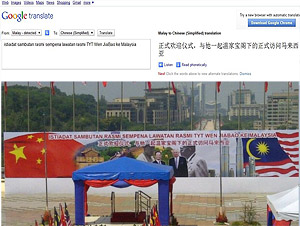 Forget all the mawkishly flattering commentary in Malaysia’s Chinese press, for Wen’s ultimate purpose of visiting both Malaysia and Indonesia is - on top of trade ties and cultural exchanges - to test China’s maritime influence. In his interview with the media in Beijing prior to departure, the Chinese premier had made clear that his government’s priorities in South-East Asia included strengthening maritime cooperation, sea-lane security and anti-terrorism efforts.
Brotherhood with Malaysia? It is all diplomatic rhetoric. The fact is, Beijing has never quite concealed its ambition to play the role of a ‘benign hegemon’ in the region that will hark back to the heyday of the Ming Dynasty. Notably, the importance of ‘China’s backyard’ now figures large in mainland Chinese media.
Wen could have saved his brief tour to Malaysia, but Najib Abdul Razak badly needed his presence to boost Barisan Nasional’s dwindling support among Chinese Malaysians. Too bad, the initially joyful atmosphere was ‘spoiled’ by a dozen of those who were brave enough to seek to question the Chinese premier on the deteriorating human rights in his country.
 But Wen is dubbed “China’s best actor” by his detractors back home and he did put up a good show at Universiti Malaya. For him, dialogues with youths are enjoyable only when they are closed-door with participants carefully screened, while an independent mind is invaluable provided it is locked behind bars.
On this, abundant is the kindred spirit between Malaysia and China.
But let’s not deviate from the core issues here.
US exerting its soft influence
Early this month, Pulitzer Prize-winning journalist Lewis M Simons wrote in USA Today that the United States was ‘back in the smart-power game’ by quietly exerting its soft influence in Indonesia.
Acutely aware of its geo-strategic importance as a maritime country, the most populous Muslim nation and the largest economy in South-East Asia, both Washington and Beijing have long been courting Indonesia’s affections. Equally vital is the archipelago’s rich natural resources, especially with the advent of energy competition.
Back in 2005, China’s promulgation of the Strategic Partnership with Indonesia prompted the US to incrementally normalise ties with the Indonesian military, ie. Tentera Nasional Indonesia (TNI).
Since then, TNI has upgraded its US-made aircraft with maintenance costs borne by Washington, while the Framework Arrangement on Cooperative Activities in the Fields of Defence has taken effect to enhance and integrate existing military ties between the two countries.
This aside, a US$56 million programme to fund production of coastal and shipboard radar systems was dedicated to the Batam Regional Maritime Command Centre, further indicating that Washington is set to make Indonesia among its most significant strategic partners, alongside Thailand, the Philippines and Singapore.
Assured of its technological superiority, the US will hope to counter China’s series of charm offensives by positioning itself as a key military supplier to regional countries who need it.
Following this, Purnomo Yusgiantoro, Indonesia’s Defence Minister, told his US counterpart Robert Gates in July last year that Jakarta would look into the possibility of purchasing US-built F-16 and C-130H Hercules aircraft. If approved, the purchase would be made through the Foreign Military Financing programme, another US grant to foreign governments who desire to receive weapons, services and training from Washington.
Washington has also lifted the 12-year ban on Kopassus, Indonesia’s elite military unit, which unequivocally affirms renewed US security interests in South-East Asia in view of Beijjing’s growing regional preponderance.
All this, no doubt, is not lost on China. As the US continues to reassert its military interests in the region, perhaps the episode that offended the Chinese leadership - and the highest echelons in the People’s Liberation Army in particular - was a series of bilateral exercises between Washington and Hanoi last August.
Burying their warring past
Ostensibly focused mainly on damage control and search and rescue, the exercises were meant to send a message that the US and Vietnam had buried their warring past and sued for peace in an attempt to check against a resurgent China.
Beijing had sided with Vietnam during the Vietnam War and later felt utterly betrayed by this ‘little brother’. And there is clearly no love lost between the two longest-surviving communist regimes in Asia.
The Chinese government knows most countries in South-East Asia are still wary of its advances into the region. Late last year, China’s clashes with Japan near the disputed Diaoyu/Senkaku Islands inadvertently heightened the sense of insecurity within Asean. There is always a constant fear of an arm race in the region that is driven by an unfettered vying for dominance by outside forces.
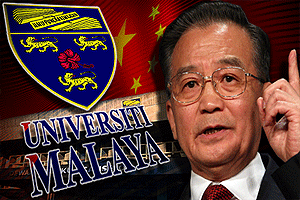 Even those governments that appear to be friendly are seeking to court favours between the two powers, Malaysia being a case in point. Seen in this light, Wen’s ‘generosity’ in churning out lucrative trade deals and paying a visit to Universiti Malaya was only a small price to pay to at least keep Malaysia neutral.
The most crucial actor, like I say, is across the seas in Jakarta, where the Chinese premier is keen to find out if the Indonesian leaders would be willing to play a prominent part in Beijing’s grand strategy in response to the US’ aggressive policy. Wen, famous for his teary eyes and sentimental utterances, will also know if he has done enough to pacify and placate the biggest neighbour in South-East Asia.
And this, really, is what the Malaysian media has failed to examine.
JOSH HONG studied politics at London Metropolitan University and the School of Oriental and African Studies, University of London. A keen watcher of domestic and international politics, he longs for a day when Malaysians will learn and master the art of self-mockery, and enjoy life to the full in spite of politicians.


