




Another lonely and painful death
Last February, a distraught father applied to the Shah Alam High Court for an order to conduct a second post-mortem on his daughter who had died at her marital home under mysterious circumstances.
Lorry driver M Subramaniam has made three attempts to find out how his daughter, died but his first two attempts were turned down by the courts. He is dissatisfied with the findings of the initial post-mortem.
Last February, a distraught father applied to the Shah Alam High Court for an order to conduct a second post-mortem on his daughter Pakiam, who had died at her marital home under mysterious circumstances.
Lorry driver M Subramaniam has made three attempts to find out how his daughter died, but his first two attempts were turned down by the courts. He is dissatisfied with the findings of the initial post-mortem.
Despite five police reports, Subramaniam claimed that the police had not conducted any investigations. This time, Subramaniam has enlisted the help of the Human Rights Commission of Malaysia (Suhakam) to get to the bottom of the tragedy.
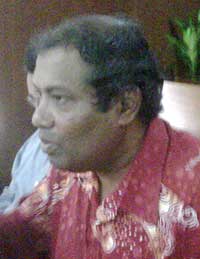 According to Suhakam commissioner Mohd Sha'ani Abdullah (
right
), their formal requests to view Pakiam's body, have been turned down by the Serdang Hospital.
According to Suhakam commissioner Mohd Sha'ani Abdullah (
right
), their formal requests to view Pakiam's body, have been turned down by the Serdang Hospital.
Suhakam said they had received the details of Pakiam's mysterious death and noted the lack of action by the police and the hospital.
They also clarified that before they could determine the next course of action, they needed to see the body and decide if it was necessary to request for a public inquiry.
Instead of lending their full support, the hospital referred Suhakam to its director-general, whose response was to demand a letter stating Suhakam's intent.
Autopsy raises suspicion
The details are as follows: Subramaniam's 23-year-old daughter, Pakiam, left the family home when she entered into an arranged marriage in September 2010 and went to live with her "in-laws" in Kulim, Kedah.
Five months later, Pakiam's mother, P Thobathi, heard allegations that her daughter was being beaten by her husband.
It is curious that most reports in the mainstream media fail to name the husband, B. James.
 Is he someone who is very important or someone who has important connections?
Does he have a very significant role in government or any political party? Is he the scion of a distinguished family, which has to be protected at all costs?
Thobathi went to Kulim on Feb 12 to check on her daughter, but was prevented from seeing Pakiam by her son-in-law.
Later that night, Subramaniam was informed that Pakiam had died. When he went to Kulim, Pakiam's husband told him that Pakiam died from the medication she had taken for a stomach ailment.
Worse was to follow when he saw his daughter's body - there were many wounds on her limbs, cigarette burns on her torso, her head was swollen, some of her teeth were missing and a thumbnail had been torn away.
The tragedy was that when Pakiam's parents bade their daughter goodbye, to set up home with her husband, she had been fit and healthy and was of sound mind.
Subramaniam lodged a police report two days after her death and, to date, he has not been able to get permission to perform a second independent autopsy at the University Malaya Medical Centre.
Domestic violence on the rise
Why is it that despite various public awareness campaigns, and several reports in the media about domestic abuse, men still treat their wives as personal chattels, to treat as they please and to discard at their leisure?
In a report compiled by the Women's Aid Organisation (WAO), with data sourced from the police, the figures are shocking.
| Year |
Violence
The police receive more than 3,000 reports of domestic violence every year, and the figures are rising. The slight dip in 2002 and 2003 could be attributed to increased awareness or possible under-reporting.
Many people are not aware that these figures only refer to reported cases. The true figure is higher.
Dr Sharifah Halimah Jaafar of the NGO Perak Women for Women (PWW) stated that ‘there were still people who see domestic violence as trivial... to be settled privately between husband and wife'.
"Cases of women being beaten up by their husband are not a one-off matter. It is a cycle that has happened many times," she said.
Why did the people living with Pakiam fail to report what had happened to her? Did they not know that there is a law that protects abused women in Malaysia? Were they themselves under threat? Did the neighbours not see or hear anything untoward?
Perhaps Pakiam herself did not know she could have applied for a court protection order or that she could have sought shelter?
Who did this to Pakiam? Her husband, her in-laws or others in the household?
Battling stigma
Why is domestic violence under-reported? Many people are ashamed of the stigma which becomes attached to the family. Perhaps they fear they will not be believed or that others will think they are making a fuss over nothing. Perhaps they have been threatened with more violence. The victims may have been told that their children would be taken from them.
It is believed that many women are abused several times before they summon the courage to report their perpetrators. For a few, like Pakiam, the consequences of delay can be death.
We must not kid ourselves that violence by men, against women, is an accepted part of our culture. It is not.
The latest announcement by the police is most despicable. They say that crime statistics given to the WAO cannot be divulged to any third party. This makes it impossible to bring those issues to the attention of the rakyat, and to substantiate reports with facts and statistics.
What are the police trying to hide? What is the government trying to hide? Does this hiding of social problems have anything to do with GE-13?
MARIAM MOKHTAR is a non-conformist traditionalist from Perak, a bucket chemist and an armchair eco-warrior. In ‘real-speak', this translates into that she comes from Ipoh, values change but respects culture, is a petroleum chemist and also an environmental pollution-control scientist.


Are you sure you want to delete this comment?
This action cannot be undone.