




Will Britain denounce Najib?
The criticism by several artistes over the treatment of Bersih activists and the use of sedition laws and the Police Act against national laureate A Samad Said shows that Malaysia is in deep crisis.
The Malaysian government and its people have never truly championed the arts. The emphasis in our education has always been on science and technology.
The criticism by several artistes over the treatment of Bersih activists and the use of sedition laws and the Police Act against national laureate A Samad Said shows that Malaysia is in deep crisis.
The Malaysian government and its people have never truly championed the arts. The emphasis in our education has always been on science and technology.
Our creative side has been neglected and suppressed. With a slant toward the sciences, we are poor at communicating, at drawing our strength from our hidden creative talents and we fail at expressing our true feelings.
The open condemnation by 128 artistes is another turning point in our history. The untapped, creative voice of Malaysia is unleashed. Last week, the artistes spoke out as one in support of Bersih's call for electoral reform.
These artistes were right when they opined that decades of mis-rule after independence had stifled creativity. However, it is not just the ordinary rakyat, whose ability to express freedom and democracy, has been suffocated. It is also the government and its agencies which lack imagination and appeal.
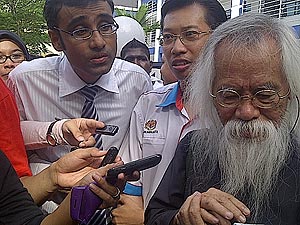 Malaysia's creative best had questioned how the authorities could conceive that Samad Said had committed sedition in his poem
‘Unggun Bersih
' with the lines, "
Semakin lara kita didera bara, kita laungkan juga pesan merdeka
... (No matter how badly we are persecuted, we shall continue the call for freedom)".
Malaysia's creative best had questioned how the authorities could conceive that Samad Said had committed sedition in his poem
‘Unggun Bersih
' with the lines, "
Semakin lara kita didera bara, kita laungkan juga pesan merdeka
... (No matter how badly we are persecuted, we shall continue the call for freedom)".
They said, "It reveals to us such poetic sensibilities of one who cares and feels for one's time and country".
In addition, the artistes felt that Malaysians lived in a "culture of fear", which could only stunt cultural development.
The artistes advocated the use of dialogue and communication and demanded that the nation's leaders be fair in its pursuit of political and creative freedom.
They said, "Regardless of the consequence, we hope that all hearts and souls entrapped would be freed, and above all (that) the country would emit rays of humanistic brilliance."
So despite the crackdowns, mass arrests and death threats, the Bersih 2.0 Walk for Democracy in Kuala Lumpur on Saturday was a triumph for the rakyat.
A culture of fear
Admittedly, the rakyat is not the only one who lives in fear. We may lead politically correct lives and dare not offend the government, royalty, the official religion and the Malays.
However, the authorities also live in fear; they fear the rakyat.
Umno/BN fears that we will hold them responsible and make them accountable for their every action. Umno/BN does not want us to ask any questions about cronyism, nepotism, corruption, embezzlement, kickbacks and abuses of power.
Umno/BN creates an education system that stifles creativity and does not promote querying minds. An educated and inquiring individual is a threat to Umno/BN.
That is why the ruling coalition feels no need for transparency. They have no inclination to declare their assets and unexplained wealth. They have no desire to do what is right for the rakyat. Their reasons for calling Bersih illegal are clear. They need to protect their own interests, future and freedom.
The artistes were right about the lack of imagination and creative expression.
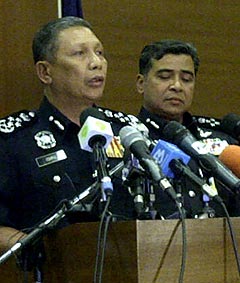 The IGP, Ismail Omar, said that 6,000 people took part in the rally and it was reported that, by evening, 1,667 arrests had been made - meaning that about a third of the people attending were detained. Video footage, however, shows attendance was higher.
Ismail also said those people had been charged for disturbing the peace, for attempting to force their way through police barriers and for taking part in an illegal event. He also defended the use of force by the policemen.
However, he made no connection to Najib Abdul Razak's betrayal of the rakyat when the meeting with Bersih's leaders was cancelled, when a stadium of Bersih's choice was rejected or that without a proper venue, the rakyat would have little choice but to filter onto the streets.
Meanwhile, Home Minister Hishammuddin Hussein had accused Bersih of attempting to overthrow the government, that it had shown disrespect towards the King and that the movement had a political agenda dictated by the opposition coalition.
However, Najib's comments that the Bersih rally was a failure because of the poor attendance were the most laughable.
If only Najib was more creative and had put his imagination to better use.
If he had engaged with the rakyat and allowed them to march, rather than call Bersih illegal, the people would have warmed to him.
If he had compromised and acceded to half of Bersih's demands for fair, clean and free elections, Najib might have received praise and perhaps potential votes in the upcoming general election.
If Najib had provided an avenue for discourse, he would have gained the respect of many.
He failed to do all of the above.
Don't hold your breath
This week, Najib who is in the United Kingdom, will be meeting Vince Cable, the Secretary of State for Business, Innovation and Skills, as well as Theresa May, the Home Secretary and Minister for Women and Equality.
Najib is also slated to meet the Lord Mayor of London in a reception at Mansion House, on the afternoon of July 14, to discuss UK/Malaysian financial services and on July 25 he will be at a MIDA forum at Claridges in Mayfair.
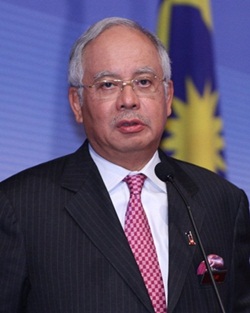 For several decades, Tunisia's Zine el-Abidine Ben Ali and especially Egypt's Hosni Mubarak, were both courted by the West because of their lavish spending power on military hardware.
At the same time, there has been ample publicity in the Western media about Najib's crackdown on Bersih.
So, should we hold our breath and expect the British government to denounce Najib? Or will they entertain him because he is seen as ‘Mister Moneybags', who is eager and foolish enough to purchase military hardware and other rubbish that the British do not want or consider obsolete?
Perhaps, the British authorities place more importance on the size of Najib's wallet, than on the well-being and democratic ideals of the Malaysian rakyat.
MARIAM MOKHTAR is a non-conformist traditionalist from Perak, a bucket chemist and an armchair eco-warrior. In ‘real-speak', this translates into that she comes from Ipoh, values change but respects culture, is a petroleum chemist and also an environmental pollution-control scientist.


