




The Chinese press and the kopitiam
Teng Chang Khim, the speaker of the Selangor state assembly, is a rare gem among all politicians in Malaysia. Once working as a court interpreter, his command of the three languages Malay, English and Chinese, is exemplar.
Linguistic skills alone do not make Teng a promising man. More impressive are his incisiveness and firm grasp of public issues that stand him in good stead in politics. One needs only to look at his effort in restoring the democratic principle of separation of powers and creating a culture of accountability with the setting up of the Selangor Select Committee on Competency, Accountability and Transparency, popularly known as Selcat.
Teng Chang Khim, the speaker of the Selangor state assembly, is a rare gem among all politicians in Malaysia. Once working as a court interpreter, his command of the three languages Malay, English and Chinese, is exemplar.
Linguistic skills alone do not make Teng a promising man. More impressive are his incisiveness and firm grasp of public issues that stand him in good stead in politics. One needs only to look at his effort in restoring the democratic principle of separation of powers and creating a culture of accountability with the setting up of the Selangor Select Committee on Competency, Accountability and Transparency, popularly known as Selcat.
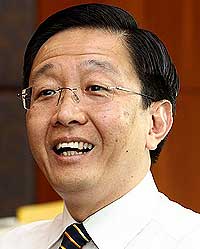 But Teng (
right
) recently got on the nerves of the mainstream Chinese press when he opined that the Chinese dailies were in a sorry state in which they were only ‘reporters’ but not ‘journalists’, some of whom were even permitted to have a column despite that their language competency was less than desirable. He also lamented the dearth of enthusiasm on the part of the Chinese press in making use of the Freedom of Information Act passed by the Selangor state assembly.
But Teng (
right
) recently got on the nerves of the mainstream Chinese press when he opined that the Chinese dailies were in a sorry state in which they were only ‘reporters’ but not ‘journalists’, some of whom were even permitted to have a column despite that their language competency was less than desirable. He also lamented the dearth of enthusiasm on the part of the Chinese press in making use of the Freedom of Information Act passed by the Selangor state assembly.
That the major Chinese dailies took umbrage at Teng’s timely reminder was an expected outcome. Instead of taking a deep look at themselves, they devoted pages to ‘commentaries’ and ‘opinions’ that dismissed Teng’s critical assessment without responding to the issues that he raised.
Worse, to distract the readers’ attention from the crux of the matter, many of the writers questioned whether Teng criticised with an ulterior motive (read: a ‘sellout’), while reminding the readers that it was the ‘generous’ press coverage given by the Chinese dailies to Teng - a maverick in the DAP - that enabled the speaker to come thus far.
In other words, jangan jadi kacang yang lupakan kulitnya , or one should think of its source when drinking water.
How surreal, that the editorial teams of the Chinese press are now quick to demand for the duty of gratitude, although they are the ones who have been chastising - directly or indirectly - the patronage mentality popularised by the Barisan Nasional and Utusan Malaysia .
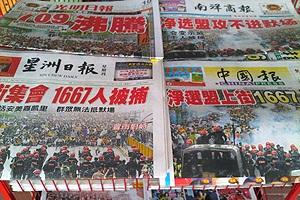 In resorting to the gratitude argument, these ‘media professionals’ have only allowed their fragile veneer of righteousness to come off, rending the reader unable to differentiate to some extent between the
Sin Chew Daily
- the paper that ‘upholds justice’ – and
Utusan Malaysia
that trumps partisan interests over civic rights.
In resorting to the gratitude argument, these ‘media professionals’ have only allowed their fragile veneer of righteousness to come off, rending the reader unable to differentiate to some extent between the
Sin Chew Daily
- the paper that ‘upholds justice’ – and
Utusan Malaysia
that trumps partisan interests over civic rights.
And one doesn’t expect a newspaper that deflects public criticism by seeking refuge in the comfort zone of communalism to rise to the occasion when the people are ready to push the political boundaries.
Wishy-washy is an understatement
Yet no amount of dodgy pieces can disguise the home truth that the quality of the Chinese press in Malaysia has dropped dramatically over the last two decades. To say it is wishy-washy is an understatement. Many a time, the leading article either parrots the government’s views or fails to offer insightful perspectives, making reading it a complete waste of time.
It is, however, good as a negative model for secondary school pupils to write better. Some silver lining there.
Teng’s observations are indeed valid. Take, for example, a senior ‘journalist’ (whose name escapes me) at Sin Chew who questioned the legality of the Bersih 2.0 rally before the massive protest. She referred to the statement by Lim Chee Wei, and remarked that in no circumstances did the Bar Council chairperson “call on the public to take part in the rally”.
However, Lim made it clear as follows:
“Public rallies have therefore been very much a part and parcel of our history, whether to protest against injustices of the colonial administration, or other injustices such as those that we are currently experiencing with respect to our electoral system. Those who say that street protests are not a part of our culture are clearly ignorant of our country’s rich history.”
It is true that Lim did fall short of urging the public to take to the streets, but the endorsement of the rally itself was unequivocal. How could the writer draw a no-street-protest conclusion from a crystal clear statement as such is everyone’s guess.
The writer is either incapable of addressing vitally important public issues or has difficulties with the English language, or both. What makes her whole piece inscrutable is that she is allegedly a law graduate.
Ambiguous coverage of the aftermath
The voluminous amount of incoherent articles against the Bersih 2.0 rally in the Chinese dailies highlights how far the ‘communal’ press industry is now removed from the realities. Yet they managed to enrage the public further with their ambiguous coverage of the aftermath.
Although some senior ‘journalists’ were opportunistic enough to adjust their initial positions, the volte-face was nevertheless executed in a clumsy and tasteless manner that only exposed their hypocrisy in full.
Confronted with the barrage of criticism on Facebook and other social media websites, Tay Tian Yan, a deputy editor-in-chief at Sin Chew , was compelled to pen a piece , ridiculing the detractors of the mainstream print media as “angry youth with less impressive knowledge and accomplishments”.
Alas, having used hastily the contents of the 14-page special report on the future of news by the Economist to hit back at his critics, Tay now finds himself in up the creek.
First and foremost, the Economist ’s apt and interesting leader , Back to the coffee house , is more about how conversational culture in the wake of the proactive social media and modern technologies is transforming news, rather than a new but messy and unruly terrain in which one must tread with care.
From the introduction through to the end, the report argues forcefully and vociferously for the case of a news ecosystem being drastically transformed, writing:
“…as news becomes more social, participatory, diverse and partisan, it is in many ways returning to the more chaotic, freewheeling and politically charged environment of the era before the emergence of mass media in the 19th century. And although the internet has proved hugely disruptive to journalists, for consumers—who now have a wider choice than ever of news sources and ways of accessing them—it has proved an almost unqualified blessing.”
The conclusion? Journalism is no longer the exclusive preserve of journalists as “ordinary people are playing a more active role in the news system”. And social media “are certainly not a fad and their impact is only just beginning to be felt”.
Media organisations now “need to reorient themselves towards serving readers rather than advertisers, embrace social features and collaboration, get off political and moral high horses and stop trying to erect barriers around journalism to protect their position”.
Completely different battlefield
In the context of Malaysia, there is a dire need for newspapers and other ‘mainstream” to reorient themselves away from the powers-that-be given the completely different battlefield out there. Just
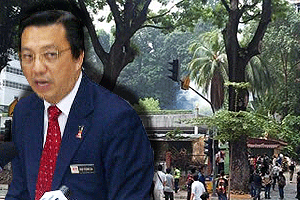 witness how
Facebook
users posted footage after footage to prove Liow Tiong Lai and the police wrong in the Tung Shin Hospital incident.
witness how
Facebook
users posted footage after footage to prove Liow Tiong Lai and the police wrong in the Tung Shin Hospital incident.
The Economist report leaves no doubt that the transformation of the news business is bringing back the once boisterous coffee house culture of the 18th century England, and “there is much to celebrate the noisy, diverse, argumentative and stridently alive environment of the news business in the edge of the Internet”.
The coffee house in England of the 17th and 18th centuries was in fact a place where men (yes, hardly women in those days) of ideas met for discussion and exploration of thoughts over a variety of topics. The Whigs and Tories each had their own usual haunts, much like the public houses with different football affiliations in nowadays England, save the rowdiness and occasional violence.
The coffee house was even known as Penny University precisely because for the price of a penny for a cup of coffee, one would come out of the premises a more enlightened person.
However, reading Tay’s piece gives one an erroneous impression that the erstwhile English coffee house was no different from the typical kopitiam in Malaysia, where ordinary folks gather and gossip over a cup of kopi, relishing in rumours and hearsays that are hard to verify.
Far from it.
If only Tay had cared to take a closer look at the cartoon on the front page of the particular issue, he would know the coffee house was no ordinary outlet: Note the notices about Pitt the Younger and Marie Antoinette on the wall, and the latest leak of Josephine Bonaparte’s emails as well as the mention of Thomas Paine by a patron.
And don’t miss out the Tea Party Gazette on the floor. These are all persons and items of the late 18th century so what do they tell us?
Simple: the coffee house was a common phenomenon in that period of English history, and the men were therefore the rightful subjects of King George III, not Queen Victoria, who only assumed the throne in 1837. By then, the coffee house culture had largely disappeared following the advent of popular journalism.
Hence, the men on the front page actually preceded the Victorian era by more or less five decades. On a side note, men in the 19th century had obviously acquired a new taste for fashion .
It is therefore safe to say that Tay’s understanding of the special report is fallacious at best and misleading at worst.
There are many ways to answer the challenge brought by the new media, but twisting an in-depth and discerning report is the worst of them. If even a seasoned journalist like Tay cannot care less to opt to stoop so low, what hope do we have of securing a mature and vibrant mainstream media scene?
“The coffee house is back. Enjoy it.” Proclaims the Economist . Too bad that for those who refuse to adapt, the taste of the cuppa is bitter indeed.
But at least Teng would be heartened to know he is now more than vindicated.
JOSH HONG studied politics at London Metropolitan University and the School of Oriental and African Studies, University of London. A keen watcher of domestic and international politics, he longs for a day when Malaysians will learn and master the art of self-mockery, and enjoy life to the full in spite of politicians.


