




Debunking personality cult
The hysterical outpouring of grief in Pyongyang - the images of North Koreans wailing, beating their chests and banging their heads on the ground - has become more newsworthy than the death of Kim Jong-il itself.
The hysterical outpouring of grief in Pyongyang - the images of North Koreans wailing, beating their chests and banging their heads on the ground - has become more newsworthy than the death of Kim Jong-il itself.
That the Dear Leader’s passing is being mourned in such a frantic manner is truly bizarre, for the man has bequeathed the country of 24 million with nothing but abject poverty and chronic food shortages.
While one may dismiss the convulsive agony as tactlessly orchestrated, it probably bespeaks the pervasive sense of loss still, not necessarily over Kim per se, but the uncharted territories ahead.
And the scene could not have been more drastically different thousands of miles away in Prague, where the funeral procession taking body of the late Václav Havel to his final resting place was marked by utmost solemnity.
Although the thousands of mourners displayed no fierce emotions, they were perhaps much more genuinely appreciative of the statesman.
After all, Havel’s extraordinary life - playwright, poet, dissident, prisoner of conscience, architect of the now iconic Velvet Revolution and eventually president all rolled into one - has contributed tremendously to the peace, stability and democracy of the Czech Republic today. While contemporaries, the life stories between Kim and Havel are poles apart.
Whereas the former was groomed consciously by his father - the Great Leader Kim Il-sung - and had everything handed to him on a silver platter, Havel fought tooth and nail against the communist regime with his pen, oratory and - most importantly - intellectual power.
Instead of reforming a country plagued by starvation and on the brink of complete collapse, Kim went on to perpetuate the totalitarian structure.
By contrast, Havel’s fortitude, tenacity and non-violent struggle helped secure freedom and prosperity for his people, leaving the world with a fine example to emulate on - even a tough act to follow.
Like Nelson Mandela, Havel - having tasted power - opted to play a constructive role of consolidating democratic culture in his country.
At times, his positions could be controversial, for instance, his support for the Iraq War in 2003, but he never failed to debate with rational ideas and facts, with no attempt at playing up public sentiments.
In short, Havel offered his people hope and directions, whereas Kim ruled his subjects with fear and intimidation, completed with a gargantuan and all-consuming socio-political engineering in the myth around him.
But personality cult can never last, evidenced by the recent developments in the Middle East. Sooner or later, the tears of the North Koreans today will turn into a fiery desire to rid themselves of the feudalistic bondage.
Personality cult is almost always a twin evil of authoritarianism. Yu Hua, a prominent novelist who has irked the Chinese authorities with his critical pieces of late, recounts in his latest book China In Ten Words an anecdote during the Cultural Revolution.
Since Mao Zedong was propagandistically analogised as the Red Sun, it would thus be “reactionary” for one to say things like “the sun has gone down”. Yu once overheard a primary school mate saying exactly that while pointing to the sky, only to be quickly corrected by the teacher to say “it is getting dark”.
The Red Sun, of course, is not meant to set
We Malaysians have our share of founding myths also, and the flags with the images of the successive prime ministers hoisted outside Umno headquarters attest to that.
Mahathir Mohamad, in particular, cunningly cultivated a latent fear and awe for him, to the extent that the mainstream press - no less so Utusan Malaysia - would carry news that were unfavourable to the royalties whenever necessary, but never to Mahathir himself.
During Mahathir’s premiership, all credits were given to him, while others were made to bear the responsibility when things went wrong.
Little wonder that the bitter man continues to blame others for ‘ Operasi Lalang’, corruption and the rot in our judiciary. He may not be always right, but he will never be wrong. Blame the media and much of the electorate that pampered him for over 22 years.
And he knows he cannot fool all of the people all of the time, that’s why he persistently refuses to have any building, road or bridge named after him, fearing that his detractors would just spit on it, which is not unlikely.
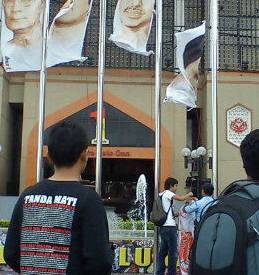 Every personality cult has to be debunked, and we have started to see it happening in Malaysia. Adam Adli’s bravery in lowering the flag with an image of Najib Abdul Razak is epoch-making, for want of a better word.
The act by the student activist may have looked symbolic, it has since assumed national and historical significance nonetheless. It was a bold statement to make: no to state oppression and yes to academic freedom, and it went down very well with young Malaysians whose minds had been so stifled over the years.
The counter-video by a group of creative youths to mock the saber-rattling Umno youth leaders is fun to watch, proving that Malaysia’s got talent!
Nothing, practically nothing, that Najib has said and done since becoming the apprentice prime minister has inspired young Malaysians in any way.
He may know the gimmicks: appearing on radio shows and putting on a football jersey, but all this is utterly lacking in substance. Adam is therefore right: he has made his point and stands by it, for respect has to be earned, not demanded.
Never feel sorry for a nation that has no heroes, for we should pity those that actually need one. Havel was never regarded as a hero, but his courage and noble ideas as a Czech citizen made national revival possible, and one that is built on firm foundation.
He just happened to be one of them who chose to speak out and respond to the challenge when the circumstances called for it.
What Malaysia desperately needs now is not another “visionary” who only ends up squandering the nation’s wealth with his/her cronies as Mahathir has done, but a leader who is principled and of strong conviction.
Seen in this light, what Adam has done is not something heroic, but it does carry a very loud and strong message: it is time to debunk the personality cult, and it ought to start with lowering the flag that carries any personality that is undeserving of the honour in the first place.
JOSH HONG studied politics at London Metropolitan University and the School of Oriental and African Studies, University of London. A keen watcher of domestic and international politics, he longs for a day when Malaysians will learn and master the art of self-mockery, and enjoy life to the full in spite of politicians.


