




Reporting crime in context
A friend alerted me to a story , ‘Hand it to the docs’, in theSun Daily (Feb 15, 2012). It was about an insurance agent named Poon who had his hand severed by three robbers when he was withdrawing money from an ATM in Ampang on Feb 3.
The story had three photos - micro-surgeon Dr Palani Ramasamy who reattached Poon’s hand; Gleneagles hospital staff holding the severed hand they found some 100m from the ATM machine; and, in an aluminum bowl, Poon’s hand with its mangled flesh and exposed jagged bones. That’s where the story had me aghast.
A friend alerted me to a story , ‘Hand it to the docs’, in theSun Daily (Feb 15, 2012). It was about an insurance agent named Poon who had his hand severed by three robbers when he was withdrawing money from an ATM in Ampang on Feb 3.
The story had three photos - micro-surgeon Dr Palani Ramasamy who reattached Poon’s hand; Gleneagles hospital staff holding the severed hand they found some 100m from the cash machine; and, in an aluminum bowl, Poon’s hand with its mangled flesh and exposed jagged bones. That’s where the story had me aghast.
If it bleeds it leads. That’s long been the practice of gutter journalism. That’s what theSun Daily did in running in its news site the graphic photo. The story’s explanation would have sufficed. But no. The story came apart on my first reading.
It said the 46-year-old insurance agent managed to drive 2km to Gleneagles’ emergency ward. But how did Poon manage to stumble back to his car, open the car door, start the engine, engaged the gear, then drive 2km to Gleneagles along Jalan Ampang with his right hand, while blood gushed from his left? How did Poon stem the arterial bleeding? In which building along Jalan Ampang was the ATM located?
Poon could conceivably do all this in his flight-or-fight response. His hypothalamus would go into overdrive, pumping adrenaline through his system, sharpening his sight and numbing his pain so he could get to Gleneagles before shock set in.
The robbery happened on Feb 3. The story was published on Feb 15. Was the story prompted by a call from Gleneagles public relations, which probably provided the photos? I could be wrong. But the story sure sounded like a PR piece going by the reporter’s intro: ‘The quick action and exemplary dedication of the doctors from Gleneagles Hospital Jalan Ampang, led to the severed hand being reattached to its owner …’
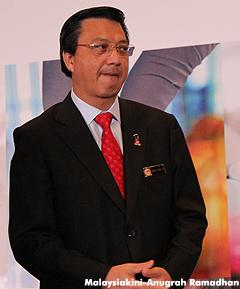 I am glad to read in a follow-up story (Feb 17) that Poon has recovered well, a week after the eight-hour microsurgery by Ramasamy and his team. The story ran a statement from Health Minister Liow Tiong Lai
(left)
, who commended the doctors for their skills.
I am glad to read in a follow-up story (Feb 17) that Poon has recovered well, a week after the eight-hour microsurgery by Ramasamy and his team. The story ran a statement from Health Minister Liow Tiong Lai
(left)
, who commended the doctors for their skills.
But in the bigger scheme of things, the minister’s statement did not count for much to address the issue of violent crime in Kuala Lumpur. Malaysian journalism has a curious practice of quoting ministers regardless of their relevance to the victims in a story. What does the health minister have to say about public safety?
The real question behind Poon’s trauma is whether violent crimes in Kuala Lumpur are in fact increasing as implied in the story. And, why were the police slow in responding to Gleneagles’ phone alert? Or, did the police rush to the crime scene at all?
Where’s the context?
Reporting about crime without clarifying the context often ends up attracting ‘tch tch’ responses from readers. Then, it’s business as usual. Such reactive reporting only serves to reinforce the fear: ‘Don’t go out after dark in KL’.
Is crime rate in KL any worse than other over-populated cities where residents live alongside legal and illegal migrant labour, where disparities in wealth are wide and opportunities for work are scarce, where police are underpaid, under qualified and thus bear a greater propensity to be corrupt?
A paper by ACP Amar Singh Sidhu published in ‘Journal of the Kuala Lumpur Royal Malaysia Police College’ (No. 5, 2006) provides good background reading for crime reporters.
TheSun Daily's story underlines the need for reporters to be highly aware of becoming desensitised to violent crimes, and consequently merely reacting to crimes in the city as an unfortunate but ‘normal' part of urban life. Which then means that for a crime story to be reported, the event will need to be more dramatic, more bloody, more violent, more shocking. That would be morbid journalism at its worst.
 Whether violent crimes have been trending up, down or stablised over the last five to 10 years in KL needs to be thoroughly researched, sourced and verified for context.
What types of crimes are more often committed that result in loss of limbs and lives? Are the perpetrators from particular ethnic groups of certain age and gender? Are the crimes organised or mere random acts? Does crime occur at particular times of the day, at particular venues?
Journalists need to be more proactive and transparent in reporting crime stories. A single story, such as Poon’s, raises so many questions that local papers should responsibly address in a special feature series, capitalising on the investigative skills of their journalists, complemented by hyperlocal reporting and ‘crowd sourcing’ as has been done for some time now by public service media.
Journalists need to take these practical steps to address the public fear that KL is becoming a high-risk destination.
 Malaysia’s public safety record does not look good overseas. Travel advisories by governments in Australia, UK, Canada and the US say similar things about Malaysia: "Incidents of bag snatching are common. There have been many cases of bags being snatched by thieves on motorbikes.
"When going out, avoid carrying valuables with you. Bags with shoulder straps should either be carried with the bag towards the pavement rather than the road, or tucked under the arm. Do not wrap the strap around your arm or shoulder and do not try to hold on to your bag. People have been injured or killed by being pulled to the ground by their bag straps."
TheSun Daily's story for its lack of context and narrow news frame only serves to perpetuate this impression.
ERIC LOO left Malaysia for Australia in 1986 to work as a journalist. He currently lectures at University of Wollongong, Australia, and also mentors international journalism students via UPIU.com , run by United Press International. He edits a refereed journal Asia Pacific Media Educator published by SAGE Publications (New Delhi) and conducts journalism training workshops in Asia. Email: eloo@uow.edu.au


Are you sure you want to delete this comment?
This action cannot be undone.