




TPPA is no panacea
It is reported that both Mahathir Mohamad and his nemesis Anwar Ibrahim may appear on the same platform in Kampung Baru, Kuala Lumpur, to speak against the proposed Trans-Pacific Partnership Agreement (TPPA) on the eve of Barack Obama’s historic visit to Malaysia.
It is reported that both Mahathir Mohamad and his nemesis Anwar Ibrahim may appear on the same platform in Kampung Baru, Kuala Lumpur, to speak against the proposed Trans-Pacific Partnership Agreement (TPPA) on the eve of Barack Obama’s historic visit to Malaysia.
 My abhorrence of Mahathir and his politics is well-known. Be that as it may, if the presence of the two highly influential figures can help put a halt to the TPPA negotiations on the part of the Najib Abdul Razak administration then so be it, although I remain acutely aware that the Mahathir family have first and foremost their own interests to protect.
For instance, as much as 90 percent of Washington’s procurements are given to American conglomerates, especially in the oil and gas sector. Should the TPPA be signed and go into effect, can our local oil and gas contractors compete with their American counterparts?
I am more than certain Mahathir, in his vehement opposition to the potentially largest trade agreement in the world’s history, has in mind Sapura Kencana Petroleum , of which his son Mokhzani is a significant stakeholder.
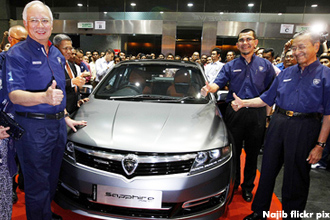 This aside, also included in the TPPA package is the car manufacturing sector, which represents yet another serious concern of Mahathir’s. Arguably the most important adviser to Proton, Mahathir is no doubt deeply worried that opening up the car market would render our national cars thoroughly uncompetitive in the face of the superior American, Japanese and South Korean products. It could even hasten the demise of the national brand that he holds dear.
Unlike Mahathir who has his son’s interests to take care of, my objection to the TPPA is informed by a strong likelihood that it would have a severe impact on Malaysia’s small and medium enterprises.
It is true that Malaysia is one of the biggest trading nations, but it does not necessarily mean signing the TPPA would naturally enhance our competitiveness.
Take the agriculture sector, for instance. Thanks to the decades of neglect by successive governments, and by that of Mahathir’s in particular because the ‘visionary leader’ was convinced of an industrialised future while being disdainful of farming and fishing, our agricultural products would be put at a disadvantage when confronted with those from Australia, New Zealand and the US.
Currently, imported rice from outside of Asean is subject to a 40 percent tariff. Still, Malaysia’s rice industry is already facing a stiff competition from Thailand. Should this be removed as required by the TPPA, one can foresee the complete collapse of our rice industry.
Invest in R&D
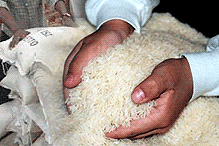 I agree we should make every effort to improve the quality of our rice, but the way to do it is not to fling the door wide open and allow cheap foreign rice to flood in. Rather, the government must do its utmost to invest in research and development (R&D) so that our agricultural products can be improved and made competitive.
It is worth reminding here that up to 2 million Mexican farmers lost their jobs in the 1990s as a result of the North American Free Trade Agreement (Nafta), triggering a crisis of undocumented Mexican migrants crossing into Texas, New Mexico and Florida in the southern US.
Signing more free-trade agreements is not the only answer to a globalising trade environment, but R&D is among the viable solutions. Unless we are prepared for the day when we have to even rely on imported food crops and diaries, we must not simply be led to believe the TPPA would instantly transform Malaysia’s competitiveness.
Has one ever pondered why, for their wealth and status as developed nations, South Korea, Japan, the US, Australia and New Zealand continue to invest hugely in the agriculture sector? A comprehensive and far-sighted national strategy would not be complete without the agenda of food security.
It is the same with the car industry. While I am equally unhappy with the sacrosanct protectionist policy in regard to Proton, the company should invest much more in R&D to raise its standards and image, preferably with a foreign partner.
 In 2007, Volkswagen ended talks with Proton on a proposed strategic partnership as the latter would not allow the German car manufacturer to have a controlling share. It would have been a golden opportunity for Proton to become a truly international brand had it conceded to the Germans.
What I am getting at is that we do not have to sign an all-encompassing trade pact like the TPPA in order to improve our car industry as this can be done under separate and specific arrangements.
As for the labour-intensive sectors such as construction and manufacturing, our heavy reliance on migrant workers and lack of environmental considerations have long been a taxing topic. Due to the provisions relating to labour standards and environmental regulations under the TPPA, Malaysia would be hard pressed to reform its labour and environmental laws.
This should be a positive development in the long term because I, too. am terribly dismayed at the way we treat our workers and dismiss the environmental repercussions, but the problem is that the US is pushing for the deal to be struck at a lightening speed, leaving little time and space for Malaysia to look into how these challenges can be overcome.
If the agreement is signed prematurely, it would only lead to higher costs detrimental to the survival of our struggling SMEs.
Furthermore, the US delegation is made up of a large number of experienced and distinguished lawyers who come with the expertise in various sectors. On the contrary, the Najib government is still unable to convince the general public that our representatives are capable enough to handle all the complex trade issues.
Painful lesson
Have we not learned the painful lesson that the devil is in the details? This is precisely one reason why Vietnam is lukewarm towards the TPPA despite being on board, for it lacks sufficient personnel with the expertise required to analyse in greater depth the potential implications of the deal.
Last but not least, the US is seeking to turn the TPPA into a geopolitical pawn so as to rein in China’s economic prowess in the region. So long as Beijing is excluded from the club, there is every possibility that the Chinese government would in response promote its own version of a trade block in the region, forcing smaller countries such as Malaysia to choose between the two giants and thereby hindering the process of Asean’s economic integration.
With this in mind, Malaysians must urge the Najib government to disclose the contents of the negotiations so far and make itself accountable to Parliament. Otherwise, a deal shrouded in the thick veil of secrecy with messy consequences is not worth signing at all.
JOSH HONG studied politics at London Metropolitan University and the School of Oriental and African Studies, University of London. A keen watcher of domestic and international politics, he longs for a day when Malaysians will learn and master the art of self-mockery, and enjoy life to the full in spite of politicians.


Are you sure you want to delete this comment?
This action cannot be undone.