




Anwar and the dangers of mediation
While observers are still uncertain about Anwar Ibrahim's path of political career, the former deputy premier has been contemplating his possible role as a mediator between Islam and the West.
 Hours after he left for Munich to seek medical treatment for his back ailment, Anwar pondered about the urgency of dialogue and his diplomatic role in bridging the two worlds in the war against terrorism.
In an interview with International Herald Tribune 's journalist, Thomas Fueller, Anwar criticises Muslims for lack of self-introspection in dealing with their own shortcomings. He slams those Muslims who are quick to blame others for their problems, and as such are devoid of the real voice of conscience. Further, he also condemns the West for their failure to understand the root causes of terrorism.
For Anwar, "the battle of terrorism is a battle of hearts and minds", in which Muslims must be challenged, "on whether a society devoid of such principles of democracy, civil society and tolerance is legitimately Islamic". Elsewhere, he speaks about the need for more openness and wider space for participatory democracy in Muslim countries as a means to check the rise of Muslim extremists, who are more likely to resort to terrorism in pursuing their struggle. Democracy, which is essentially a Western doctrine, may pave the way for annihilation of Muslim's predicaments.
While observers are still uncertain about Anwar Ibrahim's path of political career, the former deputy premier has been contemplating his possible role as a mediator between Islam and the West.
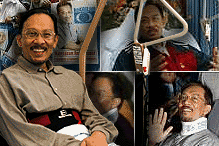 Hours after he left for Munich to seek medical treatment for his back ailment, Anwar pondered about the urgency of dialogue and his diplomatic role in bridging the two worlds in the war against terrorism.
In an interview with International Herald Tribune 's journalist, Thomas Fueller, Anwar criticises Muslims for lack of self-introspection in dealing with their own shortcomings. He slams those Muslims who are quick to blame others for their problems, and as such are devoid of the real voice of conscience. Further, he also condemns the West for their failure to understand the root causes of terrorism.
For Anwar, "the battle of terrorism is a battle of hearts and minds", in which Muslims must be challenged, "on whether a society devoid of such principles of democracy, civil society and tolerance is legitimately Islamic". Elsewhere, he speaks about the need for more openness and wider space for participatory democracy in Muslim countries as a means to check the rise of Muslim extremists, who are more likely to resort to terrorism in pursuing their struggle. Democracy, which is essentially a Western doctrine, may pave the way for annihilation of Muslim's predicaments.
Symbiotic relation
This unorthodox view about Islam, or the East generally, and the West is not uncharacteristic of Anwar. In The Asian Renaissance penned while he was in office, Anwar dwells on the symbiotic relation between East and West and the importance of civilisational dialogue. To make the dialogue fruitful, both East and West, Anwar maintains, must look at each other in new perspective untainted by bitter past experiences.
He remarks, "the East must look beyond the Crusades and the era of colonialism, while the West must look at the East and the rest of the world in a new light, a perspective illuminated by humility and sincerity."
In the 1990s, Anwar's civilisational dialogue came to a head not only with the developed West's cultural jingoism, but also post-colonial language of most Third World leaders, who viewed the West as nothing more than neo-colonisers in their midst. Democracy, freedom and human rights were regarded as tools by which the West overthrew governments in developing countries and plundered people's wealth. The establishment groups in these countries thus preferred anti-pluralist politics to a plural one.
The governments stifled dissent and instituted an array of political controls to limit the scope for political competition, while maintaining corrupt leaders in power. All this was done in the name of maintaining political stability, a prerequisite for rapid state-led economic development. Asia's booming years in the early 1990s served as a vindication of this distinctively "Asian values" politics.
Anwar, however, had a nuanced view of the Asian values. While he acknowledged that Asians, unlike the Westerners, need to traverse a different trajectory in practicing democracy, he cautioned that Asians should be less arrogant in condemning the West and concentrate more on remedying the shortcomings of their own societies, including poverty, corruption and moral decay.
'Arrogant' leaders
In an interview with The Australian Financial Review in June 1994, Anwar condemned some Asian leaders who "tend to be even on the verge of arrogance when they only look at the excesses of the West and assume that everything's all right in the East." Further, he called for "more dialogue and rapprochement between the West and the East because the future rests ultimately with the complementarity of both the strengths of the West and the East."
Anwar's inclusive approach to East-West relation struck a chord with many leaders in the West. While in office, he used this platform to forge closer ties with Western governments and influential international organizsations. It therefore came as no surprise that his sacking, trial and imprisonment drew international criticisms.
Even after six years being out of office, Anwar still gravitates international concern. Among his visitors at Alpha Klinik in Munich, where he was recuperating from back surgery, were former Indonesian President, BJ Habibie, former Australian Foreign Minister, Gareth Evan and renowned Islamic scholar and former Director of International Institute of Islamic Thought, Dr Jamal Barzinji.
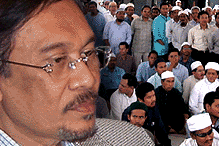 Habibie promised Anwar of whatever resources he had to help realise the latter's vision of peaceful coexistence between Muslims and non-Muslims. Former US vice-president Al Gore, also expressed his concern and willingness to work with Anwar in forging better understanding between Islam and the West.
When I was in Munich visiting Anwar, on Oct 5, 2004, he received a visit from the US Deputy Defence Secretary, Paul Wolfowitz, a neo-con figure responsible for the US invasion of Iraq where Wolfowitz and Anwar had a two hours debate and discussion on various issues involving Muslims especially terrorism, Iraq and Palestine.
He later on in his press conference after the meeting mentioned had conveyed his position on US foreign policy on Iraq and Palestine and urged that the superpower gives serious consideration to the position of all major parties concerned.
While he agreed with Wolfowitz that terrorist activities and insane killing of innocent lives cannot be condoned, he also maintained that it would not serve the cause of attaining a lasting and durable peace and global security while large sections of people and communities continue to be politically marginalised and dispossessed.
'Sold out' perception
Though Anwar's image as the 'darling of the West' gives him much needed advantage to resume a diplomatic role in bridging East/Islam-West divide, in the war against terrorism, he needs to be wary of possible efforts to once again dub him as having been 'sold out' to the West. He had paid a high price for such an image approximately six years ago.
Apart from that, given Anwar's non-government position, the effectiveness of his role as a 'diplomat' to large extent will depend on the space allowed by the Malaysian political regime under Prime Minister Abdullah Ahmad Badawi as well as the intricacies of diplomatic relations between nations.
Abdullah in his speech at Oxford University on Oct 1 highlighted the importance of dialogue in solving the conflicts involving Islam and the West at present. He also announced that Malaysia would establish a centre for conflict resolution to find ways and means to overcome the conflicts.
Given the present mood not to look back but to move forward, will Anwar have any role to play in the government's initiative, for the country's sake and that of the human race?
SHAMSUL ISKANDAR MOHD AKIN is the vice Youth chief of Parti Keadilan Rakyat. He visited Anwar Ibrahim in Munich on Oct 3 2004.


Are you sure you want to delete this comment?
This action cannot be undone.