




The four Rs of Malaysian politics
The political landscape in Malaysia is very much defined by race, religion and (economic) rent. These are the three Rs that give Malaysia its current texture; they both form and fragment the country along various ethnic and economic lines.
Separately, or together, the politics of communalism (ie race), ideology (ie religion) and corporatisation (ie rent) have been responsible for various debates in Malaysia, some of which have turned ugly, leading to organised violence, purges, and virulent political campaigns on the streets.
With the advent of globalisation, there has been the increasing belief, both at the level of the elite and laity, that Malaysia can no longer be dogged by the three Rs, anymore than it can be divided perpetually along these lines. Hence, the existence and clamour for the fourth R: reform.
Due to the gargantuan nature of these reforms, hopes have been pinned on Prime Minister Abdullah Ahmad Badawi. As the president of Umno, the strongest party that forms the mainstay of the National Front coalition, Abdullah Badawi is regarded as the person with which reforms could either fail or succeed.
The political landscape in Malaysia is very much defined by race, religion and (economic) rent. These are the three Rs that give Malaysia its current texture; they both form and fragment the country along various ethnic and economic lines.
Separately, or together, the politics of communalism (ie race), ideology (ie religion) and corporatisation (ie rent) have been responsible for various debates in Malaysia, some of which have turned ugly, leading to organised violence, purges, and virulent political campaigns on the streets.
With the advent of globalisation, there has been the increasing belief, both at the level of the elite and laity, that Malaysia can no longer be dogged by the three Rs, anymore than it can be divided perpetually along these lines. Hence, the existence and clamour for the fourth R: reform.
Due to the gargantuan nature of these reforms, hopes have been pinned on Prime Minister Abdullah Ahmad Badawi. As the president of Umno, the strongest party that forms the mainstay of the National Front coalition, Abdullah Badawi is regarded as the person with which reforms could either fail or succeed.
Enormous attention is invariably placed on Abdullah`s political position in Umno too. With the conclusion of the recent Umno election, however, where almost all of Abdullah`s cabinet ministers failed to secure a position in the Umno supreme council, there is the fear that Abdullah's reforms are numbered.
With the exception of Muyiddin Yassin, who is arguably the strongest supporter of Abdullah within Umno, there exists no signs that bold reforms could be attempted. Instead, the political fortune of Deputy Prime Minister Najib Abdul Razak seems to have risen, as most of the men in Umno are known as his allies.
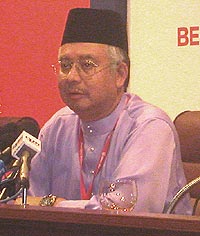 In this context, the Najib paradox - a phrase coined by Khairy Jamaluddin in 1999 to signify the strange position of Najib being the strongest leader in Umno, yet inordinately weak in his own constituency in Pekan, Pahang - has come a full circle. The Najib paradox is now afflicting Abdullah in Umno, just as he is regarded as a popular prime minister.
No discernible support
Hence, while Abdullah has received the widest mandate in the recent national election in March this year to reform the country along the three Rs, especially corruption rendered by unequal distribution of rent, there has been no discernible support in Umno to help him achieve the reforms that he desires.
Equally, Anwar Ibrahim is foiled by his own paradox too. While he commands the support of the opposition and civil society to seek reforms comprehensively, he remains barred from office. Nor are his supporters any closer to the corridors of power to make any discernible impact.
In this context, some have spoken of the need for Abdullah and Anwar to join forces at some stage to consolidate their respective positions to advance their reformist agenda.
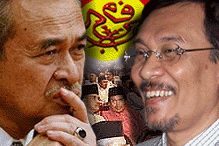 While this position may be strategically plausible, it over-assumes the ease with which the agenda of both leaders may be able to converge. Take the politics of rent, for instance. Anwar believes in `creative destruction`, in other words of allowing government-linked companies to face more free market competition.
Although this concept is borrowed from Austrian economist Joseph Schumpeter, the root of creative destruction is actually traceable to the works of Imam Al Ghazali, with whom Anwar has the greatest admiration.
Indeed, Ghazali`s idea preceded the free market doctrine of Adam Smith by some 600 years. Anwar feels sufficiently vindicated that free market competition is the key to Malaysia`s economic growth.
Full scale reforms
Abdullah, on the other hand, does not necessarily accept that this is the way forward. Being a cautious leader, Abdullah believes that full scale reforms, which may subject all 400 government-linked companies to the frenzied competition of the free market may actually throw the national economy into a tailspin.
This is because together these companies own more than 70 % of the total capitalisation at the Kuala Lumpur Stock Exchange (KLSE). Reforms that are too sudden would inject great volatility into the stock market.
As such, Abdullah has sought to change the top management of Khazanah first. In addition, he has also insisted that Khazanah and others meet key performance metrics too; one of which being higher returns to government as the most crucial indicator of whether a company is performing or not.
On religion, Anwar and Abdullah have already clashed on the idea of Islam Hadhari; with the former insisting that Islam Hadhari is 'conceptually flawed' since it speaks of introducing the politics of moderation when in fact Malaysia is in need of a greater dose of reform that is more intrusive and radical.
Intellectual visions
Thus, the specter of Abdullah and Anwar working together to resolve each of their paradoxes, while logical in the interim, cannot be easily papered over at this stage. Their intellectual visions remain too diverged.
 There is also a need for an interlocutor - a silent operator - to unite both factions. Of course, Musa Hitam, a respectable leader to both sides, could perform such a role. But the position of Abdullah is not as dire as it seems that he must necessarily reach out to Anwar first, or through Musa.
Nor would Najib, for that matter, want to precipitate anything that would lead to the return of Anwar to Umno to challenge his position.
In sum, although the politics of Malaysia are known for sudden radical turns, the current situation does not necessarily lead to urgent actions by Abdullah, Anwar or others interested in reforming the three Rs to make bold moves.
All are in the watch-mode to see how their paradoxes can be quietly resolved through patient log-rolling (ie trading of concessions), without the quick resort to the forming of alliances - both within the party, or without.
PHAR KIM BENG graduated from the International Islamic University in 1994 as a Muslim convert, having previously been a Buddhist. He has travelled around the world studying at the University of Notre Dame, where he understood the beauty of Catholic scholarship, the University of Cambridge, where he learned the importance of British education, and later the University of Tokyo, where he learned his survival Japanese.


Are you sure you want to delete this comment?
This action cannot be undone.