




Resistance is not futile
On Monday, Jan 20, 2003, police raided the office of malaysiakini and caused a disruption of about 10 hours that day. The raid was brought on by a police report filed three days earlier by Azimi Daim of Umno Youth, who alleged that a letter by one Petrof was seditious as it purportedly questioned the special privileges of the Malays. The letter was uploaded by malaysiakini on Jan 9.
Like the Petrof incident, no visitor to Screenshots , a personal online diary belonging to Jeff Ooi, seemed especially perturbed when a person nicknamed 'Anwar' blogged an entry on Sept 30 on ' Islam Hadhari and money politics '. It was a non-event. It was Umno's own actions which spiraled events to notoriety.
Anwar, who disagreed with blog owner, Ooi's view that Islam Hadhari and money politics is akin to water and oil, responded that the two is more likened to 'faeces and urine'. The analogy or metaphor of excrement appears to be a commonly used political comment. Several years ago, author Shahnon Ahmad wrote ' Shit ' regarding the political events of 1998 and that sold like hotcakes on the streets of reformasi.
I grew up in a Malay kampong . Villagers are civil to one another in broad daylight. However, villagers do occasionally express their disgust by hurling human excrement in the dead of night at houses of those who have overstepped the bounds of common decency. The shaming would continue until the offenders clean-up their act or leave the village.
On Monday, Jan 20, 2003, police raided the office of malaysiakini and caused a disruption of about 10 hours that day. The raid was brought on by a police report filed three days earlier by Azimi Daim of Umno Youth, who alleged that a letter by one Petrof was seditious as it purportedly questioned the special privileges of the Malays. The letter was uploaded by malaysiakini on Jan 9.
Like the Petrof incident, no visitor to Screenshots , a personal online diary belonging to Jeff Ooi, seemed especially perturbed when a person nicknamed 'Anwar' blogged an entry on Sept 30 on ' Islam Hadhari and money politics '. It was a non-event. It was Umno's own actions which spiraled events to notoriety.
Anwar, who disagreed with blog owner, Ooi's view that Islam Hadhari and money politics is akin to water and oil, responded that the two is more likened to 'faeces and urine'. The analogy or metaphor of excrement appears to be a commonly used political comment. Several years ago, author Shahnon Ahmad wrote ' Shit ' regarding the political events of 1998 and that sold like hotcakes on the streets of reformasi.
I grew up in a Malay kampong . Villagers are civil to one another in broad daylight. However, villagers do occasionally express their disgust by hurling human excrement in the dead of night at houses of those who have overstepped the bounds of common decency. The shaming would continue until the offenders clean-up their act or leave the village.
According to visitors to Screenshots , Anwar was registering his disgust at Umno's failure to curb corruption. It was not about ridiculing Islam.
Ooi censored Anwar's particular comment on Oct 1, reasoning that the posting could be offensive or blasphemous to visitors to his blog. He further barred Anwar from making further entries. Screenshots is like Ooi's home and the visitor, Anwar, had messed that space. Ooi has censored entries in Screenshots before this, as visitor-guests and blog-owner develop the rules of respect to the public-space in a private domain.
Sense and sensibility prevail in independent media without arm-twisting tactics and threats to personal liberty.
Contrived crisis
Malaysians and the rest of the world who were once oblivious of Malaysia's 'most influential blog' are now acquainted with it, thanks to Umno. Berita Harian (BH), "an Umno mouthpiece" according to Ooi, is a Malay-language broadsheet with an average daily circulation of 230,000 nationwide. BH is published by the New Straits Times Press (NSTP) group.
Unlike the Petrof incident, where the Umno Youth police report sprung police into raiding malaysiakini last year, police investigation of Screenshots was brought on by "media reports regarding the issue".
The media reports led Abdullah Ahmad Badawi to raise the spectre of sedition. The Deputy Internal Security Minister Noh Omar warned that he could invoke the Internal Security Act against Ooi. Sensitive issues of race and religion are construed as matters of "national security". Umno Youth's Khairy Jamaluddin, ahead of the fray, demanded an apology from Ooi, a call echoed by Kalimullah Hassan, the NSTP group editor-in-chief.
At the time of writing, police are not letting up on its "preliminary probe". Mimos Berhad, according to Energy, Works and Communications Minister Lim Keng Yaik has been tasked to investigate and take action. The government is in such an awful huff over a "contrived crisis" said opposition leader, Lim Kit Siang.
 From reports in
malaysiakini
and Ooi's own meticulous explanations in
Screenshots
, BH doctored its front-page news on Oct 2, maligning both Ooi and
Screenshots
. This means that police relied on a false report, but the reporter, editor, BH or NSTP are not charged nor chastised by the government, or investigated by the police.
From reports in
malaysiakini
and Ooi's own meticulous explanations in
Screenshots
, BH doctored its front-page news on Oct 2, maligning both Ooi and
Screenshots
. This means that police relied on a false report, but the reporter, editor, BH or NSTP are not charged nor chastised by the government, or investigated by the police.
Malaysians do not have such short memories. Human rights activist, Irene Fernandez who is currently undergoing the longest trial in Malaysian history was charged for making a false report of migrant workers' deaths in a detention centre. Fernandez denied the government's false report allegations, but had to face a debilitating trial to prove her innocence.
We still remember the unfortunate case of the Sun a few years ago. It was shut-down, its journalists retrenched after its report on an alleged assassination attempt on the former prime minister, Dr Mahathir Mohamad caused government ire. That story could not be followed up to determine the truth of the matter. The former Sun editors are suffering a civil suit for libel. From commentators, the Sun 's "faults" included its fair reporting and commentaries especially on the 1999 general election.
Moral panic
There is I think, public resonance in PAS's Husam Musa's observation that government posturing over the matter was ill- conceived. It would be mature for the government to accommodate the voices of civil society and to respect public opinion.
He called upon the government to clarify its concept of Islam Hadhari, which he likened to "Umno's political product". He reminded the media to adhere to professional ethics and that the ruckus must not be allowed to overshadow the issue of money politics in Umno.
By now, most of us have relegated the episode as a storm in a tea-cup. Some have pointed out to some alleged personal problem between Kalimullah and Ooi.
However these sentiments belie the fact that human rights defenders, whistle blowers, independent media and blog owners are endangered everyday by government reaction to free speech, expression and free press. Ooi sums it up after a week of harassment as "resistance is not futile".
There is a more appalling side to this latest incident. According to everyone who has an opinion on the matter, BH did a story which gave the excuse to justify particular actions to be taken or threatened to be taken as necessary to rectify the problem. The public is no longer gullible.
Stan Cohen (1973) has an analysis of the construction of a moral panic. Its four components are 1) exaggeration and distortion of the incidents, 2) symbolism, which includes the use of labels, images and icons to identify 'folk devils' who can be blamed for stigmatised behaviour, 3) manufacturing news such as reporting on the basis of their conformity with previously-established images and stereotypes as for example a reporting of perceived religious/ ethnic clash or disruption and 4) reaction and control where in response to the public anxiety thus created, agents of social control (police, lawmakers, judges) called to manage the deviant/group.
This is a very helpful analysis to situations like the present, and I can be sure that the intelligent public can figure out the instances when crisis construction has occurred in the past before the end of this article.
A most recent memory of an instance of moral panic in relation to religion may be the 1994 crackdown of the al-Arqam. It was the first time a human rights group like Suaram for instance had worked on ISA in relation to religion. As a volunteer with Suaram at that time, I think the crackdown brought human rights activism to another level. It demystified Islam and state power to a broader range of activists and it shaped the collective memory of civil society.
Muslim deviants and communists
On June 22, 1994, the New Straits Times (NST) cited Abdul Hamid Othman, then a deputy minister in the Prime Minister's department as saying that there was an urgent need to curb the influence of al-Arqam failing which the country could face serious social order. In mid-June Mahathir, then prime minister went to press stating that al-Arqam was suspected of setting up an army and that it was a threat to national security.
Nanyang Siang Pau on June 26 interviewed one Suya Sulaiman who refuted the government's allegations and invited the media to visit any of the al-Arqam communities at home (56) and abroad (15). There were other offers from the community to government officials for engagement. The Star quoted Hamid Othman on July 3 that the government had no plans for engagement or community visits.
The Star reported on July 5 that the speaker refused a DAP (Ahmad Nor-Bayan Baru) motion urging the government to present evidence of al-Arqam's alleged deviant teachings.
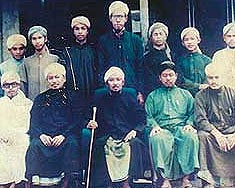 On August 5 the National Fatwa Council issued a fatwa declaring al-Arqam illegal describing it to be "the biggest threat since the communist insurgency" (
The Star
, Aug 7). On Aug 8, the
NST
reported that the Domestic Trade and Consumer Affairs Ministry has directed that all products bearing the al-Arqam logo and name be removed from all shelves of retail outlets with immediate effect.
On August 5 the National Fatwa Council issued a fatwa declaring al-Arqam illegal describing it to be "the biggest threat since the communist insurgency" (
The Star
, Aug 7). On Aug 8, the
NST
reported that the Domestic Trade and Consumer Affairs Ministry has directed that all products bearing the al-Arqam logo and name be removed from all shelves of retail outlets with immediate effect.
From Sept 2, 1994, 11 al-Arqam leaders including their legal adviser were detained under the ISA. The communities were raided by armed personnel. Most of the raids were conducted between midnight and dawn in communities whose residents were mostlywomen and children.
According to al-Arqam sources quoted by Suaram, more than 300 people were arrested for offences under the Printing Presses and Publications Act and 20 under the Societies Act in the crackdown. In one raid in Perlis on Oct 1, 90 people including women and children were arrested. The community's businesses, schools and communication centres were shut-down and properties were confiscated.
The allegedly deviant al-Arqam movement was disbanded, its leaders "rehabilitated". The ISA al-Arqam detainees confessed their deviancy over national television. They were not charged under any state criminal law for deviant teachings. There has been no further information on the alleged al-Arqam army.
Nasr (2001) opined that it was easier for the government to crackdown on al-Arqam than PAS or Abim because al-Arqam's "particular reading of Islam and sartorial regulations set it apart from mainstream Islam in Malaysia".
There are undoubtedly good reasons to think that when governments intervene, they do so as often in the interests of the governors as in the public interest. There are also good reasons to believe that even public-minded governmental action can be mistaken or misguided.
Speech about the activities of government is a means of control. Public knowledge of what politicians are up to keeps them straight and narrow and accountable. The attainment of the best government is served by access to information, free discussion, openness of discourse and the opportunity to disseminate it. Indeed, resistance is not futile.
References:
Majlis Syuyukh al-Arqam (undated, circa 1994), Isu al Arqam & Pusat Islam, Siri Jawapan dan Penjelasan vol 1 & 2 .
Charles Hector (1994), " The Arqam Affair, Detention Without Trial and Human Rights ," Suaram Update, October 1994 (Suaram).
Abdullahi A. An-Naim (1999), " The Cultural Mediation of Human Rights: The al-Arqam case in Malaysia ", in Joanne Bauer et.al (eds), The East Asian Challenge for Human Rights (London: Cambridge University Press) 147-168
Michael Hill (1988), " Conversion and subversion: Religion and management of moral panic in Singapore ," (Victoria University of Wellington, N.Z : Asian Studies Institute Publications
Deliar Noer (1983), " Contemporary Political Dimensions of Islam ," in M.B. Hooker (ed), Islam in South East Asia (Leiden: Brill) 183-215
Seyyed Vali Reza Nasr (2001), Islamic Leviathan: Islam and the Making of State Power (Oxford NY: Oxford University Press)
Stan Cohen (1973), Folk Devils and Moral Panics (St. Albans: Paladin)


Are you sure you want to delete this comment?
This action cannot be undone.