




Anwar and Malaysia's arthritic political parties
Malaysia is hobbled by its governing coalition and opposition, stricken with political arthritis. The years of neglect demand a price neither could afford nor want to pay, and controlled for years by financial, religious, political placebos.
The National Front (BN) government believed its electoral monopoly made it invincible; the opposition believed their disparate political philosophies and a feeble electoral coalition at general election time could sweep it into power.
All it did was to put in place an utter inability to shake out of their respective arthritic political frames and stop the rot, for want of thinking and political statesmanship.
It can only be set right with the help of an external force. Political parties, in government and opposition, disagree. But politics in Malaysia has moved away, in five decades, from principle and ideas, to sycophantic follow-the-leader. Nothing else matters.
Malaysia is hobbled by its governing coalition and opposition, stricken with political arthritis. The years of neglect demand a price neither could afford nor want to pay, and controlled for years by financial, religious, political placebos.
The National Front (BN) government believed its electoral monopoly made it invincible; the opposition believed their disparate political philosophies and a feeble electoral coalition at general election time could sweep it into power.
All it did was to put in place an utter inability to shake out of their respective arthritic political frames and stop the rot, for want of thinking and political statesmanship.
It can only be set right with the help of an external force. Political parties, in government and opposition, disagree. But politics in Malaysia has moved away, in five decades, from principle and ideas, to sycophantic follow-the-leader. Nothing else matters.
Whichever political party you look at, it is not politics but leaders who matter, even in PAS, the most principled of Malaysian political parties, policies depend on who is the leader. More time is spent on leaders than what they fight for.
The soul of a political party is held hostage to who is in power. Over the years, it cannot even renew itself, for the outsider sees only a squabbling party, unable to decide if it is fish or fowl. As decades pass, the leaders cringe in embarrassment over what it once stood for, as they lose their way.
A thousand mutinies in BN, even if it does not spill into the public eye, hold its leaders to ransom, even as they insist that all is well, explaining it all as proof of democracy within.
The mutinies in the opposition are no less serious; unity is possible only when all the others subscribe to the other's political dictates. The peace of the graveyard is the prevailing
political overview.
No clear idea
Politics in Malaysia, in short, is reduced to sloganeering, in government and opposition. Neither government nor opposition has a clear idea of what they stand for or indeed who they are. They insist they have direction, pointing to the ill-thought out presidential and other speeches.
But their stances change as presidents change. Political partners in the government coalition are taken for granted, their views given short shrift, and dissent is kept in line with the whip. Those in the opposition will not agree to a common minimum programme, so they could present a united front to challenge the government in general elections.
If unchecked, the political arthritis will make way for dementia, the signs of which are about us. When things go askew, as history tells us, a figure appears with a programme that could turn the tide.
He is often spurned, ignored, even destroyed, but he has the aura, the presence, the fearlessness to turn the tide. History is replete with examples of such figures: Garibaldi in Italy, Gandhi in India, Mandela in South Africa, Rizal in the Philippines, Sukarno in Indonesia, Sihanouk in Cambodia.
He need not be as heroic or larger than life as these figures, but he must be able to do what is necessary. His role may only be to kickstart the political process, but that would at least rid the political arthritis that now threatens to strangle Malaysia.
A man to bring change
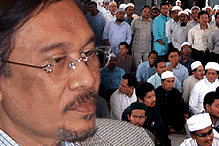 That man is Anwar Ibrahim, the jailed former deputy prime minister, who resumes a political career after his recent release from prison. He emerges a larger-than-life figure. He is ignored by the Malaysian government and media. The opposition, which once made him its mascot, now look askance at his indelible presence.
He cannot re-enter politics until April 2008, the legal restraint of any man released from prison, but is feted here and overseas as a man to watch. After his surgery in Munich, world leaders called on him, telephoned or sent messages.
The Yang Dipertuan Besar of Negri Sembilan, a former king, and his consort had lunch with him in Munich. As did the Sultan of Brunei in Jeddah. A few sultans either spoke by telephone or sent emissaries. He moved to Saudi Arabia after his surgery, as guest of the King, and returns on Oct 31.
He was intended to have come by the King's personal aircraft but shall return on a scheduled flight, because of official Malaysian protest to Saudi Arabia over their hospitality.
His return to public life unites the government and opposition against him. The BN does not want him back: the Umno general assembly last month barred his return, a pointless exercise, since he cannot join a political party until after its general assembly in 2007. It did not matter. He has emerged in Umno as its most dangerous enemy.
Political analysts and BN politicians insist his political future is only in Umno, and since he cannot return, his political career is finished. The way they put it is quaint: he cannot be prime minister if he is not in Umno.
What they will not admit is that if he should lead an opposition coalition, BN is in trouble. He could cut the Gordian knot that keeps the opposition apart; he is the only politician who could talk with PAS and the Democratic Action Party (DAP) - each with its apposite political direction.
 He is the eminent grace of one political party, the Parti Keadilan Rakyat (still known as KeADILan, though it can officially only be referred to by its acronym, PKR), which like the others, have lost its way.
However, the opposition is united in fearing his role as an opposition leader, even if it admits that his leadership could frighten the ruling coalition as nothing has in the past five decades.
He has not made a decision on his political future. Indeed he cannot yet. He is enjoying his freedom, but the shrewd politician he is, he is not averse to making his presence felt in Malaysia and the world.
With each passing day, he becomes the rabble-rousing politician he once was, but with a maturity and a philosophical integrity strengthened by his imprisonment. He is Malaysia's man for all seasons.
His detractors are many. The fear he exudes in the government and opposition is real. His position papers, since his release, gives him a political aura that few politicians - from the prime minister down - have.
Umno's reaction
Umno leaders accuse him of being beholden to foreign leaders and interests. This is sour grapes. He would have been interrogated about this issue when he detained under the ISA in 1998. If there was any truth in it, Umno would have made political capital out of it by now. Why did it not?
He was sacked for sodomy and corruption, convicted on evidence the judges declared to be tainted. His arrest split Umno and the Malay community. Umno lost its cultural hold. PAS gained political prestige by championing him. But both used him for their own ends.
Now that he is back with his political position enhanced, both Umno and PAS have cause to worry. He is now the best hope for the opposition to gain some kind of power. The BN and Umno, even if they will not admit it, know it to be only too true.
His base is his political presence, his open house in Permatang Pauh reflects this. His aides have warned Umno leaders, who attacked him at the Umno general assembly that if they persisted, he would have to retaliate. That stopped them in their tracks.
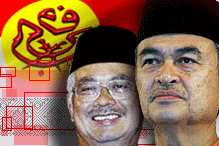 He has emerged as the whipping boy in the continuing fight for the Umno soul between Pak Lah and his deputy, Najib Tun Razak. The Pak Lah camp frightens the Najib camp with threats of a full pardon for Anwar. Of course, Pak Lah doesn't mean it. But it is enough to force Najib to be careful of his movements.
However, this could explode in both their faces. There is a move to grant him a full and unconditional pardon, one that - if the rumours are true - several sultans would go along with. But it would be egg on both their faces if he does, in the end, get an unconditional pardon.
He is the right man at the right time. It does not mean he will be prime minister or even be active in party politics after 2008. He is a catalyst to force the government and opposition to reform its thinking, and chart a new course.
Much water has passed under the bridge since his detention. But he has kept faith. He has challenged every attempt to consign him to history's dung heap. He survived them all. His accuser, Dr Mahathir Mohamad, continues to believe in his guilt; but few others do.
If the good doctor is as convinced as he was in 1998, where is the evidence that could have convicted him.
If he can get the Malaysian political debate going, Malaysia's debt to him would be incalculable.
Whether he makes it to be prime minister is irrelevant. He may, or he may not. Whether he returns to Umno is irrelevant. Whether he joins the opposition is irrelevant. But he will not keep quiet. He will continue to speak his mind, and remain in the public eye.
The government is frightened of this. When permission was asked for his supporters to be allowed to greet him when he arrived, the authorities insisted that only those with valid tickets or receiving visitors would be allowed.
To prevent any disturbance, his supporters have asked to rent a stadium to gather in. That, if the past is any guide, will be rejected, or only be allowed at the last moment. Anwar supporters do not want his arrival to be a test of strength. But if it must, it will.


Are you sure you want to delete this comment?
This action cannot be undone.