




Politics of Islam in Msia: a Muslim scholars views (Part 1)
Since Sept 11, 2001, the radar screen of the world's political opinion and security observation have been sharply focusing on Islam, Muslims, Muslim-majority states and societies, Muslim minorities in non-Muslim-majority states and societies and, above all, the politics as well as political ideas, organisations and personalities of Islamists.
Many new books on these subjects have been written, published and marketed in recent years. This is only understandable because there is certainly a pressing need worldwide to learn more about Islam, Muslims and the various aspects of their political ideas, organisations and personalities.
From the Western world, the qualities of these new books are mixed: while some are sharply articulated, scholarly, balanced, objective and, yet, thought-provoking, others simply perpetuate and spread age-old stereotypes and prejudices.
There are also many new books written and published by Malaysian Muslims narrating or discoursing the subjects of Islam and the various aspects of the politics of Muslims in the country's historical and geographical contexts. The qualities of these books are also mixed. Moreover, many of them are targeted for Muslim readers.
Since Sept 11, 2001, the radar screen of the world's political opinion and security observation have been sharply focusing on Islam, Muslims, Muslim-majority states and societies, Muslim minorities in non-Muslim-majority states and societies and, above all, the politics as well as political ideas, organisations and personalities of Islamists.
Many new books on these subjects have been written, published and marketed in recent years. This is only understandable because there is certainly a pressing need worldwide to learn more about Islam, Muslims and the various aspects of their political ideas, organisations and personalities.
From the Western world, the qualities of these new books are mixed: while some are sharply articulated, scholarly, balanced, objective and, yet, thought-provoking, others simply perpetuate and spread age-old stereotypes and prejudices.
There are also many new books written and published by Malaysian Muslims narrating or discoursing the subjects of Islam and the various aspects of the politics of Muslims in the country's historical and geographical contexts. The qualities of these books are also mixed. Moreover, many of them are targeted for Muslim readers.
An exceptional book
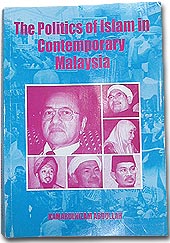 Dr Mohd Kamarulnizam Abdullah's recent publication
The Politics of Islam in Contemporary Malaysia
(Bangi, UKM, 2003) is an exception: it is written and published in English and hoped to reach out to non-Muslims, both inside and outside Malaysia.
Dr Mohd Kamarulnizam Abdullah's recent publication
The Politics of Islam in Contemporary Malaysia
(Bangi, UKM, 2003) is an exception: it is written and published in English and hoped to reach out to non-Muslims, both inside and outside Malaysia.
Kamarulnizam is a lecturer and head at the Strategic and International Relations Programme, School of History, Politics, and Strategic Studies at the Faculty of Social Sciences and Humanities, University Kebangsaan Malaysia (UKM). He is now heading a research team funded by Malaysia's Intensified Research Priority Area (IRPA) on Malaysia' threat perception on Asia-Pacific.
He is also a visiting lecturer at the Oxford Diplomatic Council, United Kingdom, and an editorial member for the Australasian Journal of Human Security (New Zealand).
He obtained his Bachelor of Science in Political Science and Certificate in International Relations from University of Utah, Salt Lake City, United States; his MA in International Relations from the Australian National University, Canberra, Australia, and his Ph.D. in Politics from the Lancaster University, United Kingdom. His main research area is on Political Violence, Religious Militancy, and National Security issues that pertinent to Malaysia and the Southeast Asia region. He has presented numerous papers in domestic and international conferences and seminars
In an attempt to understand in a more in-depth manner the politics of Islam in Malaysia from a historical perspective, malaysiakini recently interviewed Kamarulnizam via e-mail. In the exchange, the current political contests among Malaysian Muslims in different political parties and organisations are also critically discussed.
Inaccurate, sparingly analysed
Malaysiakini: Many books, monographs and papers on Islamist politics in Malaysia have been written and published by Malaysian Malay-Muslim intellectuals and academics but one observation is that yours is the most dispassionate and objective discourse. How do you, as a Malaysian Malay-Muslim, detach yourself emotively from the subject of your study which is the politics of Malaysian Malay-Muslims?
 Kamarulnizam:
It cannot be denied that many books have been written on the subject. However, there were either inaccurate or sparingly analysed (mostly written by Western scholars), or what I called ethnically or religiously biased (since the subject was written by Malaysians or in particular (Malay-Malaysians). Western writers on the subject tend to be blunt by making inaccurate and sweeping statements on the issue. They claim to be experts (by just doing library research, interviewing some people, and staying in the country for few months). As for the local Malays-Muslims writers, they would like to portray a positive image of the subject and try to re-correct the mis-perception on political Islam. I tried to do that but as an academic and a researcher I have to be objective for I believe that Malay Muslims themselves, including their leaders, should be blamed for dragging religion as part of their political weapons. I do think this argument is something new but I believe that I have managed to put in perspective.
Kamarulnizam:
It cannot be denied that many books have been written on the subject. However, there were either inaccurate or sparingly analysed (mostly written by Western scholars), or what I called ethnically or religiously biased (since the subject was written by Malaysians or in particular (Malay-Malaysians). Western writers on the subject tend to be blunt by making inaccurate and sweeping statements on the issue. They claim to be experts (by just doing library research, interviewing some people, and staying in the country for few months). As for the local Malays-Muslims writers, they would like to portray a positive image of the subject and try to re-correct the mis-perception on political Islam. I tried to do that but as an academic and a researcher I have to be objective for I believe that Malay Muslims themselves, including their leaders, should be blamed for dragging religion as part of their political weapons. I do think this argument is something new but I believe that I have managed to put in perspective.
There is a school of opinion that only Muslims can understand and write about Islamist politics (or only Chinese/Indian can understand and write about Chinese/Indian politics) best. However, in your book, you make many approving references also to Western, Chinese and other non-Malay/Muslim scholars. Are you suggesting that knowledge and scholarship even on Islamist politics is universal and not bound by the ethnic backgrounds or religious affiliations of academics or writers?
Although I made some reference to their works, it does not mean that I agree with their argument. I have to acknowledge their contributions to the subject and I do not think a discipline or subject-matter belongs to a particular group.
Why did you write and publish a book on Islamic politics in Malaysia in English, not Bahasa Malaysia? Who are your targeted readers?
I need an international audience. I need my audience to understand an "internal" (Malay-Muslim) perspective on the issue which is objective and impartial.
There is one religion or faith called Islam but there are many different schools of thoughts, political organisations and personalities in Malaysia and throughout the world, claiming to be Islamic or striving to protect or advance Islam. Why has one faith branched out into so many contending schools of thoughts, political organisations and personalities?
One must understand that Islam is not only religion but also culture. This is how Islam strives. What unites Muslims is the (belief in the) Oneness of God, the Prophet Muhammad and the concept of Ummah. Yet Islam allows divergence in the interpretation based on particular time and societal background/understanding. That's why Islam in Malaysia may be practiced differently from Islam in West Asia or even in Indonesia.
(Part 2 will be published on Oct 25.)
JAMES WONG WING ON is chief analyst of Strategic Analysis Malaysia. He is a former DAP member of Parliament for Kampar (1990-1995) and a former columnist for the Sin Chew Jit Poh Chinese daily (now Sin Chew Daily ). He read political science and economics at Monash University in Melbourne, Australia.


