




Politics of Islam in Msia a Muslim scholars views (Part 2)
In this final part of a question-and-answer session , Dr Mohd Kamarulnizam Abdullah, Universiti Kebangsaan Malaysia's Head of Strategic and International Relations Programme, explains how Muslim or Muslim-majority political parties operate, mobilise and compete for all-inclusive support in Malaysia.
In this final part of a question-and-answer session , Dr Mohd Kamarulnizam Abdullah, Universiti Kebangsaan Malaysia's Head of Strategic and International Relations Programme, explains how Muslim or Muslim-majority political parties operate, mobilise and compete for all-inclusive support in Malaysia.
Malaysiakini: How should non-Muslims publicly discuss or comment on the politics of Muslims or common public policies or decisions made by Muslim politicians or public servants in a multi-ethnic and multi-religious society like Malaysia without being perceived by Muslims as being 'anti-Islam'?
 Kamarulnizam:
They can openly discuss the issue objectively. They are many non-Malay writers who have discussed the subject in academic journals (which are not widely circulated among the general public). But we cannot take the issue as a racial issue. It must be discussed in wider context. For example, when we discuss militancy and radicalism, we must understand that it is not part of the religion. It is influenced by cultural confluence and societal political development and history. Hence, it is unfair to correlate Malays with Islamic militancy because it is not part of Malay civilisation and history.
Kamarulnizam:
They can openly discuss the issue objectively. They are many non-Malay writers who have discussed the subject in academic journals (which are not widely circulated among the general public). But we cannot take the issue as a racial issue. It must be discussed in wider context. For example, when we discuss militancy and radicalism, we must understand that it is not part of the religion. It is influenced by cultural confluence and societal political development and history. Hence, it is unfair to correlate Malays with Islamic militancy because it is not part of Malay civilisation and history.
In your book, you narrate and discourse Malay-Muslim politics in Malaysia from a historical perspective through the nationalist Umno and Islamist PAS as well as two other NGOs, namely (the Muslim Youth Movement of Malaysia) Abim and Arqam, but where is the secular Malay Left which includes the socialists and communists and which had a rather distinct ideological outlook? Are they not important historically?
 My focus is only on Islamic-based groups. I am writing an article for a journal on leftist Malays.
Although the issue of 'Islamic state' has been featured in all general elections, both positively and negatively, your study seems to suggest that the objective of establishing an 'Islamic state' has never been stipulated in the formal constitutions of Umno, PAS, Abim and Arqam. How do you explain this discrepancy between what is not formally stipulated and what is championed rhetorically in electoral campaigns or public political discourses?
Because these groups have accepted the fact that Malaysia is a multi-racial and multi-religious country. These groups, especially the political parties won't get support if they become too 'leftist'. For example, PAS knows that the party cannot rule the country without the support from the non-Malays. They also need Malay political support since they share the same support base with Umno. They cannot associate themselves with the nationalist Umno. They have to invent something to seek support. Islam is the tool.
Yet at the same time they would lose the non-Malays' support. PAS knows they are losing to Umno for non-Malay support. But they know that not all Malays support Umno either. PAS would gain support when there are internal problems within Umno or when there are leadership crises either at the state or federal level. But PAS cannot be Umno. The agenda is about Islam although the underlying struggle is about the
Malays.
You observe in your book that the socio-economic background of Umno's delegates to general assemblies has changed from poorer school teachers and religious teachers to wealthier businessmen and corporate leaders, giving rise to 'money politics'. How has the change affected Umno's Islamic agenda and Islamic credential or image?
To some extent yes but Umno also has to be realistic that they need these supporters for its financial survival. These are the people whom Umno has supported through NEP (New Economic Policy). It is payback time for them. But at the same time the money politics issue surfaces concurrently with the active involvement of these corporate people in Umno. The issue is not about controlling money politics. Money politics is everywhere. It happens in the US presidential election. The real issue is that whether money politics can buy one's dignity and country's sovereignty. The Malays must learn from the fall of the Malacca Empire.
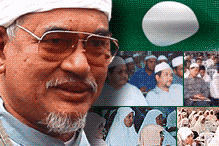 You also observe that since 1982 after a younger generation of Islamists took over power from the pro-nationalist old guard, PAS has become more Islamic but less ethno-nationalistic. But after the 2004 general election, PAS seems to need another fundamental shift of paradigm. Do you think PAS is capable of reforming itself again without leadership change? What changes, in your opinion, are needed for PAS to regain its electoral popularity?
I think PAS is now in the process of changing and the blessings has come from the top. You can see how young PAS leaders have changed in terms of their appearance. No more turban or kopiah but Western suits and blazers. To what extent their change will translate into votes, I do not know. For years Malaysian voters have been swayed by sentiment in their voting pattern but not by appearance or internal political restructuring/reformation.
Keadilan (which has since merged with PRM to become Parti Keadilan Rakyat) was founded as a Muslim-majority multi-ethnic and multi-cultural opposition party and doom was predicted for it since Day One. But it somehow survived in the past five years under the most adverse circumstances. In your assessment, what are the strengths and weaknesses of Keadilan?
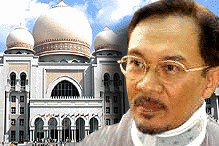 The main weakness is that its survival is based on a particular personality, namely (former deputy premier) Anwar Ibrahim. What happens if Anwar is no more around for whatever reason? For the past several years, those in Keadilan managed to play around with Anwar's arrest. But now they must change their political strategies especially after Anwar is free. The main strength is that the party has managed to bring in a new dimension in Malaysian politics - political reform. For years there was no such party capable enough to challenge the government on the issue of transparency, accountability and honesty.
On a positive note, there have been some changes in the way the government is handling the country. This is the point where Keadilan might get more support from the younger generation which does not share Umno's sentimental memory of gaining independence.
Anwar Ibrahim is now a free and apparently very influential man both domestically as well as internationally. In your opinion, what role or roles would he play in the politics of Malaysia, especially the politics among Muslims? How would he manage relations between the West and Muslim world at the global level?
I hope he plays his cards right because 'Umno people' are waiting to attack him whenever they feel it fits their political strategies. Anwar will continue his role as a political reformist (just as in Abim before). The government may not be comfortable with some of his remarks but they have to accept it. I think Anwar also will play a prominent role in the international arena. It is rather early to assess his role in managing the debate between the East and West but I believe he will play a prominent role.
Since Sept 11, 2001, the Muslim world has been confronted with many challenges and pressures as the result of what is said to be anti-Western and anti-American terrorism. Suddenly, the radar screen of the world's public attention and opinion is focused on Islam, Muslims and Muslim-majority states and societies. How have all these challenges and pressures changed the Islamist politics and discourses in Malaysia?
 It has given more ammunition for Umno to attack PAS. So far Umno has managed to deliberately associate PAS with militancy since some of their members were 'involved'. But at the same time Umno must also be careful in bringing up Islamic matters for its political rhetoric, since it would become a signal to outsiders that Umno too has been 'Islamised'.
Linking Umno with the al-Qaeda group, as argued by Prof Rohan Gunaratna in his book 'Inside Al-Qaeda Global Network of Terror' (London, Hurst, 2002), did not help Umno. So Umno has to be very careful not to get involved in the political rhetoric of Islam. The main strategy now is to reintroduce (former premier) Dr Mahathir Mohamad's concept of the inculcation of Islamic values into Prime Minister Abdullah Ahmad Badawi's Islam Hadhari .


