




Special report: Are madrasahs jihadi factories?
 Ahmed Rashid is the acclaimed author of the book
Taliban
, the definitive study of the Taliban movement and other jihadi organisations that have sprung up all over Central Asia and Pakistan in the wake of the Afghan conflict and the resurgent jihad in Kashmir. A veteran political commentator on Pakistan and Central Asia, he was the only journalist who had actually lived with, studied and followed the rise of the Taliban from its inception in the early 1990s to 2002.
Ahmed Rashid is the acclaimed author of the book
Taliban
, the definitive study of the Taliban movement and other jihadi organisations that have sprung up all over Central Asia and Pakistan in the wake of the Afghan conflict and the resurgent jihad in Kashmir. A veteran political commentator on Pakistan and Central Asia, he was the only journalist who had actually lived with, studied and followed the rise of the Taliban from its inception in the early 1990s to 2002.
 An acknowledged expert on radical religio-political movements and their internal politics, Ahmed has been studying and writing about these movements extensively over the past few years. During his visit to Pakistan, Farish A Noor spoke to Ahmed Rashid about the phenomenon of these jihadi movements, their internal dynamics and how students from Southeast Asia have become the unwitting victims of a superpower game of realpolitik they barely understood themselves.
Farish: These days there is much speculation in Southeast Asian circles about the so-called 'threat' of militant religious movements emanating from Pakistan and Central Asia. We have seen the meteoric rise of self-proclaimed 'experts' on these jihadi movements popping up all over the Asean region, spinning all kinds of stories about militant terrorist cells and how these groups are spreading their tentacles as far as Southeast Asia.
 Ahmed Rashid is the acclaimed author of the book
Taliban
, the definitive study of the Taliban movement and other jihadi organisations that have sprung up all over Central Asia and Pakistan in the wake of the Afghan conflict and the resurgent jihad in Kashmir. A veteran political commentator on Pakistan and Central Asia, he was the only journalist who had actually lived with, studied and followed the rise of the Taliban from its inception in the early 1990s to 2002.
Ahmed Rashid is the acclaimed author of the book
Taliban
, the definitive study of the Taliban movement and other jihadi organisations that have sprung up all over Central Asia and Pakistan in the wake of the Afghan conflict and the resurgent jihad in Kashmir. A veteran political commentator on Pakistan and Central Asia, he was the only journalist who had actually lived with, studied and followed the rise of the Taliban from its inception in the early 1990s to 2002.
 An acknowledged expert on radical religio-political movements and their internal politics, Ahmed has been studying and writing about these movements extensively over the past few years. During his visit to Pakistan, Farish A Noor spoke to Ahmed Rashid about the phenomenon of these jihadi movements, their internal dynamics and how students from Southeast Asia have become the unwitting victims of a superpower game of realpolitik they barely understood themselves.
Farish: These days there is much speculation in Southeast Asian circles about the so-called 'threat' of militant religious movements emanating from Pakistan and Central Asia. We have seen the meteoric rise of self-proclaimed 'experts' on these jihadi movements popping up all over the Asean region, spinning all kinds of stories about militant terrorist cells and how these groups are spreading their tentacles as far as Southeast Asia.
As a result of this, and the hegemonisation of the so-called 'war on terror' discourse that is being steamrolled by Washington, the governments of many Asean countries have introduced new laws to safeguard peace and maintain order, though activists like myself are concerned about how these laws will impact on fundamental liberties and how they will affect the lives of ordinary citizens. Already we have seen arrests and detentions of suspects all over the region, and much of this has been justified by the information given by the security experts. You have been studying this phenomenon longer than anyone else. How do you react to what is happening?
Ahmed: These experts as you call them have no real in-depth knowledge of Pakistan and its complex internal politics, nor of the complex regional dynamics that is at work here. They do not understand the internal politics of Pakistan or the internal politics of the jihadi groups that link them with the state apparatus and various political agencies. Much of their information is derived from state security and intelligence sources, from Pakistan or the United States. This is already a worrying point, for it fails to raise the obvious question: who created this new generation of jihadi groups in the first place, if not the Pakistani government and the Americans and their allies?
Farish: The weakest link seems to be the madrasahs that are said to be linked to the Islamist movements in Pakistan. Judging by what we read and see on the news one gets the impression as if all the madrasahs have been turned into jihadi factories. But surely this is not the case?
Ahmed: The stereotype of the madrasah as a jihadi factory is simply not true, as you yourself know: you have been to some of them. We should begin by pointing out that the madrasahs are not a homogenous phenomenon. The problem lies with some of the new madrasahs that are not really institutions of Islamic learning in the proper sense of the word.
But many of the older madrasahs that have links to the older, established Islamist parties and organisations are actually well-run schools that offer a combination of subjects. Some provide a balanced, rounded education and even teach social sciences and 'hard' science subjects. In some of them, they even teach comparative politics, literature, comparative religion, and so on - and even allow their students to read Western philosophers like Marx.
So it would be wrong and unfair to label all these madrasahs as jihadi centres of training. The madrasahs run by more established parties like the Jamaat-e Islami provide much better education than in the government system. Their curriculum may be conservative, but that is not the same as saying they are jihad-oriented. They produce real religious scholars and priests, just like theology schools in the West produce Christian priests.
The newer madrasahs, especially those formed after the Afghan conflict, are the ones linked to the ex-mujahideen groupings that are more radical and jihad-oriented. But I emphasise this is a relatively new phenomenon. They are not really established in the institutional sense and when comparing their teaching standards to the more established ones they are very poor.
These madrasahs are really sponsored by the jihadi groups that were in turned backed by the Pakistani government and during the anti-Soviet war in Afghanistan in the 1980s by the American government. They were the recruitment camps for the mujahideen who were used against the Soviets. After the Afgan conflict, these recruits and the new ones were pointed towards the rising insurgency in Kashmir and other conflicts such as in Chechnya by both militant groups and local intelligence agencies. But all along they were known to their sponsors and even protected by them.
Farish: So you are saying that the real agents behind the jihadi movements and militant units are still active and working in the open? I saw that Muridke, the centre for the Lashkar-e Taiba (now known by its civilian front Jamaat-ul Dawa) is still functioning in the open.
Ahmed: Yes, Muridke is still operating quite openly. And we all know that the real leaders and agents behind these groups are at large. The leader of the militant group Lashkar-e Taiba that is based at Muridke, Faeez Saeed, led a demonstration against the Pakistan-India peace process right in the centre of Lahore. This year he also led another demonstration in support of AQ Khan the nuclear weapons expert, out in the open along with thousands of his followers in Lahore as well. Yet despite the ban on his group nothing has happened them directly.
 These groups have been protected by elements within the Pakistani government. In fact, not too long ago the army were quite close to these groups, and openly so: they courted them, funded them, armed and trained them and encouraged them to do their jihadi work, particularly in Kashmir. The same applies to many other of the jihadi groups that thus far have escaped detention or closure. They are still operating openly and their leaders are not being caught.
Farish: Despite that there is growing pressure on Pakistan to clamp down on these groups and arrest their leaders. I have been trying to contact the spokesman of the Jamaat-ul Dawa, the civilian front for the Lashkar-e Taiba, Yahya Mujahid. Yet he has been very evasive and it has not been possible to get a word out of them for the records. They are all lying low at the moment.
Ahmed: Islamabad is under pressure from Washington to arrest these guys and put a stop to their activities once and for all. So it's not a surprise if they are lying low and won't say anything on record. But apart from their own fear of arrest there are also others who don't want them to talk to scholars like you. For a start, there is the whole business of their collusion with the government, foreign donors and sponsors, the question of their sources of funding, who has been protecting them, etc. This implicates more than that jihadis themselves.
It remains a fact however that they have been backed by the governmental forces all along and that it was they - not the mainstream Islamic parties - that really radicalised the struggle in Kashmir and turned it from a political struggle into a holy war, a jihad.
There is now the hope that after the two recent assassination attempts on President Musharraf in December 2003 that the Pakistani government and military should realise that it cannot compartmentalise al-Qaeda and the local groups; that they should go for them all.
Farish: And so do you think that what has happened recently - namely the arrest of boys from Malaysia and Indonesia - has been just a token gesture of appeasement? They were picked up at the Jamiat Abu Bakar seminary in Karachi and other institutions said to be linked to the Jamaat-ul Dawa/Lashkar-e Taiba, though the Jamaat-ul Dawa denies any direct involvement in these madrasahs or the affair.
Ahmed: The arrest of foreign students are really a token offering, a way of satisfying Washington and other foreign governments and showing that something is being done. It is a way of making it look as if these groups are being put under control, when we know that is not really the case.
But the foreign students like the ones from Malaysia and Indonesia are really the weakest and most vulnerable ones of all. They are foreigners; they don't understand what has happened and what they have got themselves into; they don't realise what they have been used for and whose interests they were serving, and they are the least important and least protected.
Farish: Why do you think the Southeast Asian boys from the Karachi madrasahs were picked up, and not foreign students from other madrasahs elsewhere? Has this more to do with domestic Pakistani politics and the convoluted relationship between the jihadi groups and the government?"
Ahmed: Since Sept 11 some of the more radical groups have been targeted for removal. Lashkar-e Taiba was the most active and one of the most violent groups in Kashmir, and so it was an embarrassment for the government. Also there was pressure on Islamabad by Washington and India to clamp down on them so that the India-Pakistan peace process could continue. That's why they and a few other groups were singled out.
It is also important to note that the mainstream Islamic parties have never been heavily into jihad. They saw the Kashmir issue as a political problem and in terms of their approach to domestic politics they have always taken a more constitutional approach.
But the radical groups were not going to disband quietly and some rose up against the government. That is why some groups like the Lashkar-e Taiba have been targeted and not others. But the foreign students who get involved in these groups probably had no idea of these groups' relations with the government, and have been caught in the crossfire.
Farish: From my own experience living with and interviewing these foreign students I get the distinct impression that most of them had no idea of what Pakistan was like before they got here. Many of them heard of their madrasahs by word of mouth or hearsay. Few had even been abroad prior to coming to study here. This is certainly the case with the students in the established madrasahs; I don't see why it should be any different with the more radical ones.
Ahmed: That is true of both foreigners as well as Pakistanis. Most people forget that even ordinary Pakistanis don't really know what goes on in these madrasahs and few people can tell the difference between the established ones and the radical ones.
The militant groups are good at recruitment and advertising their services. They make it a point to recruit extensively and intensively, and produce a lot of propaganda propagating their services to Islam and Muslims. To ordinary people what they preach is no different from the established Islamic groups.
But the sophistication of the radicals lies in the way that they manage to disguise their real agenda. They never tell you what they really expect of you, what they want to do with you and what they expect you to do for them in turn. The boys who get caught in their grip often get indoctrinated and trained to be hardline jihadis, but don't even realise that their training is far more radical and dangerous that what is offered at the mainstream madrasahs. In fact, now there are many Pakistani parents who are crying out against these jihadi groups for sending their boys out to fight in Kashmir and Afghanistan, when they thought they were sending their boys to be given Islamic education.
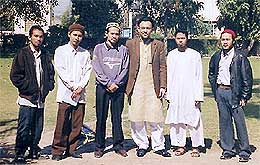 I'm not surprised therefore if Malaysian and Indonesian students have got caught in their trap like this. For the average Malaysian or Indonesian parent living in the countryside, he or she simply thinks that his child is going to be given a normal Islamic education. I seriously doubt that they send their boys to Pakistan to get military training or to get himself killed. The boys from Southeast Asia had no way of knowing what they were getting themselves into; neither did their parents. In all my years of research, I have hardly come across boys who knew what they were doing prior to going to these schools. Most Pakistani boys go to these madrasahs because they offer cheap basic Islamic education, and that is probably the only education they may ever get.
Farish: The picture that is emerging in the course of my research is a rather sordid one with young boys being led up the garden path by unscrupulous militants and their governmental sponsors to do their dirty work; and then getting themselves arrested and detained as sacrificial victims in some superpower bargaining process. Who is really to be blamed here?
Ahmed: In the 1980s, it was the clear policy of the Pakistani government, the American government, other Western governments and all their intelligence agencies to encourage foreign students to come and study in Pakistani madrasahs, so that they could be recruited and trained as Mujahideen. In the 1990s, it becomes more murky, but certainly the jihadi militias and Pakistani intelligence were involved.
During the Afghan conflict Pakistani army leaders and politicians proudly boasted of how they had created an international Islamic front or brigade to combat the Soviets. The US funded and supported this all along. Everything was done in the open and they were all part of it and they protected the jihadis. They had students from all over the world: from China to Southeast Asia, Africa to Europe and the Arab countries. It was truly a multinational force.
The Americans walked away from Afghanistan after the conflict with the Soviets and left regional governments to deal with the consequences of having trained these militias. Then in 1989, the Kashmir conflict flared up and the militants and the new recruits were redirected by Pakistan to this new conflict.
Now after Sept 11, the Americans have realised their mistake and suddenly they call these groups terrorists. Everyone is shifting the blame on the other: Washington wants to blame Pakistan, so Islamabad is now putting pressure on the jihadi groups. But at the same time these groups have become entrenched and they have gone mainstream.
Their interests are linked to that of their sponsors, patrons and protectors as well. They are not willing to disband and so when the pressure is on they sacrifice a few of their followers and recruits as scapegoats. The only innocent ones in this whole scenario are the foreign boys themselves, who are young, nave, innocent and vulnerable. They are the real victims.
Special report: Inside Pakistan's madrasahs
Tomorrow: Is 'sepak takraw' a form of 'terrorist training' too?
Dr FARISH A NOOR is a Malaysian political scientist and human rights activist. He is presently an academic researcher at the Zentrum Moderner Orient (ZMO) in Berlin, and is the author of ' New Voices of Islam ' (ISIM, 2002), ' The Other Malaysia ' (Silverfish, 2002) and ' Islam Embedded: The Historical Development of PAS 1951-2003 ' (MSRI, 2004). He is also a radio essayist for the BBC World Service. His column ' The Other Malaysia ' is an attempt to write a deconstructive account of Malaysian history, seen from the point of view of the Other and the subaltern.


Are you sure you want to delete this comment?
This action cannot be undone.