




Special report: Entering the spiders web
Yayha Mujahid was not an easy man to meet. Ever since the presidential ban on the militant jihadi group Lashkar-e Taiba, its former members have come under heavy surveillance and policing. Yet Lashkar still operates in the Indian Kashmir region and some of its former leaders in Pakistan have set up a new civilian outfit - the Jamaat-ul Dawa - which claims that it has no links to the former anymore.
Nonetheless suspicions and doubt remain and the public is concerned about the present and future activities of the Jamaat-ul Dawa. As yet there have been no attempts to restrict the activities of its key leaders such as Hafeez Muhammad Saeed - one of the main reasons being that the Lashkar had never engaged in violent sectarian activities in Pakistan itself.
As the spokesman for the Jamaat-ul Dawa, Yahya Mujahid has to deal with the press and scholars on a fairly regular basis, though the man does not seem inclined to play his role in too public a manner.
Requests for an interview were made by phone and email, and after two weeks it was finally agreed that he would answer questions via a go-between. He arrived at the office late in the evening and only then could my questions be put to him.
Yayha Mujahid was not an easy man to meet. Ever since the presidential ban on the militant jihadi group Lashkar-e Taiba, its former members have come under heavy surveillance and policing. Yet Lashkar still operates in the Indian Kashmir region and some of its former leaders in Pakistan have set up a new civilian outfit - the Jamaat-ul Dawa - which claims that it has no links to the former anymore.
Nonetheless suspicions and doubt remain and the public is concerned about the present and future activities of the Jamaat-ul Dawa. As yet there have been no attempts to restrict the activities of its key leaders such as Hafeez Muhammad Saeed - one of the main reasons being that the Lashkar had never engaged in violent sectarian activities in Pakistan itself.
As the spokesman for the Jamaat-ul Dawa, Yahya Mujahid has to deal with the press and scholars on a fairly regular basis, though the man does not seem inclined to play his role in too public a manner.
Requests for an interview were made by phone and email, and after two weeks it was finally agreed that he would answer questions via a go-between. He arrived at the office late in the evening and only then could my questions be put to him.
For those who know little of this organisation (which practically means most in Southeast Asia), some background information would be useful. Founded in 1988, the Lashkar was from the outset a jihadi militant organisation set up with the primary purpose of conducting jihad in Indian-occupied Kashmir.
At that stage the Lashkar and other jihadi groups in Kashmir were regarded as part of the 'non-conventional' force that was being used by both the Pakistani armed forces and political elite to gain leverage over India. Lashkar received considerable support from the armed forces and key personalities within the Inter-Services Intelligence agency (ISI) during the conflict in Afghanistan and Kashmir. General (Rtd) Hameed Gul, former ISI head, has openly admitted that the agency was primarily responsible for arming and training a number of militant jihadi groups based in Azad Kashmir and along the Indo-Pakistan border. ( Newsline , February 2001).
The Lahskar has been one of the most successful jihadi groups working in Indian Kashmir. It employs the use of specially trained and dedicated fidayeen troops who are sent on extremely difficult and dangerous missions. (Indian authorities blame the attack on the Red Fort of Delhi on 22 Dec, 2000 on the Lashkar. In January 2001 six Lashkar fidayeen troops mounted an attack on Srinagar airport which led to a 45-minute long firefight with Indian security forces and the death of all the attackers who took part.
The Lashkar has never employed suicide bombers or suicide attacks though, for they regard such tactics as unIslamic.) In December 2001 the United States government officially declared the Lashkar to be one of the officially designated terrorist outfits on its watch list. Since then the US government has put enormous pressure on the Pakistani government and armed forces to ban the Lashkar and to rein in its activists, but to no avail.
Separate entity
Following the ban on the Lashkar by presidential decree on 12 Jan, 2002, its former members and leaders are still active in Pakistan today through a new civilian front calling itself the Jamaat-ul Dawa. Officially this denies any direct links to the Lashkar and insists that it is a separate entity.
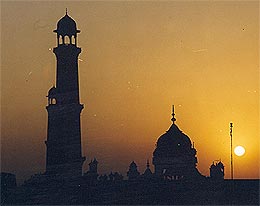 But the relatively new group has an impressive organisational structure and network of affiliated bodies: it boasts of having 2,200 unit offices all over Pakistan as well as 24 'launching camps' along the contested line of control between India and Pakistan. Most of the activities of the Jamaat-ul Dawa are based at Markaz-e Dawa-ul Irshad, in Muridke (45 km north of Lahore), a 50ha complex which is protected by its own security force and which declares itself to be an 'Islamic state'.
The markaz runs a number of institutions, including 16 schools and colleges, 135 secondary schools, and a US$300,000 medical centre which includes blood banks, mobile clinics and ambulance services.
Life in the self-contained and insulated 'Islamic state' of the markaz is austere and discipline is strict. The markaz is kept under armed guard, generally closed to outsiders, though its activities are conducted in the open (such as recruitment) and there has been little state interference. The leadership of the movement regards music, art and popular culture as haram and forces all its young members to grow beards and live according to their strict and literal interpretation of the Sunnah .
The young recruits are taught to control their individual urges, suppress their individual personalities and live in a closed communal setting. Personal property is frowned upon and collective action encouraged. The education of the students in the markaz and the schools patronised and supported by the markaz is based on a strict and narrow neo-Salafiyya Wahhabi-Deobandi inspired curriculum and the central theme is the necessity of jihad - here interpreted and presented primarily as external aggression against the perceived enemies of Islam.
As a result of pressure from Islamabad and Washington, Lashkar leader Hafeez Muhammad Saeed withdrew from the leadership and assumed the post of leader of the Markaz-e Dawa-ul Irshad.
The leadership of the Lashkar then went to Maulana Abdul Waheed Kashmiri, and the Lashkar then claimed that they would henceforth base all their activities solely in Indian-controlled Kashmir (in order to deflect criticism and accusations from the Indian government that Pakistan was harbouring and supporting anti-Indian terror groups.) In a further move to distance the markaz from the Lashkar, the markaz was re-organised and renamed the Jamaat-ul Dawa, which now presents itself as the civilian, political wing organisation that ostensibly foregoes the use of violence.
This does not, however, mean that the Lashkar has ceased all recruiting operations in Pakistan, or rejected the concept of jihad or war against India. In November 2003 the organisation's leaders addressed a congregation of followers at a Friday prayer session where they openly boasted that the Lashkar has recruited 7,000 new members. (This was reported in their own organisational newspaper, Jihad Times ).
 The Lashkar also claims that it has gained recruits from countries like Yemen, Algeria, Sudan, Iran, Chechnya, US, Britain and Southeast Asia. It claims to have the widest network of recruitment and communication within and without Pakistan, with links that span North America, Europe, the Arabs states, Africa and Southeast Asia. It remains as the
jihadi
group that has caused the most damage and incurred the highest cost in terms of human lives to the Indian army.
The Lashkar also claims that it has gained recruits from countries like Yemen, Algeria, Sudan, Iran, Chechnya, US, Britain and Southeast Asia. It claims to have the widest network of recruitment and communication within and without Pakistan, with links that span North America, Europe, the Arabs states, Africa and Southeast Asia. It remains as the
jihadi
group that has caused the most damage and incurred the highest cost in terms of human lives to the Indian army.
While the Lashkar has been forced to relocate to India its civilian front the Jamaat-ul Dawa operates in the open in Pakistan. Despite the demands and pressure from the US to crackdown on all jihadi groups in the country, the Pakistani government, armed forces and intelligence have been slow to act against the Jamaat-ul Dawa. Furthermore the Jamaat-ul Dawa still conducts education and training activities in its markaz at Muridke and is still actively recruiting new cadres and soliciting funds openly.
According to a report by the Herald (September 2003) the ban on these organisations have failed to work (although the Lashkar's main militant training camps in Muzaffarabad like camp Qila Bandi, camp Aqsa and camp Mansard are currently inoperative).
Open agenda
Set against such an explosive context, I asked Yahya what he thought about the arrest of Southeast Asian students from the madrasahs in Karachi that are said to be part of his organisation's network. The reply he gave was the last thing I expected, and had me more confused than ever.
According to Yayha: "The madrasahs in Karachi where the foreign students were arrested had nothing to do with us, the Jamaat-ul Dawa. Despite all that you have heard, the Jamiat Abu Bakar madrasah is not under our control. It is actually a madrasah run by the Ahle Hadith movement."
(The Ahle Hadith movement is a neo-Salafiyya conservative revivalist and purist movement that began in India in the 19th century. Its aim was to 'purify' Indian Islam from other 'contaminating' influences that includes traces of Hindu, Christian, Greek and Western ideas and practices. It is still a powerful force in many parts of the Indian sub-continent.)
Yayha did not deny the close bonds and ideological affiliation between the Jamaat-ul Dawa and the Ahle-Hadith, but insisted that the two were also separate entities: "Yes, we share similar concerns and values, and we mutually support and agree with each other in our common struggle, but we do not and have not had any direct organisational linkages.
"We have our own madrasahs, but the ones in Karachi had nothing to do with us. Because of our close affiliation the media came to the wrong conclusion: they thought the Jamiat Abu Bakar madrasah was under our control, when it was actually under the Ahle Hadith's."
And what about the other madrasah that was raided by the police, the Jamiat Darasat-ul Islamia madrasah? Here Yayha appeared more evasive and fudged his answers.
"That madrasah (Jamiat Darasat-ul Islamia) was previously under the control of the Jamiat-ul Ulema-e Islam (JUI), of the Fazlur Rehman faction. They were the ones who invited and housed the foreign students, including the ones from Malaysia and Indonesia. We were not involved in this recruitment. But they (the JUI) were not running it properly and so the local trustees put their faith in us instead. They passed control of the Jamiat Darasat-ul Islamia madrasah to us and that was the only time that the Lashkar had foreign students in its own madrasah in Karachi."
 It was a clever formulation, to say the least. By insisting that the students at Jamiat Darasat-ul Islamia were there before it was taken over by the Lashkar, Yayha seemed to be washing his hands off the whole affair. If, in the wake of the arrests on Sept 20 and 23, there are no longer any Southeast Asian students in the madrasah, then he would be correct in saying that they no longer host any foreigners in their seminaries.
I asked him if the latest turn of events has put the Jamaat-ul Dawa on guard and whether they would consider re-activating their madrasahs and opening them to foreign students again.
Yahya was adamant in his reply: "We no longer have any foreign students in our madrasahs. Its not that we don't want them, but at the moment we simply cannot and we know it. We are being closely watched and therefore something like that can be used to trip us up. All our students now are Pakistani students. The last time we had foreign students was before the Lashkar-e Taiba was banned. At that time we were openly inviting both local and foreign students to our seminaries and camps. But at that time it was all done in the open and everyone knew about it."
Yayha's frank statements were refreshing and unnerving at the same time: "We (Jamaat-ul Dawa) have to play it very carefully right now and we need to be on our guard. We know that the situation in the country at the moment is not conducive to our struggle, and we have to be careful. So if foreign students wanted to come to us right now, we would discourage them from doing so. That is why we have removed all the jihad-related material from our website and stopped issuing jihadi literature. We are not stupid, obviously."
But why has there been no attempt to close down their operations? It was this question that I needed to answer most of all, though by then the answer was predictable.
The spokesman of the Jamaat-ul Dawa simply pointed out a fact that had been brought to my attention time and again by many others who know the score equally well: "They (the security forces) are watching us and trying to keep tabs on us. But we know they are being pressured to do so by the government and the United States, and we keep our distance. But they have never really come for us because they know that our activities have really been directed at and in Indian Kashmir.
"In Pakistan we simply recruit and train our members and fighters, but we have never caused any sectarian conflict in the country. Therefore we are not a domestic threat, more a threat to others outside Pakistan, and that is why the Indians in particular want us to be banned. But we are not hypocrites: we have never hidden our agenda and everyone knew what we were doing. We never hid that from others, or apologised for our stand. We have been open about our jihad to liberate Kashmir from India all along."
Of all the encounters I had in Pakistan, this was the most difficult and surreal. For a start, Yayha open denial of any involvement of the Jamaat-ul Dawa in the activities of the madrasahs in Karachi has put into question every single report and official statement to date. Till now there is no way to confirm or deny this denial, until more facts present themselves to local journalists and researchers.
And if, as Yayha contends, the claim that one of the madrasahs in Karachi was actually run by the JUI and it was the JUI that invited the Southeast Asian students to Pakistan in the first place is correct, then another can of worms has been opened.
For this would implicate not only the JUI under the leadership of Fazlur, but also the present government of Pakistan as well, for the JUI is currently a member of the six-party Muttahida Majlis-e Amal coalition that is actually the government of the day. The arrest, interrogation and subsequent deportation of the boys from Malaysia and Indonesia therefore looks like a case of the Pakistani government washing its hands off a mess that they had started in the first place.
One thing however remains clear: In the eyes of these groups, their struggle for jihad has been fought with little consideration for the unwitting recruits whom they lure to their banner. And the claims made by participants and observers alike suggest that what has been happening in Pakistan over the past two decades is a much bigger and more complicated process that has consumed the time, resources, energies and lives of people from all over the world.
The Malaysian and Indonesian boys who were arrested in Karachi may not have even known that they were about to enter a spider's web of overlapping and often conflicting strategic and military interests, but for now they are the ones who have been caught and handed over to satiate Washington's desire for arrested suspected jihadis .
What really happened in Karachi and what were the boys told before they even left for Pakistan? Had they heard about these madrasahs and the groups affiliated to them, or did they simply arrive with little else but good faith and pious wishes? None of these questions can be answered unless and until an open public trial or enquiry is given to them; but at present all parties concerned - most notably the US and Pakistan - seem more inclined to chalk up an impressive list of arrests and claim that the 'war against terror' is being won.
Judging by the current developments in Pakistan and the region as a whole, Washington's heavy imprint on the Pakistani government and the madrasah system can only result in a backlash. No doubt more arrests will follow, and more foreign students - perhaps from other parts of the world - will also be arrested and detained under laws that do not grant them an open trial and right to defend themselves in public.
Amidst the sound and fury of accusations, denials and counter-accusations, the group that stands to lose the most happens to be the foreign students in the madrasahs of Pakistan. Suspected of everything under the sun and vulnerable in a country they hardly know and whose politics they understand even less, these boys may be the victims of a geo-political tussle on a global scale, victims of realpolitik.
Dr FARISH A NOOR is a Malaysian political scientist and human rights activist. He is presently an academic researcher at the Zentrum Moderner Orient (ZMO) in Berlin, and is the author of 'New Voices of Islam' (ISIM, 2002), 'The Other Malaysia' (Silverfish, 2002) and 'Islam Embedded: The Historical Development of PAS 1951-2003' (MSRI, 2004). He is also a radio essayist for the BBC World Service. His column 'The Other Malaysia' is an attempt to write a deconstructive account of Malaysian history, seen from the point of view of the Other and the subaltern.


Are you sure you want to delete this comment?
This action cannot be undone.