




M'sia needs more young voters
Democracy gives ownership of a nation to the people. This is an elegant concept that comes with a caveat. The point at which people fail to shoulder the responsibility, democracy fails. It is replaced by cronyism, corruption and far too often, dictatorial leaders who feel entitled to being at the helm of a nation.
Atlas, the Greek god, was punished by Zeus after his failed rebellion against the god. A certain retelling posits a different view that Atlas was holding the world on shoulders protecting it. In an increasingly grim political atmosphere, the only resolve is for the new generation to speak up. For them to become part of the political machine and be heard.
Political process ought to be humanised and if every citizen were to go up to the polling stations and vote, the power of the collective would save the political breakdown.
The Malaysian story is at a breaking point. As the spoken word artist Shane Koyczan would put it: we are all Atlas.
Democracy gives ownership of a nation to the people. This is an elegant concept that comes with a caveat. The point at which people fail to shoulder the responsibility, democracy fails. It is replaced by cronyism, corruption and far too often, dictatorial leaders who feel entitled to being at the helm of a nation.
Atlas, the Greek god, was punished by Zeus after his failed rebellion against the god. A certain retelling posits a different view that Atlas was holding the world on shoulders protecting it. In an increasingly grim political atmosphere, the only resolve is for the new generation to speak up. For them to become part of the political machine and be heard.
Political process ought to be humanised and if every citizen were to go up to the polling stations and vote, the power of the collective would save the political breakdown.
The Malaysian story is at a breaking point. As the spoken word artist Shane Koyczan would put it: we are all Atlas.
Notably, 63 percent of the Malaysian population actually voted during GE13. While many young voters turned out, far too many did not. They often feel that they cannot make a difference in the political system. In fact, one-third of US youth voters feel that way according to a Harvard Institute of Politics poll. Far too often, they simply feel left out and don’t feel like they have a voice. Young voters are often disillusioned with the failures of the political process and choose to not even participate therefore.
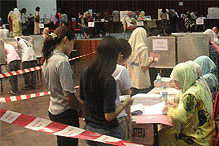 In the 2013 general election, 2.6 million Malaysians registered to cast their ballots for the first time, making up roughly a fifth of Malaysia's 13.3 million eligible voters. At 20 percent, that was a force to be reckoned with. The numbers will only increase next year. It is approximated that at least 40 percent of the electorate will be dominated by the youth. As that happens, it becomes important that we engage with the rift. In a political demographics where power is concentrated in the hands of a few, that becomes a tragedy.
Malaysia is a democracy waiting for people to reclaim power. While we complain too often, it is a country that requires everyone to hold the baton and transform the atmosphere.
Youth apathy foremost leads to a cycle of negativity whereby the belief that politics is useless gets reinforced.
While not voting or not participating in political process or not criticising political leaders seems innocent, it very much isn’t. A cycle of negative reinforcement excludes an increasingly greater number of people who would otherwise be contributing activists for political transformation.
But more perniciously, such apathy allows our leaders to go out on a power rampage. When we keep silent, political institutions hatch increasingly devious plans to capture more power and they feel immune to consequences. Anything evil is objectively bad, but it is a sad affair when tyranny waltzes away in a chamber of silence.
The lack of interest also means political criticism does not become part of our daily conversation. Which is when misinformation spreads and becomes the proxy for truth. But even worse, people in general do not realise the need for increased participation.
A vicious cycle of ignorance
Political injustices are more veiled than ever. Hundreds of millions are spent to keep the people unaware of injustices. They are told not to care for the injured down the road. Backdoor deals are done every day. A culture where political discussion is not on the table is a culture of political ignorance, where a whole new generation never finds out about the political solutions to political problems. Their misgivings are perpetually ignored.
There are very practical reasons to be part of the political process. Malaysian graduate unemployment levels are disconcerting. Among the 400,000 who are unemployed in Malaysia, a substantial number of them are the youth. Minister in the Prime Minister’s Department Abdul Wahid Omar added that 161,000 graduates, aged between 20 and 24 years, had yet to find a job. Student loans and college tuitions are on the rise.
These days, it is almost impossible to find a decent affordable place to live in KL and many other parts of Malaysia. Students also suffer when the general direction of education does not give them a competitive edge in an increasingly globalised work force. The problem is therefore how representatives would rather solve other problems, and the solution, is becoming a force to be reckoned with.
But more importantly, they can do unbelievable things when together. Young voters can be passionate advocates for progressive values. As the generation that grows up with a greater understanding and appreciation of integration, they preach and practice such values better than anyone else.
Young people have assembled in Paris and made the global leaders sign a treaty to put binding obligations on reducing carbon dioxide. Skeptics believed that would never come about. Young people have stood in the streets of New York, Washington, Cleveland, Austin, London and all around the world under the banner of ‘Occupy Wall Street’ when corrupt capitalism became patently unjust and repressive.
They spark campaigns such as '#BlackLivesMatter' and bring issues like racism to global consciousness. They dominate places such as Silicon Valley and research labs around the world, shaping our future and working every waking hour to create a better world. This is the generation of revolution and awareness. They pick their battles, but when they do, they surely win.
There are lessons to be learnt all around the world. Young people assembled in droves to vote for the only non-dynastic candidate in 2014 Indonesian elections. This had set a milestone, as for the first time in many years, Indonesia exited the realm of political dynastic capture at the top.
The story of Canadian Prime Minister Justin Trudeau is also an inspiring one. In a country that was becoming increasingly conservative, Trudeau won only by the power of young voters, women and minorities. All of those people turned up to vote - but more importantly, they campaigned for values he stands for. The result was a dream come true; as Canada becomes one of the few western nations to open its arms wide to refugees and Trudeau becomes a role model for battling Islamophobia, the power of young voters in the ballot box becomes undeniable.
The course of action is now easier than ever. Your political post can potentially get thousands of up-votes and shares in a myriad of social media platforms. Your post documenting political injustice can make headlines in national newspapers and force representatives to answer. You can quite literally just get a few friends together and campaign for the candidate who suits your needs better.
There is always a way to contribute for anyone with the heart of a contributor.
We are to remember that when the rich oligopolies fund their political minions in a political structure that is further removed from people, stories from the ground become the most important tools of dissent for everyone and we, the youth of Malaysia, have held on to far too many.
SYED SADDIQ SYED ABDUL RAHMAN is a part-time lecturer at Universiti Islam Antarabangsa (UIA) Malaysia and is Asia’s best debater, winning the United Asia Debate Championship in May 2015.


Are you sure you want to delete this comment?
This action cannot be undone.