




Tsunami: For want of a nail
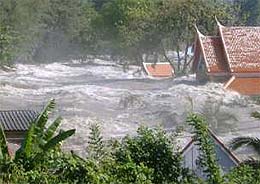
A callous Malaysian government lost its nerve, cordoned off the areas where the tsunami struck in Penang, Langkawi, Kedah on Boxing Day, prevented aid reaching these areas, and took pride in its incompetence and arrogance.
The immediate reaction was of rats deserting a sinking ship. No one took responsibility and did not allow anyone else to do so either. Government agencies and departments which should have rushed in automatically did not, since they were not ordered to.
It would have been worse if private groups and individuals, on their own, had not rallied to prevent a greater tragedy. The beachboys in Batu Ferringhi, Penang, moved into action when told by friends and relatives by mobile phones of the havoc wreaked in Langkawi, and ensured that people, including those staying in the fully-booked hotels, stayed away.
The disaster would have been worse if not for these unsung heroes. It was private bodies and organisations that responded first. The government agencies and bodies were inert or offered conflicting advice. To avert the tragedy was the last thing on their minds.
The government cannot help because it is poor, said Deputy Prime Minister Najib Abdul Razak. But not so poor to buy immediately, as he announced earlier, a tsunami-detection system from Japan that, if the past is any guide, would be useless the moment it is commissioned. An impressive network of systems exists to cope with any disaster, but it ceases to function when and where it is most wanted. Each is well-equipped but badly maintained and of no conceivable use when disaster strikes.
A callous Malaysian government lost its nerve, cordoned off the areas where the tsunami struck in Penang, Langkawi, Kedah on Boxing Day, prevented aid reaching these areas, and took pride in its incompetence and arrogance.
The immediate reaction was of rats deserting a sinking ship. No one took responsibility and did not allow anyone else to do so either. Government agencies and departments which should have rushed in automatically did not, since they were not ordered to.
It would have been worse if private groups and individuals, on their own, had not rallied to prevent a greater tragedy. The beachboys in Batu Ferringhi, Penang, moved into action when told by friends and relatives by mobile phones of the havoc wreaked in Langkawi, and ensured that people, including those staying in the fully-booked hotels, stayed away.
The disaster would have been worse if not for these unsung heroes. It was private bodies and organisations that responded first. The government agencies and bodies were inert or offered conflicting advice. To avert the tragedy was the last thing on their minds.
The government cannot help because it is poor, said Deputy Prime Minister Najib Abdul Razak. But not so poor to buy immediately, as he announced earlier, a tsunami-detection system from Japan that, if the past is any guide, would be useless the moment it is commissioned. An impressive network of systems exists to cope with any disaster, but it ceases to function when and where it is most wanted. Each is well-equipped but badly maintained and of no conceivable use when disaster strikes.
Malaysian television and radio stations did not interrupt their holiday programmes, and did not send out an alert until 10 hours after the tsunami struck, warning people not to go to the beaches. The agencies sent messages to their state offices of the impending danger but not to radio and television stations.
The round-the-clock specialised disaster centres and bodies breached their operational procedures to shut down their operations for the holidays, and were caught as unawares as those affected by the tsunami.
The only group allowed to make political capital out of this tragedy was Barisan Nasional (BN). All others were kept out. When tragedy strikes, it should have called on all to help. It did not. It views the opposition as a breed less than vermin. So its response was not unusual.
The few thousand ringgit promised to the tsunami victims in Kedah and Penang remains unpaid a week after the disaster. Najib was in charge when the tsunami struck, but nothing would move until Prime Minister Abdullah Ahmad Badawi returned from holiday overseas.
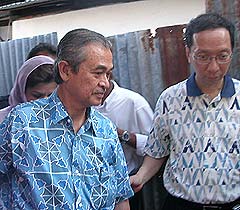 So did Penang Chief Minister Koh Tsu Koon, who was in New York with his son who was seeking medical attention. But he returned only after speaking to Abdullah. The years in office have inured him to the plight of his people.
Every visit to the disaster area has been a photo-opportunity, a political move to show how caring a callout government can be. But do those concerned mean what they say? All one can make of the official responses is of a government breaking apart from within. The government and civil servants are keener to show they are on their toes than provide the desperately needed help.
National scandal
That they cannot respond to a national tragedy is a national scandal. The stark truth is that the Malaysian state is institutionally inept. It is manned, no doubt, by brilliant, upright and moral individuals; but when they assume the mantle of the state, their competence, abilities and attributes drops to a half or lower and suffused with a distaste for addressing the problems the people face.
The people have become chattels to be kicked about, not those in whose name they govern. When tragedies like this occur, they are ignored, with the occasional burst of interest when the prime minister or other high minister visits to show all is well or all efforts made to sort out their problems. But it is made clear that this help comes from the generosity of the BN government, it is another BN project fulfilled. Keeping statistics, however wrong, is far better, in its view, than looking after the people who elected it into power.
A cohesive centre however holds the BN government together through a feudal authority that is itself suspect, and a mindset in government. Politician and civil servant, while they cannot stand one another, must nevertheless protect each other from 'outsiders', other groups contending for power and, of course, the people.
The more out of touch they are, the more they stick together. And they await for cues from the feudal leader before they act. This is what happened over the Boxing Day disaster. No one would act on his own, not even the deputy prime minister who was in charge, since ultimate power resides in the prime minister and he must decide what must be done.
 The BN government is an alliance of centrifugal forces held together by a feudal leader. If he is strong, the fissures are hidden; if not, as now, the anarchy and the threat to secede rise to the fore. It cracks up in every day events, and are swiftly papered over, but not when a disaster like the tsunami hits us. Then the fissures break open.
When did the government evaluate the tsunami-detecting systems? Or was it a political statement by the deputy prime minister to show the government is in charge? I suspect the latter. Especially in view of his conflicting systems about not helping those who need it most in this disaster.
The disaster should be a wake-up call, but it will not be. The prime minister is in charge of too many important departments of state, to which he cannot focus his attention on to the degree he should.
He would not delegate for his own political safety. But that he would not causes a thousand mutinies to break out. The infighting is what characterises the BN and government he leads. There is no end in sight. As Benjamin Franklin wrote in his 'Poor Richard's Almanack' in 1759: "A little neglect may breed mischief ... for want of a nail, the shoe was lost; for want of a shoe the horse was lost; and for want of a horse, the rider was lost." Here the mischief is not little!


Are you sure you want to delete this comment?
This action cannot be undone.