




Malaysian civil rights in the 80s - a recap
 There is a relatively popular fairy tale made up by the Malaysian ruling elites and their mouthpieces that the nation-building process is a rather simple and happy one: after the Umno-MCA-MIC 'fought off' British colonialism and 'defeated' the 'communist terrorists', the nation and its people began to live in 'stability', 'harmony' and 'economic prosperity', only to be disrupted occasionally by some 'anti-national' elements among a 'vocal minority' of 'Chinese chauvinists', 'Islamic radicals' or 'American agents'.
Also, for many years (even until now), the ruling elites make sure that the mass media and institutions of higher learning are controlled tightly enough so that the no intelligent but 'ungrateful' people would go to the public domain and point out that the emperor actually wears no cloth.
But, time has also changed and most of the people have grown up. Adults want to read real history about themselves and their parents and grandparents, not fairy tales.
So, Dr Kua Kia Soong has again taken up the intellectual challenge of telling the real history and this time he focuses on the civil rights movement in Malaysia that flourished in the 1980s.
 There is a relatively popular fairy tale made up by the Malaysian ruling elites and their mouthpieces that the nation-building process is a rather simple and happy one: after the Umno-MCA-MIC 'fought off' British colonialism and 'defeated' the 'communist terrorists', the nation and its people began to live in 'stability', 'harmony' and 'economic prosperity', only to be disrupted occasionally by some 'anti-national' elements among a 'vocal minority' of 'Chinese chauvinists', 'Islamic radicals' or 'American agents'.
Also, for many years (even until now), the ruling elites make sure that the mass media and institutions of higher learning are controlled tightly enough so that the no intelligent but 'ungrateful' people would go to the public domain and point out that the emperor actually wears no cloth.
But, time has also changed and most of the people have grown up. Adults want to read real history about themselves and their parents and grandparents, not fairy tales.
So, Dr Kua Kia Soong has again taken up the intellectual challenge of telling the real history and this time he focuses on the civil rights movement in Malaysia that flourished in the 1980s.
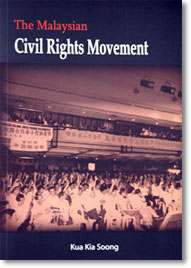
In the recently published The Malaysian Civil Rights Movement (Kuala Lumpur, SIRD, 2005), the British-educated sociologist and Chinese educationist, former DAP Member of Parliament and former political detainee chronicles and documents in factual details the on-the-ground mass movement of Malaysia's minority communities struggling for recognition and inclusion and against the many state-sponsored forces (like the secret and riot police as well as the Internal Security Act) and frauds (BN-controlled mass media).
The Malaysian Civil Rights Movement , with a forward written by lawyer-cum-politician Sivarasa Rasiah, is indeed a prcis of the collective hopes and fears of minority communities in Malaysia such as Chinese, Indians, Orang Asli, Christians, Hindu.
Of course, as more recent history unfolded in 1998 has shown, many of these collective hopes and fears have also been addressed by another wave of mass movement, namely the Reformasi as many of leaders and activists of the civil rights movement in the 80s have also come to empathise and identify with the collective hopes and fears of the marginalised and downtrodden Malay/Muslim masses.
If read in this light, The Malaysian Civil Rights Movement would certainly contribute to the transcendence of the divide-and-rule legacy of Umno-MCA-MIC which the ruling alliance has inherited from British colonialism.
After publication of the book, this writer, in the tradition of 'devil's advocacy', asked the author several self-critical questions. Reproduce below is the full text of the email exchanges between this writer and the author.
Malaysiakini: What first inspired and motivated you to chronicle and document this short history of the civil rights movement in Malaysia? What purpose do you want the book to serve?
Kua: In this new book, I have documented the civil rights movement in which I played a part during the 80s. It is important because it remains an inspiration to those whose civil rights are denied them even today since all these "national" economic, social and cultural policies are still unchanged.
It is generally accepted by all observers of Malaysian society that genuine inter-ethnic harmony is still elusive. While the vision-impaired rulers of this country continually try to pin the blame on the existence of the different streams of mother-tongue schools in the country, we all know that it is the imposition of racially discriminatory policies which are the roots of polarisation in Malaysia.
I fervently believe that "a nation that oppresses another can never be at peace". In so many unequal societies, the ruling class tries to maintain its hegemony by creating divisions among the people to prevent their unity of interests. In this country, it's clearly the "bumiputera/non-bumiputera"
distinction. The "special position" provision in the 1957 Constitution has been warped into a licence for gross discrimination in many government policies which led to the civil rights movement during the 80s.
This civil rights movement of the 80s can serve as a reminder to all who are struggling for basic human rights that it takes unwavering leadership, good organisation, mass base and direct action to create a movement. Conversely, the decline of this movement after 1990 should alert the present generation into figuring out what has to be done to achieve those rights.
It is clear from your book that the civil rights movement in Malaysia is essentially conceptualised as the struggle of minorities such as Chinese, Indian, Orang Asli, indigenous East Malaysians, Christian and other non-Islamic religious communities in Malaysia for national recognition and inclusion. What about the many socially, economically and politically marginalised Malay/Muslim masses?
 I have made it clear from the start of the book that I am writing about the civil rights movement of the 80s. Thus apart from the main movement involving the Chinese Malaysian associations, I have included other movements of the 80s such as the Anti-Radioactive Movement of Papan, Bukit Merah; the Anti-Logging Blockades in Sarawak, as well as the struggles in the plantations. These struggles have involved Malaysians of all ethnic communities. I have not included isolated cases of struggles during that decade which was outside the ambit of my study.
There is also a question of what is meant by civil rights. Civil rights can of course be defined in the broadest of terms to incorporate such rights "appertaining to a person by virtue of his or her citizenship in a state or community." But such a definition makes civil rights practically synonymous with human rights. Nevertheless, the general notion of civil rights has to do with the rights of citizens to liberty and equality. In the US, civil rights are rights secured to citizens in that country by their 13th and 14th amendments to the Constitution and by various acts of Congress, e.g. Civil Rights Acts. Thus, when we refer to the civil rights movement in the US, it is clear that we are referring to the black people's movement for equal rights even though civil rights legislation is equally applicable to all Americans.
I do point out at the outset that: "Since colonial days, Malaysians (of all ethnic communities) have not failed to stand up and fight for their civil rights. This particular study looks at the 80s "
In the book I try to discuss why a similar civil rights movement failed to take off in the Indian community. In fact, I even say that I did not think a civil rights movement existed in the Chinese community anymore after 1990 even though there have been isolated cases of struggles, such as Suqiu, the Kuala Lumpur cemeteries, and SRJK Damansara (Baixiao).
There is a school of thought that the civil rights movement in Malaysia which is largely non-Malays/Muslims is anti-national and chauvinistic. What is your opinion?
Now, who loves the nation more those who would divide the people into races and form monoethnic parties to champion the cause of their 'race' or those who do not want racial divisions and believe in multi-culturalism?
Let me share with you some snippets from the Joint Declaration 1985, which can be seen as the Malaysian "Civil Rights Charter":
"II.3. We condemn all forms of chauvinism, racism and religious fanaticism.
"4. We fervently believe that equal civil and political rights are the preconditions for the promotion of national unity and progress our people can only be united on the basis of freedom, equality and democracy.
"5. We demand that the government respect the Malaysian people's basic right to freedom of organisation, assembly, speech, publication and other fundamental liberties guaranteed in the Federal Constitution.
"6. We demand that the government implement effective measures to eradicate poverty and uplift the people's standard of living, irrespective of race"
I have tried to explain at great length in various publications that I have written (e.g. Malaysian Cultural Policy & Democracy, Huazi 1990) why the Chinese community defends its civil right to mother tongue education and why it is not chauvinist. In another publication of mine (Mother Tongue Education of Malaysian Ethnic Minorities, DJZHLC 1998), we can see very clearly that not only the Chinese Malaysian community but also the Indian, Kadazan, Murut, Iban, Bidayuh, Orang Asli and other ethnic communities in Malaysia all want to defend and develop their mother language.
It is tragic if educated people cannot distinguish between what is a legitimate civil right demand and what is chauvinistic. On 0ct 28, 1985, I wrote an article in The Star entitled: 'The Need for Race Relations Legislation' (See my Malaysian Political Myths, Huazi 1990:183). This was in response to rampant racism and chauvinism prevalent in the local Malay-language media at the time. Incidents of sorts are well documented in this article.
I urged the legislating of a Race Relations Act not only to combat racism and chauvinism but also to outlaw racial discrimination in the official sphere: "This will serve not only to uphold the dignity and integrity of every ethnic community but also to promote equality of opportunity and harmonious relations between persons of different ethnic groups."
In the era stretching from the Pacific War in the 1940s to 1990s, the counter-hegemony movement in Malaya/Malaysia was largely made up of non-Malays/Muslims and Malays/Muslims were seen to be conservative supporters of the establishment, but from the mid-1990s onward, the communal composition seems to be reversed in that many non-Malays/Muslims were perceived to be politically apathetic and conservative while an increasing number of Malays/Muslims are pro-active and energised in opposition politics and NGOs. How do explain this reversal of role?
The changed class composition in the respective communities has a lot to do with this so-called reversal of roles. The non-Malay component in the working class used to be a decisive factor in the early era and thus they led not only the labour movement but also the anti-colonial and anti-fascist movements. In recent years, it's hard to spot any Chinese working class leaders in a May Day rally. Clearly, the Chinese population has become more and more middle class.
But being "middle class" does not mean you're rich. I know for a fact that many students in the private colleges come from families which can hardly pay for their education. Still, people of this 'middle' class who live in a country where they are treated as second-class citizens tend to think of survival first.
I have tried to explain the waning of the civil rights movement in the Chinese Malaysian community after 1990 in this new book. This has a lot to do with the changed political economic setting since the government has been forced to deregulate the economy and relaxed some of the strictures imposed by the Industrial Coordination Act, among others.
The change in calibre of the leadership of the Chinese associations through skillful infiltration by the ruling parties is another factor.
Then again, there is the question of the lack of an alternative since the Chinese community has all along been voting for the opposition as a protest against the Barisan Nasional rather than because of the attractiveness of the opposition parties. The opposition has failed to come together to present itself as an alternative to the BN.
On the other hand, the growing strength of the opposition among the Malay community is the most encouraging development in Malaysian politics to date because it means that the days of the old communalist politics of Umno are numbered. Where the opposition will take them will depend on the collective wisdom of PAS and Parti Keadilan Rakyat. Heaven forbid that they be led into religious bigotry and racial chauvinism.
Our country will truly blossom when the people of all ethnic communities decide to accept one another based on freedom, justice, basic democratic and human rights.


