



Racism begins at school
For some children, racism would involve name-calling, making fun of how others speak, and criticisms about one’s parents and their occupations.
Paul, not his real name, studied at a Mission school, and believes that his anglicised name helped him escape the worst racist taunts. He saw the effect of racism on his Indian and Chinese friends, especially in the less academic classes, where fights were common. At a low point in his life, Paul said, “I wish I were Malay.”
The following is Paul’s story about his school days.
For some children, racism would involve name-calling, making fun of how others speak, and criticisms about one’s parents and their occupations.
Paul, not his real name, studied at a Mission school, and believes that his anglicised name helped him escape the worst racist taunts. He saw the effect of racism on his Indian and Chinese friends, especially in the less academic classes, where fights were common. At a low point in his life, Paul said, “I wish I were Malay.”
The following is Paul’s story about his school days.
“I weep every time I see Yasmin Ahmad’s ‘Merdeka’ adverts. I wish I could return to my kindergarten and primary school days. We got on fine with one another. We had fun. For instance, we would be curious about circumcision and ask our Malay friends about it. We would be told in graphic detail. We laughed a lot then.
“Even the parent-teacher association (PTA) was more multi-racial than in secondary school. Both Malay and non-Malay teachers and our parents would reinforce the message to work hard.”
After primary school, most of Paul’s Malay friends left for secondary schooling in boarding schools.
He said, “At secondary school, the collective racial stereotyping started. I had to make difficult social decisions, whether to make multiracial friends, or choose from my own race. When I reached puberty, ‘they’ tagged me ‘a smelly Indian’. So, I kept away from the Indians.
“I joined the Chinese group, but they spoke in their own lingo, withheld information and boasted about their family’s wealth.
“The teachers told us that life would be difficult as we were non-Malay. Malays had all the opportunities and privileges, but if we studied hard, we could get a scholarship. Some teachers even advocated leaving the country.
“I came across many racist Malay teachers. They spoke in a softer tone to the Malays, and it was made clear that we were not privileged. There was a backlash of racial vitriol because Malays were seen to be lazy, and opportunities were handed to them on a silver platter.
“The difference between the non-Malays and Malays/Muslim intensified, before the Sijil Pelajaran Malaysia (SPM). Teachers forced us to memorise the Moral paper. Even straight ‘A’ students were stressed-out.
“Even if we had scored 9As, we knew that an A(-) or B grade in the Moral paper would have disqualified us from a scholarship.
“Oh, how we disliked the Malays then. It was seen as a form of discrimination by the government against the non-Malays.”
Malays are required to sit for the Agama paper at SPM.
Age of indoctrination
Paul believes that the age of indoctrination occurs between the ages of 17 and 19. For his Form Six, Paul enrolled in a national school which offered his course options, and this is where he encountered full-blown racism.
“It was a national school, with a Malay majority. Islam was shoved in your face. I was firmly put in my place in my first day at school.
“I felt isolated. After 11 years of English education in a Mission school, my Malay was rusty. I wasn’t Muslim and could not sit with the Malays. There was no warmth at all.
“The Chinese students spoke Mandarin and used the word ‘Keling’ freely in their conversation. They built walls in boy-girl relationships, hinting that Indian guys were a threat to Chinese girls.
“The Indians were equally community minded and conversed in Tamil. They mostly talked about movies and culture. It was a circus!
“I could only get on with the ‘coconuts’, the Indians who were ‘brown’ on the outside, but ‘white’ on the inside.”
Paul’s teachers targeted Indian students and he said, “One teacher blasted Hindraf for their association with rebellion, and would look at the Indian pupils and say, ‘Ni nak kena sembur je’, using the euphemism for tear-gas and water cannon to scold us.”
At his lowest point, in Form Six, Paul said, "That was the beginning of my self-hate, when I questioned my identity.
“I wished I was Malay. All I wanted was a sense of belonging. ‘Balik India’ did not refer to me. I am Malaysian. I wanted to have a kampung. I just wanted to claim Malaysia as mine.”
Paul is now studying for a postgraduate degree at a university in England.
In Malaysia, institutionalised racism is used as a tool to modify behaviour, and instill a culture of fear and loathing in our schools, universities, the civil service, and public institutions. The indoctrination of the National Civics Bureau (BTN) helps to create a certain mindset in Malaysians.
Paul claimed that racial gang bullying was rife in schools, but on April 4, Ti Lian Ker, an MCA central committee member, said that school bullying is everywhere and it has nothing to do with ethnic politics.
Racism affects our physical and mental health. It lowers our self-esteem, destroys community relations, is a factor in low productivity in jobs, reduces our life-expectancy and is a bar to social and economic participation.
Key to ending this tyranny
Racism is not just about Malay against non-Malay and vice-versa. It also occurs within communities. The Malays are key to ending this tyranny in Malaysia, but few Malaysians want to talk about sensitive issues, such as race.
Paul is contemplating remaining overseas, but why should we lose more Malaysians to the brain drain?
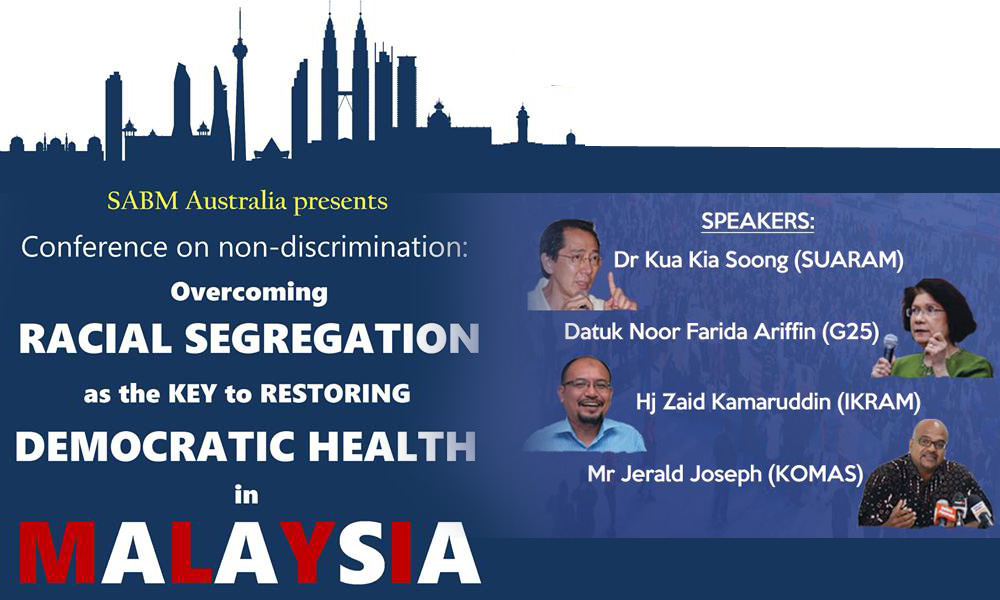
If you would like to help overcome racism, Saya Anak Bangsa Malaysia (SABM) in Australia is organising a conference on ‘Overcoming Racial Segregation to Restore Democratic Heath in Malaysia’ in Melbourne on April 16.
The panel will consist of Dr Kua Kia Soong (Suaram), Noor Farida Ariffin (G25), Zaid Kamaruddin (Ikram) and Jerald Joseph (Komas).
It is free and will be held at the Brunswick Town Hall. Details are in the poster.
Your views are important. SABM would like the discussion to be about overcoming racism, to continue in Malaysia.
MARIAM MOKHTAR is a defender of the truth, the admiral-general of the Green Bean Army and president of the Perak Liberation Organisation (PLO). Blog , Twitter .


Report this comment
Are you sure you want to delete this comment?
This action cannot be undone.