




The enigma of Kampung Baru
Kampung Baru, located as it is in the midst of the most expensive real estate in the Klang Valley, is an urban blight. The lack of development in this Malay enclave is reflective of the state of the Malay community generally.
The authorities are only now acknowledging the plight of Kampung Baru. They have still not grasped the essence, that is, the problems of this community reflect those of the larger Malay society.
Contrary to the prevailing preoccupation, this is not a 'Malay problem' but one of under-development generally. The solution lies less with the endless denigrations of the presumed deficiencies of the Malay psyche or culture, and more with adopting the wisdom of development economics.
An insight into modern economics is that effective and efficient institutions are crucial for development, specifically institutions that link owners of capital to its users. Financial intermediaries like banks link the owners of money (savers) to its users (investors).
You cannot have a vibrant economy unless you have a robust banking system. Show me a backward country, and I will show you one without efficient banks. The economic meltdown of 1977 was not an 'economic' crisis, but a banking crisis.
Malaysia has plenty of institutions created specifically to look after the economic interests of the bumiputera community. Unfortunately these have degenerated into what my friend Din Merican refersto as ' pagar makan padi institutions' (committing breach of trust). They serve the greed of the political elite and their cronies.
Kampung Baru, located as it is in the midst of the most expensive real estate in the Klang Valley, is an urban blight. The lack of development in this Malay enclave is reflective of the state of the Malay community generally.
The authorities are only now acknowledging the plight of Kampung Baru. They have still not grasped the essence, that is, the problems of this community reflect those of the larger Malay society.
Contrary to the prevailing preoccupation, this is not a 'Malay problem' but one of under-development generally. The solution lies less with the endless denigrations of the presumed deficiencies of the Malay psyche or culture, and more with adopting the wisdom of development economics.
An insight into modern economics is that effective and efficient institutions are crucial for development, specifically institutions that link owners of capital to its users. Financial intermediaries like banks link the owners of money (savers) to its users (investors).
You cannot have a vibrant economy unless you have a robust banking system. Show me a backward country, and I will show you one without efficient banks. The economic meltdown of 1977 was not an 'economic' crisis, but a banking crisis.
Malaysia has plenty of institutions created specifically to look after the economic interests of the bumiputera community. Unfortunately these have degenerated into what my friend Din Merican refersto as ' pagar makan padi institutions' (committing breach of trust). They serve the greed of the political elite and their cronies.
Complexities of ownership
In Kampung Baru and other areas under Malay ownership, there are no effective institutions linking the owners of capital (in this case, land) to its investors (developers). There are three elements: landowners, developers, and institutions linking both. Solving the problem, and thus effecting development, requires attention to all three.
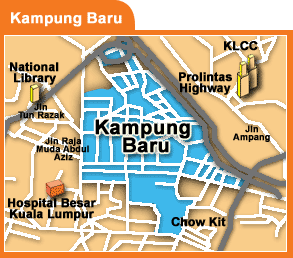 The ownership of these lands is far from clear. The property may have belonged to one individual a generation or two ago, but today it is being claimed by his numerous descendants.
With so many owners, the process of making decisions can be a monumental challenge. Consequently these valuable assets remain essentially trapped and frozen, the equivalent of money under the mattress. That capital is not doing its owner or the economy any good.
It may be argued that unlike the money under the mattress which may be stolen, eaten by moths, or lose value through inflation, land does not deteriorate and will keep appreciating in value. That is not sound economic thinking.
What is lost is the opportunity cost. Had the land been developed, imagine the returns it would have provided to its owners, quite apart from the benefits that would accrue through ensuing economic development.
Malay land ownership is also complicated by myriad inheritance rules. The patriarch may opt for civil law, designating who gets what through a will. That is a rarity. His survivors may stake a claim through Islamic law or even tradition ( adat ), thus adding to the complexity of distribution of inheritance. Imagine the complication if the old man had multiple wives.
My wise father chose a different route; he transferred ownership to his children while he was alive. He made sure that the parcels of land were not divided or had multiple ownership. We, his children, had to settle in cash among ourselves on the differences in value. He also defied convention (religious and traditional) by distributing his assets equally, not favouring either sons or daughters.
Most Malays shy away from such estate planning. After two generations you can imagine the mess in ownership. This is the problem facing Felda settlers today; no one has educated them on this important issue.
Before embarking on grand ideas of development, Malay leaders should first create institutions to solve this ownership crisis. One way is to encourage family trusts, with controlling authority vested in a few individuals. Another would be to ban the fragmentation of land below a certain size.
Long lease periods
Another obstacle is that much of the land comes under the Malay Reservations Act and thus cannot be sold to non-Malays. An axiom of commerce is that if you limit the potential market for an asset, you effectively reduce its value. The rationale for establishing Malay Reservations may be noble, but there is no escaping this economic reality.
This problem is not insurmountable. Land in Hawaii too cannot be sold to non-native (Polynesian) Hawaiians. Yet they have crafted a novel solution with long-term (100-year) leases. Malaysia needs similar laws to recognise long-term leases on Malay Reservation land.
Clarifying the ownership and easing the various restrictive covenants would attract developers to invest in land owned by Malays.
The noted Peruvian economist Hernando De Soto in his book, 'The Mystery of Capital', posits that residents of the Third World are poor not because they lack capital, but rather because their rights to it are not clarified or even respected. Thus they cannnot leverage those assets to productive use. Kampung Baru is an excellent case in point.
 When former prime minister Abdul Razak Hussein established the Urban Development Authority (UDA), it was to spearhead Malays into the property and construction sectors.
Unfortunately UDA concentrated on developing state land rather than that belonging to Malays. UDA, Pernas Construction and a host of Malay developers could be the vehicle to develop Malay-owned land on a long-term lease basis a la Hawaii.
Malays also need institutions to link owners and users of other forms of capital. Earlier I alluded to financial intermediaries. Banks operate by charging interests; this is anathema to Malay Muslims.
Modern Islamic banks do not charge interests in the usual sense, and they have done much to mobilise Malay savings and spur economic development. Tabung Haji, which functions like a mutual fund, is another excellent model. It now has nearly five million depositors and RM12 billion in deposits.
The challenge is to expand on such successes. Tabung Haji could mobilise the trapped assets in other Muslim countries, or expand into retail banking and financing, thus releasing poor Malays from the clutches of money-lenders.
Skills and funding
We also need institutions that link the owners of skills and knowledge (the modern form of capital) to their users. I may have the skills to grill a mean satay , complete with my secret marinating sauce, but I have no money to open a restaurant or stall.
Enter the mini venture capitalists. In return for part ownership of my enterprise, they would fund my venture and make a profit if my company become successful - and so would I.
MARA trains hundreds of mechanics, chefs, hairdressers and electricians. Why not fund them to start their own businesses? Similarly, Petronas could give its petrol station franchises to mechanics, and schools could give contracts for their canteens to young chefs. Not only would we get genuine Malay entrepreneurs, we would also get better services with this strategy.
Recently a former rock musician and now a certified scuba instructor approached me as a fellow diver on funding his diving operations. The local banks would not touch him and his application to the Youth and Sports Ministry went unheeded.
The government has venture capital firms to finance IT start-up companies in the Multimedia Super Corridor. Venture capital activities are 'high risk and high reward'; they are ill suited to be managed by the civil service types.
I would leave such activities to the private sector. The government should instead have 'micro credit' or 'low tech' venture capital-like funds to help the satay seller with this stall, the mechanic with his garage, and the scuba instructor with his dive shop.
The solution to the economic enigma of Kampung Baru specifically and of Malays generally lies within the sights of modern economics. The problem cannot be solved by resorting to clichs on the shortcomings of our culture or psyche. Nor can we wistfully wait for the appearance of 'towering personalities' to rescue us.


